The Death That Made a Saint Permanent: Al-Dabbāgh, His Burial, and the Sacred Geography of Fez
Awliyāʾ in the Moroccan Islamic tradition do not diminish at death. They become legible. During their lives they are partially concealed — operating through the narrow circle of those capable of recognizing them, hedged by the discretion they impose on their own disciples, visible to the city at large only in fragments and rumor. Death removes the concealment. What was local becomes part of the city's living sanctity. What was personal becomes collective. What was spoken in a room becomes written in a book, sung in an elegy, visited at a shrine, invoked in a letter three centuries later.
This is what happened to Mawlāy ʿAbd al-ʿAzīz ibn Masʿūd al-Dabbāgh, who died on Thursday morning, 20 Dhū al-Qaʿda 1132 / 7 December 1720, at thirty-six lunar years, and was buried that same day outside Bāb al-Futūḥ, beside the Rawḍat al-Anwār — the gate at which, seven years earlier, he had received his spiritual opening.
He was an illiterate weaver from Ḥūmat al-ʿUyūn in Fez. He had never attended a session of learning, never sat with a master, never traveled to the great centers of Islamic scholarship. He entered Fāsī sacred memory as one of its most formidable figures — numbered among the city's patron awliyāʾ alongside Alī ibn Ḥirzihim (d. 559/1164), Aḥmad ibn Ali al-Barnūsī (575/1180), and Abū ʿAbd Allāh al-Tāwudī ibn Sūdah (d. 580/1184), all disciples of the great Abū Yaʿazzā Yalannūr (d. 572/1177) of the Middle Atlas, whose spiritual line had shaped Moroccan Sufism for six centuries before him. He did this without any of the credentials that tradition had built over those six centuries as the markers of legitimate sanctity.
The question this article addresses is not whether al-Dabbāgh was a walī — his circle answered that definitively, and the three centuries since have not seriously contested it. The question is how a death becomes a founding event. How a burial at a city gate becomes a sacred center. How a man who left no writing becomes one of the most written-about figures in Moroccan Sufi literature. How the grief of a small circle of disciples becomes the collective memory of a city.
The answer requires two texts that have not often been read together. The first is al-Dhahab al-Ibrīz min Kalām Sayyidī ʿAbd al-ʿAzīz, composed by Aḥmad ibn al-Mubārak al-Lamṭī al-Sijilmāsī, al-Dabbāgh's most distinguished disciple, the scholar who gave the young sharīfain saint his permanent textual form. Al-Ibrīz is the book that made al-Dabbāgh visible beyond his quarter, beyond his city, beyond his century. It is also a book that, by design, suppresses his death. In twelve chapters and across hundreds of pages of theological dialogue, al-Dabbāgh's mortality appears once — in a dream vision that immediately dissolves it into omnipresence. The dialogic logic of Al-Ibrīz has no room for mourning. It was written to prove that al-Dabbāgh surpassed every scholarly formation the tradition possessed; a death scene would have introduced the one register in which he could not surpass anyone.
The second text is Taysīr al-Mawāhib fī mā li-Abī Fāris min al-Manāqib, composed by Muḥammad ibn Muḥammad ibn ʿAbd al-ʿAzīz al-Murābiṭī al-Sijilmāsī — a disciple who reached al-Dabbāgh through Ibn al-Mubārak and who spent years collecting testimonies from the inner circle. Taysīr al-Mawāhib restores what Al-Ibrīz suppresses: the human event of al-Dabbāgh's death. The dates. The domestic signs. The names of the children — ʿUmar, Idrīs, Fāṭima. The grain harvest with its twelve-day deadline. The urgent letter. The man bedridden for four days when his disciple arrived. And at the center of everything: the graveside, and what happened there.
At the graveside, Muḥammad ibn Aḥmad ibn Ḥanīnī — a scholar from Zurāra, two days' journey from Fez — washed al-Dabbāgh's body, shrouded it, led the funeral prayer as imām, and lowered him into the grave. He performed all four acts that Islamic tradition reserves for the most intimate. And Aḥmad ibn al-Mubārak was present — standing in the congregation, praying behind a man who had studied under him. Al-Murābiṭī records this with deliberate precision: Ibn Ḥanīnī could not have gone forward by any rule of scholarly protocol, since he had studied under Ibn al-Mubārak, but God placed him forward, and Ibn al-Mubārak gave his permission. What the graveside enacted was a division of labor written in the grammar of Sufi succession: one man carries the body into the earth and receives the living chain; the other carries the voice into the centuries and produces the permanent text. Ibn Ḥanīnī becomes al-Dabbāgh — "whoever can reach you, you are me" — and Ibn al-Mubārak becomes his ambassador to every reader who will never reach Bāb al-Futūḥ.
This division is the founding event. Everything that follows — the elegies, the shrine, the orthodox visitation practice that three centuries have not corrupted, the entry into Fāsī sacred memory, the letter from al-Tījānī to al-Dabbāgh's grandson invoking his madad as though he were still alive — everything follows the logic established at the graveside on 20 Dhū al-Qaʿda 1132.
The walī becomes visible after death in five registers simultaneously. In literature: the hagiographic text travels where the saint could not, and Al-Ibrīz is the supreme instance, making al-Dabbāgh present in Sijilmāsa and Tāza and every circle where Ibn al-Mubārak's 139 sources were read. In poetry: the elegies composed by al-Shanṭījī, Adūsh, an anonymous Fāsī scholar, and Ibn al-Tāzī construct al-Dabbāgh's posthumous authority not as private grief but as collective epistemological claim — four poets building four arguments about what the city has lost and what it has not. In the annual mawsim: the commemorative cycle that embeds the saint in collective time, making him cyclically present across generations. In the presence of progeny: the Dabbāgh Idrīsid sharīfs in Fez are the living proof of the lineage's continuity — each encounter with a descendant is an encounter with an extension of the walī . And at the shrine itself: the physical anchor at Bāb al-Futūḥ where all four registers converge, maintained across three centuries with an orthodoxy that is itself a form of fidelity to al-Dabbāgh's own teaching. He warned repeatedly that a walī who accommodates the visitor's craving for karāmāt confirms the visitor in spiritual immaturity. The absence of innovation at his shrine is his circle's longest argument.
Al-Dabbāgh enters among Fez's recognized patron awliyāʾ already dense with sanctity. Mawlāy Idrīs II had anchored the city's sacred geography since the ninth century. Abū Yaʿazzā Yalannūr and his disciples Alī ibn Ḥirzihim and Aḥmad ibn Ali al-Barnūsī had given Moroccan Sufism its normative Mālikī synthesis. Abū ʿAbd Allāh al-Tāwudī ibn Sūda — the shams al-balad, the sun of the city, student of both Abū Yaʿazzā and Ibn Ḥirzihim, of whom Ibn Ḥirzihim said he had traversed the stations of Abū Yazīd al-Bisṭāmī in forty days — lay buried outside Bāb al-Ghisa as the threshold between the city and what lies beyond it. Into this hierarchy, built over five centuries by scholars, jurists, and trained Sufis, entered an illiterate weaver who had never studied with anyone. He did not earn his place among Fez's awliyāʾ by resembling them. He completed it by being what none of them were — proof that the tradition's own deepest logic, the direct gift of God to whom He chooses, had not exhausted itself in the men who carried formal credentials.
This article reads al-Dabbāgh's death as the event that made this completion legible.
1. Two Texts, One Event: The Archive of a Hidden Death
Al-Dhahab Al-Ibrīz is structured as a dialogue. Aḥmad ibn al-Mubārak presents himself as the recorder of what he witnessed and heard — a scribe for a man who could not write, a scholar providing the apparatus of legitimacy for knowledge that arrived without institutional sanction. The book's architecture serves its argument: if al-Dabbāgh could answer questions that stumped trained scholars, resolve disagreements among legal schools, distinguish authentic hadith from fabrication without ever having studied the hadith sciences, and describe spiritual stations that the masters of the tradition had only partially mapped — then the book that demonstrates all of this is the proof of a kind of authority that transcends the credentials required to produce it.
Within this architecture, death is an anomaly. The dialogic form implies an ongoing conversation, a living presence, an inexhaustible source still speaking. To end that conversation with a deathbed scene would be to introduce mortality into a text organized around the demonstration that al-Dabbāgh's knowledge came from a source that does not die. Ibn al-Mubārak understood this. The decision to suppress the death in Al-Ibrīz was not oversight — it was structural fidelity to what the book was built to do.
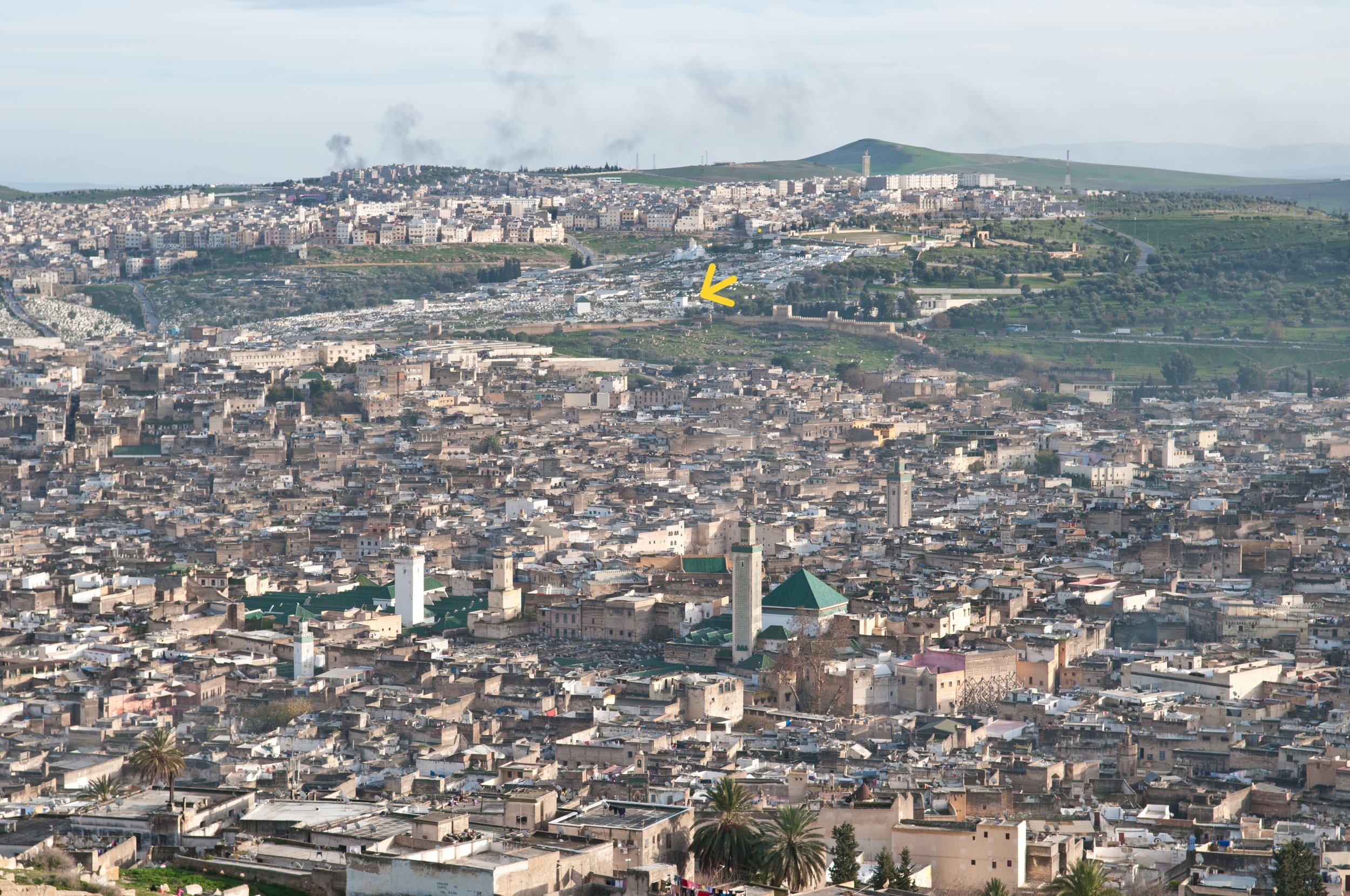
Figure 1. Fez al-Bālī seen from the hills, with the location of the rawḍa of Mawlāy ʿAbd al-ʿAzīz al-Dabbāgh marked by the yellow arrow at the northern edge of the medina, outside Bāb al-Futūḥ. In the foreground, the minarets and green-roofed shrines of the medina's sacred center — among them the Qarawiyyīn complex — stretch across the valley floor. The rawḍa sits at the threshold: between the living city and its dead, between the gate of the fatḥ and the necropolis that received the saint's body in 1132/1720.
Al-Ibrīz contains one acknowledgment of al-Dabbāgh's death, placed in the sixth chapter, and it is immediately dissolved. Ibn al-Mubārak records that after the death he forced himself to visit the grave repeatedly — until al-Dabbāgh appeared to him and said:
“My essence is not imprisoned in the grave — it fills the entire world, inhabiting and permeating it, and wherever you seek me you will find me. Do not think I am your Lord — for your Lord is not contained in the world, while I am contained in it.”
The statement is precise in its theological calibration. Al-Dabbāgh is not claiming divine status — he explicitly forecloses that reading. He is claiming something structurally different: omnipresence within creation, the capacity to be reached from any point in the world, the dissolution of the localization that death might seem to impose. The grave does not limit him. Bāb al-Futūḥ is not more al-Dabbāgh than Sijilmāsa. This is the theological argument Al-Ibrīz needed, and it arrives precisely where the book had to acknowledge that its subject was dead.
What Al-Ibrīz does not provide is the event itself. No date. No description of the illness. No domestic texture. No account of who was present and what they did. The death in Al-Ibrīz is a theological proposition, not a historical occurrence. For the occurrence, the reader must go elsewhere.
Muḥammad al-Murābiṭī al-Sijilmāsī composed Taysīr al-Mawāhib fī mā li-Abī Fāris min al-Manāqib as a supplementary archive — a collection of testimonies from those who had known al-Dabbāgh directly, organized not by theological argument but by witness. He reached al-Dabbāgh through Ibn al-Mubārak, who served as the intermediary through whom the entire outer circle of disciples entered the inner circle's world. His method was rigorous: he collected written testimonies from named companions, presented each testimony to al-Dabbāgh himself for verification, and recorded only what had been approved. The text is a structure of witnessed and certified accounts.
Within this structure, al-Dabbāgh's death receives what Al-Ibrīz withholds: its full human specificity. Dates. Names. The children — ʿUmar, Idrīs, Fāṭima — suddenly visible as individuals in the domestic circle around the dying man. The brother ʿAlī present at the deathbed. The grain harvest with its twelve-day deadline, sent out and returned to find the man bedridden. The urgent letter, unprecedented in years of correspondence. The four days of illness witnessed. The four days until death.
Al-Murābiṭī also preserves what Al-Ibrīz cannot: the grief. The companions' testimonies carry the weight of a community facing the loss of its center. The elegies al-Murābiṭī collects and transmits are not theological propositions — they are expressions of rupture, of a world reorganized by absence, of men trying to account for what has happened to them. This emotional register is entirely absent from Al-Ibrīz, which was built to demonstrate authority, not to mourn its source.
The two texts divide the archive of al-Dabbāgh's death between them in a way that appears accidental but is structurally necessary. Al-Ibrīz provides the theology of his posthumous presence — the argument that death does not limit him, that he can be reached from anywhere, that his authority continues unbroken. Taysīr al-Mawāhib provides the event that required that theology — the death itself, with all its human specificity, the community's grief, and the structural measures taken to survive it.
Neither text is complete without the other. A reader of Al-Ibrīz alone encounters a living presence that never dies — but has no account of how that presence negotiated the transition. A reader of Taysīr al-Mawāhib alone encounters a death fully documented — but without the theological framework that explains what the death means within al-Dabbāgh's own understanding of sanctity and posthumous authority. Together, they constitute a single archive: one text performing the suppression that al-Dabbāgh's authority required; the other performing the restoration that his community required. The tension between them is not a contradiction. It is the productive friction of two texts serving different but complementary functions in the preservation of a saint's memory.
Al-Murābiṭī understood this. He was a disciple of Ibn al-Mubārak as well as of al-Dabbāgh. He had read Al-Ibrīz. He knew what it contained and what it omitted. His decision to write Taysīr al-Mawāhib was in part a decision to supply what Al-Ibrīz had by design left out — not to contradict Al-Ibrīz but to complete it, to give the archive its missing dimension. The two texts were designed to be read together, and read together is how this article reads them.
2. The Signs Before the Death
Two years before his death, at the feast of ʿĪd al-Aḍḥā in 1130/1718, al-Dabbāgh made a request that his companion Aḥmad ibn Masʿūd al-Yāzighī initially heard as an ordinary instruction about domestic provision. Al-Dabbāgh asked him to make the sacrificial slaughter for his children the following year. The request was unusual in its insistence: “We want you, my son, to make the sacrifice for my children next year — it must be.”
The companion understood this to mean a worldly journey — that al-Dabbāgh would be traveling and unable to perform the sacrifice himself. The phrasing 'it must be' registered as emphasis, not as premonition. Only afterward, when al-Murābiṭī records the episode in Taysīr al-Mawāhib, does its meaning become clear: al-Dabbāgh was arranging provision for his children for the year following his death. Forty days of that following year remained when he died.
The episode belongs to a recognizable pattern in Moroccan hagiographic literature — the saint who knows the time of his departure and makes arrangements accordingly, without announcing it in terms his companions can fully receive. Al-Dabbāgh's knowledge of his own death is not a karāma in the conventional sense; it is a structural feature of his authority. The same kashf that had allowed him to read the private sins of disciples at distances of several days' journey, to describe places he had never physically visited, to know the contents of sealed letters before they were opened — this kashf extended to his own death and organized his final acts with the same precision it brought to everything else.
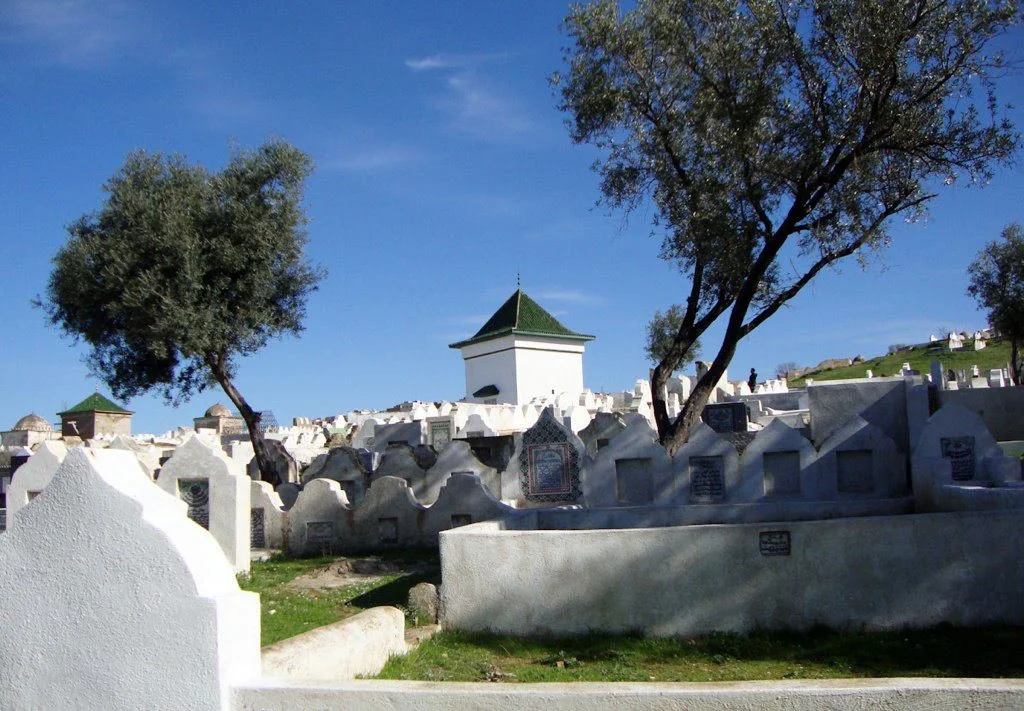
Figure 2. The rawḍa of Mawlāy ʿAbd al-ʿAzīz al-Dabbāgh seen from within the necropolis outside Bāb al-Futūḥ, Fez.
In the month of his death, al-Dabbāgh sent the same companion to harvest the remaining crop on his land and set an explicit deadline: twelve days. The companion asked for more time; al-Dabbāgh conceded twelve days and no more. The companion went, worked quickly, and returned within the deadline — to find al-Dabbāgh bedridden, four days already into the illness from which he would not recover.
The returning companion asked al-Dabbāgh's blessing over what had been consumed from his provisions during the harvest. Al-Dabbāgh's response — his last recorded act of provision for his circle — was: "Everything in my hand is yours and your children's, alive and dead."
The formula ḥayyan wa mayyitan — alive and dead — is not a casual expression. In the context of Sufi succession, it is a statement about the continuity of baraka across death. What al-Dabbāgh is saying is not that his possessions will be left to the companion when he dies; he is saying that his gift — his spiritual provision, his attention, his madad — does not end with his bodily death. The same formula that his disciple uses to express devotion ('I am yours, living and dead') al-Dabbāgh here uses in its active, giving direction: the provision continues in both states.
Taken together, the ʿĪd al-Aḍḥā commission and the grain harvest episode establish that al-Dabbāgh's death was not something that happened to him. It was something he managed. The walī who had organized his disciples' lives with preternatural precision — predicting births, arranging political outcomes, knowing the contents of distant conversations — organized his own departure with the same care.
This is theologically significant. In the Moroccan Sufi tradition, a saint's knowledge of his own death is not simply a marvel to be catalogued alongside his other karāmāt. It is evidence of the depth of his integration into the divine will. He who knows when he will die is he who has no resistance to it — who moves toward his own death the way a river moves toward the sea, without deflection, because he can see where the current runs. Al-Dabbāgh's final weeks are a demonstration of precisely this: a man who sees clearly, arranges carefully, and departs on schedule.
For the community left behind, this knowledge retroactively sanctifies the grief. They are not mourning a death that came unexpectedly and disrupted a project. They are mourning a departure that the departing man had foreseen, prepared for, and structured to leave his circle intact. The grief is real — al-Murābiṭī preserves it without sentimentality — but it is grief within a structure, not grief against chaos.
3. The Graveside Inversion: Ibn Ḥanīnī, Ibn al-Mubārak, and the Division of Inheritance
The burial of al-Dabbāgh was not a domestic accident. It was a structured transfer of authority, prepared years in advance, enacted through ritual, and recorded by al-Murābiṭī with the precision of someone who understood exactly what he was witnessing.
The preparation began with a request. Ibn Ḥanīnī records in his own taqyīd — written in his hand, transmitted to al-Murābiṭī, presented to al-Dabbāgh himself for verification and approval — that he had noticed al-Dabbāgh speaking of his death with a frequency that alarmed him. He feared he would not be present when it came. He asked, invoking the right of the Prophet ﷺ, to be there. Al-Dabbāgh's answer was not consolation. It was an appointment: “That shall be, God willing — and you are the one who will wash me and lower me into the grave.”
Two acts named. Two acts promised. This is not a dying man's wish. It is a saint's designation, delivered with the same certainty he brought to every statement about what the unseen had already decided. Al-Dabbāgh also told Ibn Ḥanīnī where he would be buried, and charged him with purchasing the plot. The purchase was made eight days before the death — not in anticipation of imminent illness, but because al-Dabbāgh had set the date and Ibn Ḥanīnī had been given his instructions.
On the night Ibn Ḥanīnī was leaving after one of his visits, al-Dabbāgh spoke to him about the knowledge of God. Ibn Ḥanīnī thanked God for the gift of that conversation. Al-Dabbāgh's response was precise: “The good thing is: you will be standing at my grave within eight days of your return.”
Ibn Ḥanīnī left the next morning. On the eighth day, a letter arrived from al-Dabbāgh — unprecedented in the years of their relationship, nothing like it had ever come before: 'Come at once. Come at once.”
Ibn Ḥanīnī arrived to find al-Dabbāgh already bedridden, four days into an illness he had entered knowing its destination. Al-Dabbāgh died four days after Ibn Ḥanīnī's arrival. The arithmetic is exact: eight days from departure, four days of illness witnessed, death on the twelfth day. Ibn Ḥanīnī had not been summoned to a deathbed. He had been summoned to an appointment made years earlier, its timing calculated to the day.
Ibn Ḥanīnī washed the body. He shrouded it. He led the funeral prayer as imām. He lowered al-Dabbāgh into the grave with his own hands.
All four acts. Every ritual that Islamic tradition reserves for those standing in the position of greatest intimacy with the dead — Ibn Ḥanīnī performed them all. In Moroccan Sufi tradition, to wash a saint's body is to receive his baraka in its most concentrated form, the transmission happening through the hands at the moment between death and burial when the walī's spiritual substance is understood to be maximally present before it disperses into the world. This alone would have been a signal honor.
But the structural scandal is not the washing. It is the prayer. Aḥmad ibn al-Mubārak was present. He stood in the congregation and prayed behind Ibn Ḥanīnī. Ibn al-Mubārak was the most distinguished scholar in al-Dabbāgh's circle — the man who had spent years cross-referencing al-Dabbāgh's utterances against 139 works of Islamic scholarship, who had staked his scholarly reputation on the validity of an illiterate weaver's gnosis. By every measure of Moroccan scholarly protocol, Ibn al-Mubārak should have led the funeral prayer. And Ibn Ḥanīnī had studied under him. The student does not lead prayer ahead of the teacher. Courtesy, hierarchy, and every precedent in the tradition pointed in one direction.
God pointed in another.
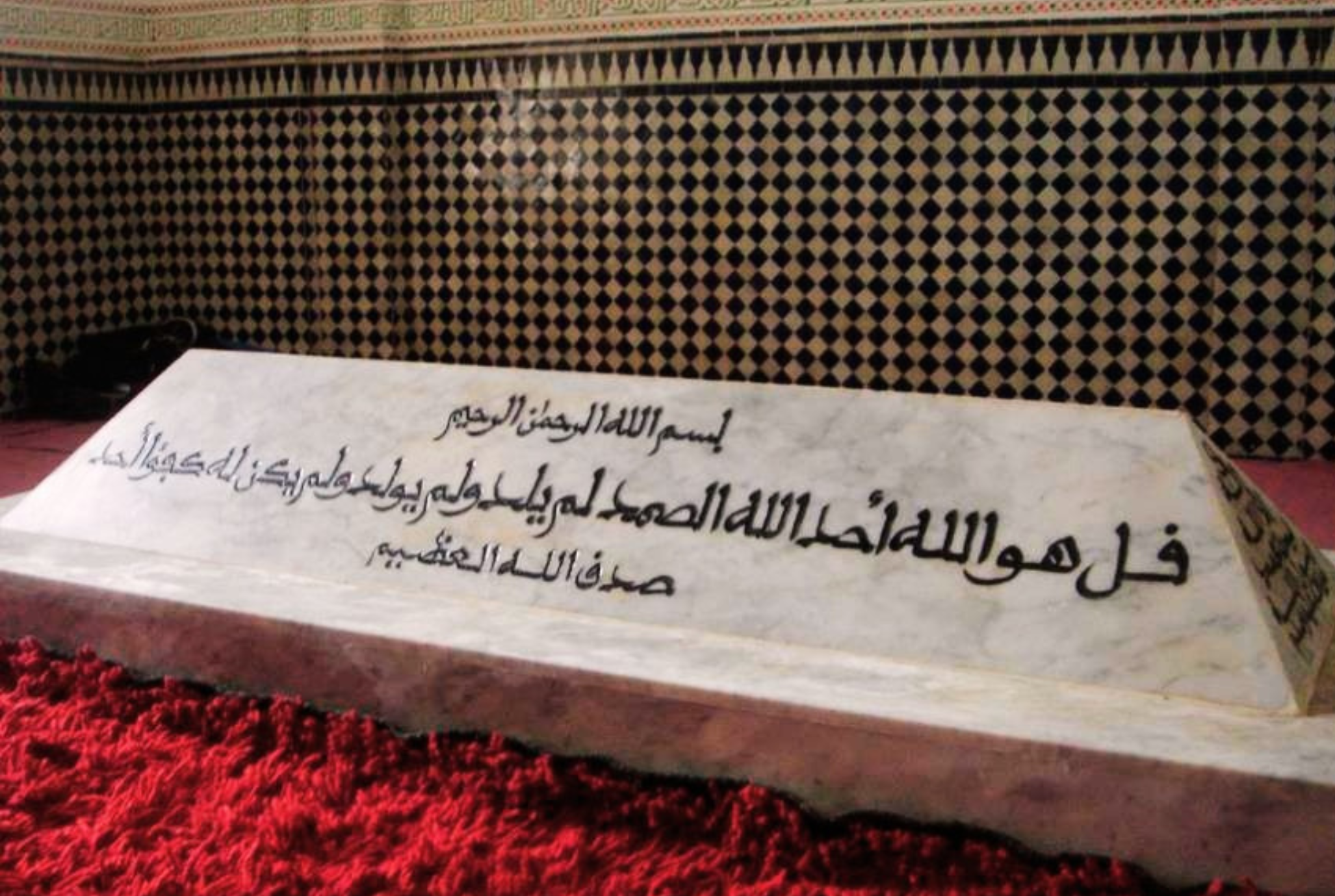
Figure 3. The marble tomb of Mawlāy ʿAbd al-ʿAzīz al-Dabbāgh within the qubba, Fez. The tombstone bears Sūrat al-Ikhlāṣ — the chapter of divine unity and transcendence — in elegant Moroccan calligraphy against white marble. The red carpet, the zellij tilework of the interior walls, and the simplicity of the tomb itself reflect the orthodox character of the shrine.
Al-Murābiṭī records the inversion without defensiveness and without elaboration beyond what the theology requires. His phrasing at page 122 of the Taysīr is exact:
“Courtesy toward the shaykhs would not have permitted him to go forward, since he had studied under him — but God placed him forward, until our master the scholar gave his permission.”
Three agents, three acts, one sentence. God placed Ibn Ḥanīnī forward. Ibn al-Mubārak gave his permission. Ibn Ḥanīnī did not push forward — the passive construction is deliberate and theological. He was placed. The initiative was not his, the authority was not his ambition, the inversion was not his doing. What looks like a breach of protocol is in fact its deepest fulfillment: the protocol of divine appointment superseding the protocol of scholarly hierarchy.
And Ibn al-Mubārak's permission is not a concession. It is the completion of the argument he had been making for years in Al-Ibrīz. The book had said: this illiterate shaykh surpasses every scholarly formation the tradition possesses. The graveside said: the man who wrote that book now stands behind the man the shaykh trusted most. In stepping back, Ibn al-Mubārak did not lose his place in the transmission. He confirmed it — as the witness whose recognition matters precisely because it cost him something to give.
What the graveside enacted was a division of labor that the community required in order to survive al-Dabbāgh's death. Ibn Ḥanīnī received the living chain. Al-Dabbāgh had told him directly: 'When I die, whoever can reach you — you are me.' He had been given the burial site, charged with purchasing the plot, appointed to perform every ritual act at the moment of maximum spiritual transmission. The baraka passed through the hands that washed the body.
Ibn al-Mubārak received the textual inheritance. Al-Ibrīz is his — the 139 citations, the twelve chapters, the scholarly apparatus that validated al-Dabbāgh's authority in the language scholars understand. Without Ibn al-Mubārak, al-Dabbāgh remains a local phenomenon, a walī of Ḥūmat al-ʿUyūn known to those who crossed his threshold. Without Ibn Ḥanīnī, the living chain ends at the grave and the community has no center. The two inheritances are not competitive. They are complementary and structurally necessary.
Al-Murābiṭī understood this with perfect clarity. His elegy — and the anonymous elegy he preserves — names both men in the same breath, and the image both poems reach for is fire: al-Dabbāgh's death as a conflagration that would have consumed the community, and two men standing between the community and dissolution.
فَوَالله لَوْلاَ اللهُ وَابْنُ مُبَارَكٍ * سَلِيلُ الرِّضَا صِهْرُ الرَّسُولِ أَبِي بَكْرِ
By God — were it not for God, and Ibn Mubārak,
scion of contentment, son-in-law of the Prophet's companion Abū Bakr
كَذَا ابْنُ حَنِينِي الذَّكِيُّ مُحَمَّدُ * لِإِخْمَادِ مَا قَدْ ثَارَ مِنْ لَهَبِ الجَمْرِ
and the perceptive Muḥammad ibn Ḥanīnī
to extinguish what had blazed of the embers' flame
لَقَدْ نَشَبَتْ لِلْمَوْتِ فِينَا أَظَافِرُ * وَعَرَضْنَا الدَّهْرَ الْمَشُومَ إِلَى الْخُسْرِ
the claws of death would have seized us,
and we would have surrendered to ruin under time's ill omen.
The formal transmission of authority had been spoken years before the death. It was enacted at the graveside. But its meaning was confirmed in the word al-Dabbāgh used when he spoke of what would happen after he was gone: anta anā — 'you are me.' Not: you will represent me. Not: you will carry my teaching. The formulation is ontological. Ibn Ḥanīnī does not stand in for al-Dabbāgh — he becomes him, in the only sense that matters for Moroccan Sufi succession: the one who reaches Ibn Ḥanīnī reaches al-Dabbāgh.
Al-Tāzī's qaṣīda states that al-Dabbāgh's designation of Ibn Ḥanīnī as successor was written — committed to paper in formal record: “His being the successor I saw written in his own handwriting in the register.”
The graveside at Bāb al-Futūḥ on 20 Dhū al-Qaʿda 1132 is where that record was ratified in the only medium that cannot be contested: the body in the ground, the hands that placed it there, the prayer led by the appointed man, the scholar who stepped back and gave his permission, and the community that witnessed all of it and survived.
4. The Burial Site: Sacred Geography at Bāb al-Futūḥ
Al-Dabbāgh did not choose his burial site arbitrarily. The Dabbāgh family's ancestral burial ground was at the shrine complex of Sīdī ʿAlī ibn Ḥirzihim — where Sultan Mawlāy al-Rashīd (r. 1075–1082/1664–1672) himself was interred, and where al-Dabbāgh's own father Mawlāy Masʿūd rested. To be buried there would have been to follow the family's established pattern, to rest among his own people in a site already sanctified by generations of his lineage.
Al-Dabbāgh chose differently. He instructed Ibn Ḥanīnī to purchase a plot to the right of the Rawḍat al-Anwār — associated with the saint ʿAlī ibn Ṣāliḥ, died 903/1498 — outside Bāb al-Futūḥ. The gate where, in 1125/1713, he had received his great spiritual opening. The gate where, according to al-Ibrīz, the veil had been lifted and he had entered the state that would define the remaining seven years of his life.
The choice is structurally resonant in a way that no account of the burial site has fully elaborated. Al-Dabbāgh was born spiritually at Bāb al-Futūḥ. He would be buried beside it. The gate of the opening becomes the gate of the return — the place where the saint's public spiritual life began is the place where his body enters the earth. The geography is autobiography.
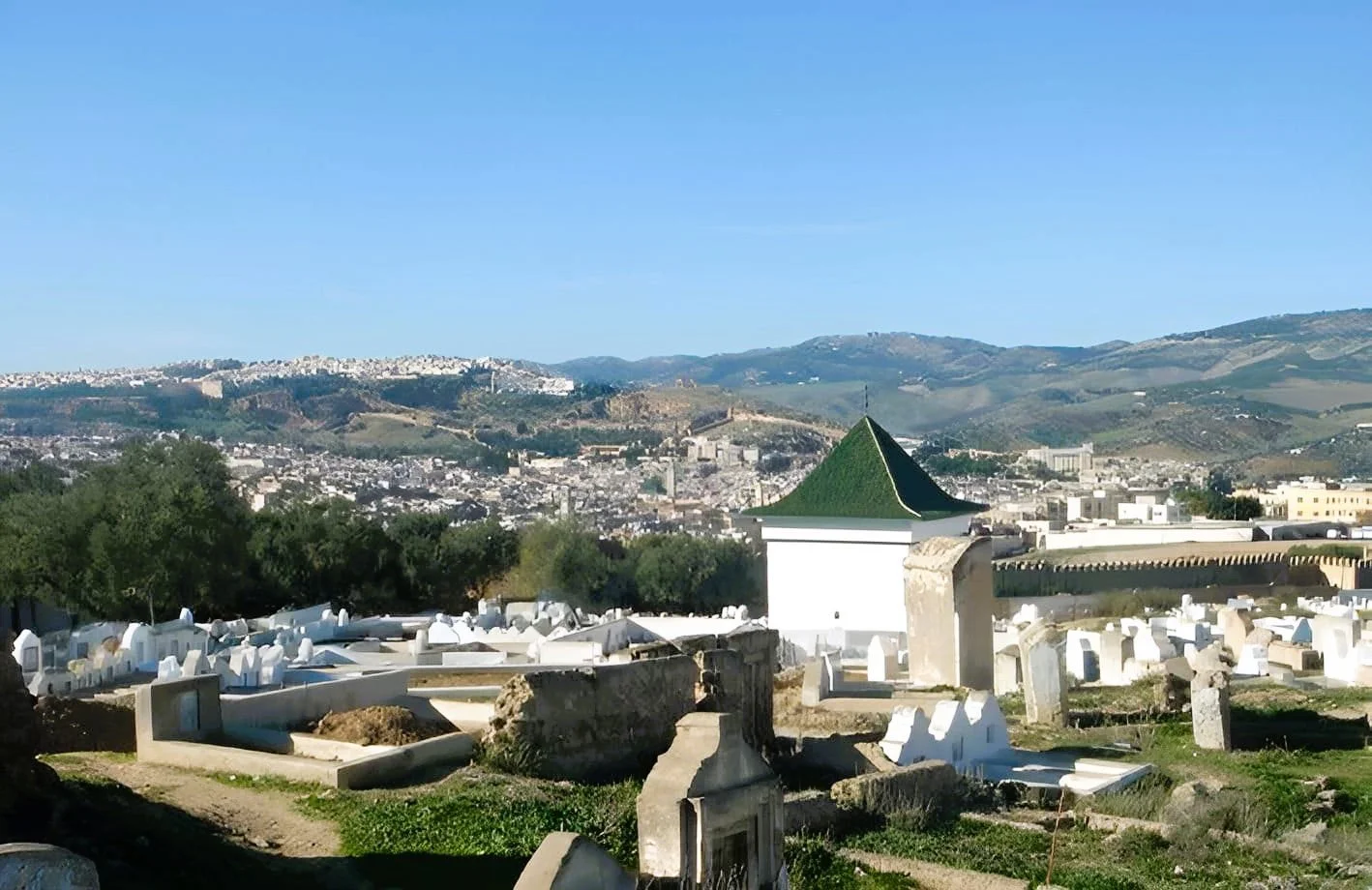
Figure 4. The rawḍa of Mawlāy ʿAbd al-ʿAzīz al-Dabbāgh seen from above, with the medina of Fez stretching behind it toward the hills. Visible behind the qubba are the remains of Rawḍat al-Anwār — the burial place of Sīdī Abū al-Ḥasan ʿAlī ibn Ṣāliḥ, student of Sīdī ʿAbd al-ʿAzīz al-Tabbāʿ, himself a student of the great Muḥammad al-Jazūlī. Al-Dabbāgh chose to rest beside this site deliberately — entering in death the company of a silsila that ran directly to the author of Dalāʾil al-Khayrāt. The ancient city walls of Fez are visible to the right.
Bāb al-Futūḥ — named after the Yifranid prince al-Futūḥ ibn Dūnas, and the first gate Mawlāy Idrīs ibn ʿAbd Allāh built in Fez, originally called Bāb al-Qibla so that the people of the nascent city might orient themselves toward prayer — was among the great northern gates of Fez al-Bālī. The necropolis outside it was among the most populated sacred spaces in the city, layered with the dead of multiple centuries, marked by the shrines of awliyāʾ and scholars whose presence had accumulated over generations into a dense sacred topography.
At his death in 1132/1720, al-Dabbāgh's rawḍa was established within a sacred geography already shaped by centuries of wilāya. His burial placed him first in the shadow of Mawlāy Idrīs II — Imām of the Ahl al-Bayt, founder of the city, and living continuation of prophetic authority in the Maghrib — whose shrine at the heart of the medina is the spiritual axis around which all of Fez's sacred life organizes itself. Beyond this foundational presence, al-Dabbāgh entered the company of the city's great awliyāʾ: ʿAlī ibn Ḥirzihim and his son Muḥammad at its eastern edge, Abū ʿAbd Allāh al-Tāwudī at its southern gate, and Abū Ghālib (d. 558/1163) and Aḥmad al-Yamanī (d. 1113/1701) within its sacred interior, and Abū al-Maḥāsin Yūsuf al-Fāsī (d. 1013/1604) among its recognized patron awliyāʾ. These were the figures already present in Fāsī sacred memory when Sīdī ʿAbd al-ʿAzīz entered it.
The generations that followed deepened the sacred density of the space around his rawḍa. Aḥmad al-Ṣiqillī, Alī al-Jamal, and Aḥmad al-Tījānī — all of whom came after al-Dabbāgh — entered the sacred geography of Fez in ways that drew on his presence and extended the spiritual weight of the medina. By the nineteenth century, Bāb al-Futūḥ had become one of the most spiritually layered thresholds in the city. Al-Dabbāgh did not simply join a pre-existing hierarchy — he anchored a sacred zone that continued to attract wilāya long after his death.
The collective forgiveness dream recorded in Taysīr al-Mawāhib extends al-Dabbāgh's sanctifying presence to the entire necropolis. Aḥmad ibn Masʿūd al-Yāzighī reports the vision of a man who declared that on the day al-Dabbāgh was buried at Bāb al-Ḥamrāʾ — the gate or gate complex associated with the burial site — God forgave every believing man and woman buried in that cemetery. The saint's burial day retroactively sanctifies all the dead who share his ground. And the visionary had died twelve years before al-Dabbāgh, had never known him or heard of him. The intercession operates outside the circle of discipleship, outside the boundaries of personal relationship, across the barrier of death in both directions.
Ibn Ḥanīnī's last commission from al-Dabbāgh — the purchase of the burial plot — was completed eight days before the death. This detail matters beyond its documentary precision. In Moroccan practice, the preparation of a grave before imminent death is understood as an act of tawakkul — surrender to God's will, acceptance of what the divine decree has already written. For al-Dabbāgh to have designated the site and arranged its purchase eight days in advance, through a disciple who did not yet know the death was eight days away, is to make the preparation an act of prophetic certainty rather than medical anticipation.
The plot was ready. The location had been specified. The grave was waiting. When Ibn Ḥanīnī arrived on the eighth day to find al-Dabbāgh bedridden, the earth outside Bāb al-Futūḥ had already been designated and purchased. The community would not need to deliberate about where to bury their shaykh. Everything had been arranged.
5. Posthumous Presence: The Expansion of Authority
Al-Dabbāgh's own statement about his posthumous presence — preserved in Al-Ibrīz — is the theological foundation on which everything else is built. The statement is careful. It claims omnipresence within creation while explicitly rejecting identification with the divine. The saint fills the world; God is not contained in the world. Al-Dabbāgh can be reached anywhere; God transcends the categories of location entirely.
This is not a marginal theological position. It draws on a well-established Sufi understanding of the walī's posthumous availability — the tradition of visiting awliyāʾ' graves not as an act of memorialization but as an act of encounter, on the premise that the saint's rūḥ is not imprisoned in the grave but freely present and capable of response. What al-Dabbāgh adds is the explicit first-person claim, in a vision reported directly by Ibn al-Mubārak: the saint himself articulating the theology of his own continued presence.
The statement has a practical implication that al-Dabbāgh makes explicit: wherever you seek me, you will find me. This is an invitation to the entire geography of his potential visitors. The man in Marrakesh who reads Al-Ibrīz and cannot travel to Fez — he can reach al-Dabbāgh from where he is. The woman in Tāza who has heard of al-Dabbāgh through her husband's account of the book — she can turn toward him without traveling. The disciple who lives four days' journey from Bāb al-Futūḥ — he can call and be heard. The shrine is the center, but it is not the only point of access. Al-Dabbāgh is maḥṣūr fī al-ʿālam — contained in the world, present throughout it.
The elegies collected in Taysīr al-Mawāhib do not address al-Dabbāgh in the past tense. They address him directly, in the present, as a living interlocutor. Al-Tāzī's qaṣīda — the longest and most structurally elaborate of the four — contains a passage of direct address that is, in theological terms, a prayer of intercession:
فَيَا عَبْدَ العَزِيزِ إِلَيْكَ جِئْنَا / وَمَوْجُ ذُنُوبِنَا لَذُو الْتِطَام
O ʿAbd al-ʿAzīz, we have come to you
and the waves of our sins crash and surge.
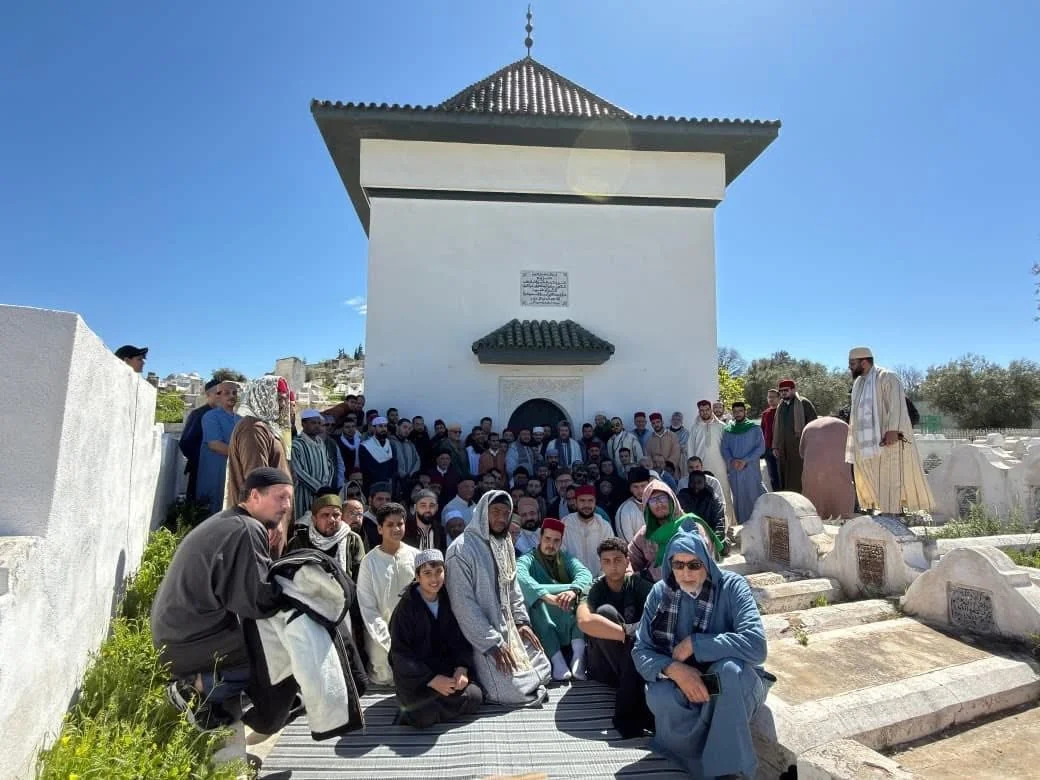
Figure 5. A gathering of visitors at the rawḍa of Mawlāy ʿAbd al-ʿAzīz al-Dabbāgh outside Bāb al-Futūḥ, Fez — one of the spiritual heritage tours organized in the city. Scholars, students, and seekers from different backgrounds stand and sit before the qubba in the posture of ziyāra.
The poet addresses al-Dabbāgh as one addresses a living saint at whose threshold one stands — naming one's need, acknowledging one's unworthiness, trusting in the saint's capacity to intercede. The fact that al-Dabbāgh is dead does not change the grammar of the address. He is addressed as present because the elegiac tradition in Moroccan Sufi poetry understands the saint's death as a change of location, not a termination of presence.
The expansion of al-Dabbāgh's posthumous authority did not stop with the generation of his disciples. It grew. The major hagiographers of Morocco across two centuries returned to him repeatedly, each adding a layer to the tradition's collective understanding of what he represented.
Muḥammad ibn al-Ṭayyib al-Qādirī (d. 1187/1773), writing in Nashr al-Mathānī within decades of al-Dabbāgh's death, was among the earliest to fix the burial site with precision: between al-Darrās ibn Ismāʿīl and ʿAlī ibn Ṣāliḥ, near Rawḍat al-Anwār, outside Bāb al-Futūḥ, with a qubba already standing. Al-Qādirī was also the most measured voice in the tradition — noting that al-Dabbāgh's masters were unknown to him or to anyone he knew, yet recording the karāmāt and the shrine without hesitation. His restraint is itself evidence: a careful historian who did not suppress what he could not fully explain.
Idrīs al-ʿAlawī al-Madgharī (d. 1316/1898), writing in al-Durar al-Bahiyya, gave the posthumous expansion its most lyrical formulation:
“When God took him to Himself, the lights of his knowledge radiated across the horizons, and tongues were preoccupied with them at evening and at dawn.”
This is the theology of posthumous expansion in its purest form: death does not diminish the walī's lights — it releases them. What had been concentrated in a single person in a single quarter of Fez now radiates outward without limit. The horizons receive what the city had contained.
Muḥammad ibn Jaʿfar al-Kattānī (d. 1345/1927), writing in Salwat al-Anfās, gave al-Dabbāgh his fullest chain of honorifics — quṭb al-dāʾira, shams al-asrār al-fākhira, al-murabbi al-akbar — and made the most ambitious claim of any hagiographer:
“God revived the Sufi path through him after its traces had faded, and revealed through him the sciences of spiritual reality after its lights had dimmed.”
This is not a claim about al-Dabbāgh's personal rank. It is a claim about his function in the history of Moroccan Sufism: he was the renewal, the revival, the moment when a tradition that had grown dim was reignited. Al-Kattānī places him in the line of the mujaddidūn — the renewers — whose appearance marks a turning point in the tradition's life.
The hagiographic prose tradition was accompanied by a poetic tradition that carried al-Dabbāgh's memory into a different register — one of celebration, invocation, and genealogical pride.
Muḥammad ibn al-Ṭayyib al-Qādirī himself included al-Dabbāgh in his Arjūza Durrat al-Mafākhir — a poem of intercession through the great sharīfian figures of Morocco, placing Sīdī ʿAbd al-ʿAzīz alongside Mawlāy ʿAbd al-Salām ibn Mashīsh, Abū al-Ḥasan al-Shādhilī, and the sharīfs of Wazzān. The verse is brief but precise:ِ
وَمِنْهُمُ الدَّبَّاغُ عَابِدُ العَزِيزِ * المُصْطَفَى جَلَّ مَكَانَهُ الحَرِيزِ
Among them al-Dabbāgh, servant of the Almighty
the Chosen One, exalted is his protected station.
Ḥamdūn ibn al-Ḥājj al-Sulamī al-Fāsī (d. 1233/1817), one of the great poets of his generation, gave al-Dabbāgh's story its most resonant poetic formulation in ʿUqūd al-Fātiḥa. His three verses connect al-Dabbāgh to the testimony of Al-Ibrīz, to the prophetic good tidings, and to the spiritual lineage that runs through his grandfather back to the Prophet ﷺ:
وَمِنْهُمُ وَلَهُمْ عَبْدُ العَزِيزِ جَلاَ * حِلاَهُ ذُو الذَّهَبِ الإِبْرِيزِ فِي كَلِمِ
Among them and belonging to them is ʿAbd al-ʿAzīz,
whose adornments were revealed by the one of Pure Gold in words.
وَجَاءَ وِفْقَ بِشَارَةِ الرَّسُولِ بِهِ * فَلاَحَ شِبْهَ سَوَادٍ لِلْعُيُونِ نَمِي
He came in fulfillment of the Prophet's good tidings of him,
appearing like the dark of the pupil that gives the eye its sight.
وَجَدَّ جِدُّهُ فِي سُؤَالِ رَبِّهِ فِي * جَمْعٍ بِجَدِّهِ حَتَّى نَالَهُ فَحُمِي
His grandfather strove in supplication to his Lord to be united with his ancestor,
until he attained it and was protected.
Three claims in three verses: that Al-Ibrīz revealed what al-Dabbāgh was; that his appearance fulfilled a prophetic good tiding; and that his spiritual rank was the fruit of his grandfather's supplication for union with the prophetic lineage. The poem does not mourn. It celebrates a genealogical and spiritual achievement — the young Idrīsid sharīf of Fez as the living fulfillment of what the Prophet ﷺ had foretold and what his ancestors had prayed for.
The most powerful evidence of al-Dabbāgh's continued posthumous authority in the tradition is not from the generation of his disciples. It is from Aḥmad al-Tījānī (d. 1230/1815)— founder of the Tījāniyya, one of the major Sufi orders of the nineteenth and twentieth centuries — writing to al-Dabbāgh's grandson ʿUmar ibn Muḥammad ibn Idrīs al-Dabbāgh, who occupied the position of preacher (khaṭīb) at Masjid al-Dīwān in Fez, in terms that treat al-Dabbāgh's spiritual support as a present-tense reality:
“... The complete Qutb, the perfect Ghawth... our master ʿAbd al-ʿAzīz al-Dabbāgh — may God extend to us and to you his spiritual support.”
The use of madad in the present tense — 'may God extend his support' — is a claim that al-Dabbāgh's spiritual provision continues to flow, that it can be extended to those who seek it, that the grandson who carries the name also carries access to the grandfather's baraka. Al-Tījānī is not commemorating a historical figure. He is invoking a living spiritual resource, one that he believes can benefit himself as well as the descendant he is addressing.
6. The Elegies as Collective Epistemology
Al-Shanṭījī's Zayniyya
The first elegy in al-Murābiṭī's collection is by the Fāsī scholar and judge ʿAbd Allāh ibn Muḥammad ibn al-Qāḍī al-Shanṭījī. His zayniyya moves through four movements: the grief, the portrait of the walī, the living inheritance of Ibn al-Mubārak and al-Ibrīz, and the final darkness sealed by a chronogram. The poem's central claim — that humanity has become a body without a soul — is not rhetorical excess. It is a precise theological statement: the quṭb is the spiritual principle that animates collective human life, and his absence is felt not by his circle alone but by the world entire.The first elegy in al-Murābiṭī's collection belongs to ʿAbd Allāh ibn Muḥammad ibn al-Qāḍī al-Shanṭījī — a Fāsī scholar and judge who had sat with al-Dabbāgh, been struck by what he encountered, and understood what had been lost. When the news of the death reached him, he composed a zayniyya — rhyming in zāy — that moves through four distinct movements: the grief, the portrait of the walī, the living inheritance of Ibn al-Mubārak, and a final darkness sealed by a chronogram.
بِتُّ فِي أَفْكَلٍ وَفِي أَرْزِيزِ * وَاسْرِ زَفَراً أَزِيزِ
I spent the night in trembling and in shivering cold,
sighs moving through me like a moan.
نَعَمْ اَلعَالَمُ الأَنَامُ تَدَاعَى * لِمَصَابٍ عَلَى الأَنَامِ عَزِيزِ
Yes — all of humanity has been called to mourn
a calamity precious and heavy upon them all.
فَكَأَنَّ الأَنَامَ جِسْمٌ بِلاَ رُوحٍ * لِفَقْدِ الإِمَامِ عَبْدُ العَزِيزِ
It is as though humanity has become a body without a soul
at the loss of the Imām, ʿAbd al-ʿAzīz.
The quṭb is the spiritual principle that animates collective human life. His absence is not a personal loss — it is a cosmological event. The poem's opening three bayts establish this without apology, and then turn to the portrait.
الشَّرِيفُ المُشَرَّفُ وَمَنْ لَيْسَ يُدْلِي * بِيَدٍ مِنْهُ فِي مَدَى التَّحْوِيزِ
The noble sharīf, the ennobled one —
none can claim a hand from him in all the reach of his dominion.
يَقْدِرُ الشَّيْخُ أَنْ يَجِيءَ بِنَجْلٍ * بَيْنَ شَيْخٍ مُعَمِّرٍ وَعَجُوزِ
The Shaykh had the power to bring forth a son
between an aged elder and an old woman.
مَلَكَ الشَّانَ فِي انْفِعَالاَتِ مَاذَا * فَالْمُحَالاَتُ دَرَنٌ لِلنَّحْوِيزِ
He possessed command over — what shall we call it
for the impossible was mere dust before his crossing.
اَلْوَلِيُّ الَّذِي الخَوَارِقُ مِنْهُ * فِتَنٌ وَصْفَ التَّصْدِيدِ وَالتَّعْجِيزِ
The walī from whom the miracles flowed are
a temptation to description — baffling, beyond telling.
فَالكَرَامَاتُ وَالمَكَارِمُ طُرَّا * قَاطِبَاتٍ أَجَابَهَا بِالنُّشُوزِ
The karāmāt and the noble gifts, all of them together
he answered them all with an elevation beyond reach.
كَثُرَتْ هَذِهِ وَهَذِي فَلَيْسَتْ * تَقْتَرِي بِالبَسِيطِ وَالتَّرْجِيزِ
These multiplied, and those multiplied — neither
can be captured in plain verse or in rajaz.
لاَ تَرَى عَيْنُهُ سِوَى اللَّهِ حَتَّى * فَازَ بِالجَمْعِ فَوْزَ خِلٍّ مَحُوزِ
His eye saw nothing but God — until
he attained the station of union, the triumph of the beloved secured.
جُبِلَتْ نَفْسُهُ عَلَى السِّرِّ * وَالْاِخْلاَصُ فِيهِ جَبْلَةُ المَغْرُوزِ
His soul was fashioned upon the sirr — and sincerity
within it was the very nature of what had been planted in him.
مُنْفِقٌ لِلْأَنْفَاسِ وَالنَّفْسُ فِيهِ * وَالنَّفِيسُ اسْتِقَامَةُ المَحْفُوزِ
He spent his very breaths — and his soul within them
and the most precious thing was the uprightness of one divinely guarded.
تِلْكَ يَا مَنْ يَرُومُهَا دَرَجَاتٌ * تَرْتَقِي بِالتَّوْفِيقِ لاَ بِالنُّفُوزِ
These, O you who seek them, are stations
ascended by divine grace — not by force of will.
نَبْزُهُ بِالدَّبَّاغِ وَافِقٌ إِذِ لْ * ـلقَلْبُ يَصْلُحُ وَهْوَ كَالخَنِيزِ
His epithet al-Dabbāgh fits him well —
for the heart is tanned and cured through him.
أُلْهِمَ السِّرَّ وَهْوَ فِي السِّرِّ وَعْدٌ * مِنْ عَلِيمِ الأَسْرَارِ ذُو تَنْجِيزِ
He was inspired with the sirr — and within the sirr is a promise
from the Knower of Secrets, one that is fulfilled.
حَلَبَةُ العَارِفِينَ فِيهَا فَحْلٌ * مُسْتَبِدٌّ بِغَايَةِ التَّبْرِيزِ
In the arena of the ʿārifīn there is a champion
sovereign in the utmost excellence.
عَلَمٌ مُفْرَدٌ مُنَادَى بِرَفْعِ * وَبِفَتْحٍ فِي الحَالِ وَالتَّمْيِيزِ
A singular landmark, called with elevation
and with fatḥ in his state and his discernment.
وَاحِدُ العِلْمِ بِالحَقَائِقِ كَشْفاً * فَاسْتَتَارَ الضَّمِيرُ مِثْلَ البُرُوزِ
Singular in knowledge of realities through kashf
so that the hidden became as manifest as what is plain.
عَجَبٌ أُمِّيٌّ إِذَا أَمَّ أَبَداً * كُلَّ عِلْمٍ مَعْنَىً بِلَفْظٍ وَجِيزِ
A wonder; one unschooled, yet forever leading
every field of knowledge, its meaning in a concise word.
بِلِسَانٍ عَلَيْهِ مَنَّ قَلْبُ صِدْقٍ * كِسْوَةٌ طُرِزَتْ بِلاَ تَطْرِيزِ
With a tongue upon which a heart of sincerity
bestowed a garment embroidered without embroidery.
تَشْرَحُ الغَامِضَاتَ مِنْهُ رُمُوزٌ * رَدَّتِ الْعِلْمَ كُلُّهُ فِي الرُّمُوزِ
His symbols explain the obscure
gathering all knowledge back into symbols.
نَخْلَةٌ مِنْ مَعَارِفٍ وَتَتَهَاوَى * رَطْباً يُجْتَنَى بِغَيْرِ هَزِيزِ
A palm tree of gnosis; its dates falling to be gathered
without the shaking of branches.
بَحْرُ فَيْضٍ مَمْدُودَةٍ غَيْرُ مَقْصـ * ـورٍ عَلَى وَارِدٍ وَلاَ مَهْمُوزِ
A sea of outpouring, extended restricted
to no visitor, pressed upon by none.
فَيْضَةٌ بِالعُيُونِ مِنْ أَرْضِ فَاسٍ * مَنْقَعٌ لِلْقُلُوبِ فِي تَبْرِيزِ
A spring flowing with eyes from the land of Fez
a pool for hearts to drink from, excelling all.
فَمِنَ القَوْمِ مَنْ سَقَاهُ بِبَحْرٍ * وَبِنَهْرٍ وَمَنْ سَقَاهُ بِكَوْزِ
Among the people, some he watered with an ocean,
some with a river — and some with a cup.
هَذَبَ الوَارِدِينَ بَلِ المُرِيدِيْـ * ـنَ فَلَيْسَ المَلْمُوحُ بِالمَلْمُوزِ
He refined those who came — and the disciples —
so that what is glimpsed is not what is merely touched.
مَنْ يُرْوَى وَيَرِدْ مَعَالِيهِ يَنْظُرِ * بِحَجَاهُ فِي التَّاجِ وَالإِبْرِيزِ
Whoever wishes to drink and approach his heights
let him look with his mind's eye in al-Tāj and al-Ibrīz.
Here the poem turns. The walī is gone — but the book remains. Ibn al-Mubārak is named as the lantern of the corridor through which al-Dabbāgh's knowledge can still be reached.
وَضَعَ عَلاَمَاتِ الزَّمَانِ أَبُو العَبَّاسِ * مَشْكَاةُ ذَلِكَ الدَّهْلِيزِ
The landmark of the age — Abū al-ʿAbbās —
the lantern of that corridor.
مِنْ سِجِلْمَاسَةَ أَعَارَتْهُ فَاساً * فَتَقَاضَتْ تَقَاضِيَ المَبْزُوزِ
Sijilmāsa lent him to Fez
and demanded him back as one demands what has been taken.
أَحْمَدُ بْنُ المُبَارَكِ العَالِمُ العَامِلُ * أَصْفَاهُ اللَّهُ بِالتَّعْزِيزِ
Aḥmad ibn al-Mubārak — the scholar who acted —
God purified him with honor and might.
عَلَمُ الْعِلْمِ وَالوَلاَيَةِ خَفَّاقٌ * عَلَى رَأْسِ رُمْحِهِ المَرْكُوزِ
The banner of knowledge and wilāya, fluttering upon
the tip of his planted lance.
أَوْرَثَتْهُ عِنَايَةُ اللَّهِ بِالخِدْمَةِ * فِيهِ مِفْتَاحُ كُلِّ الكُنُوزِ
God's care granted him through service
the key to all the treasures.
يَجْتَبِي اللَّهُ مَنْ يَشَاءُ إِلَيْهِ * مُيَرِّيهِ المَكْنُونَ كَالمَزُوزِ
God chooses whom He wills toward Himself
granting him the hidden as a gift beyond price.
إِنَّمَا الأَوْلِيَاءُ لِلنَّاسِ فِي التَّخَوُّفِ * حُصُونٌ مُحَصَّنَاتُ الحُرُوزِ
The awliyāʾ are for the people in their fear fortresses
fortified, bearing their amulets.
فَبِهِمْ تَتَّقِي أَذَى كُلِّ شَيْءٍ * تَتَّقِيهِ حَتَّى صُؤَابَ الدُّرُوزِ
Through them you are protected from every harm
from every affliction that can befall.
فَانْبِزُونِي بِحُبِّهِمْ وَاسْلُبُونِي * أَنْ تَحَاشَيْتُمُوهُ كُلَّ بَنُوزِ
Call me by my love for them — strip me of everything
if you have avoided them, every gain is loss.
قَدْ أَخَذْنَا غُرُوزَهُمْ إِذْ أَخَذْتُمْ * بِغُرُوزٍ شَتَّانَ بَيْنَ الغُرُوزِ
We have taken their essence — while you have taken a different essence.
What a distance between the two.
فَمُبَغِّضُ الصَّالِحِينَ يَكْفِيهِ حَظَّا * وَجَزَاءً بِأَنَّهُ جَرْمُوزِ
The one who hates the righteous — it is enough for him
as his portion and his reward that he is a fool.
مَاتَ إِنْ مَاتَ كَالمُخَنَّقِ غَيْظَاً * ثُمَّ إِنْ عَاشَ عَاشَ كَالمَحْوُوزِ
If he dies, he dies like one strangled by his own rage
and if he lives, he lives as one enclosed and trapped.
فَقَدَ النَّاسُ نُورَهُمْ وَسَنَاهُمْ * فِي الدَّيَاجِي بِحَادِثٍ هَزْهِيزِ
The people have lost their light and their radiance
in the darkness — by a trembling, shaking event.
عَامَ إِحْدَى بَعْدَ الثَّلاَثِينَ فِي عِشْرِينَ * مِنْ قَعْدَةٍ لِشَقٍّ حَزِيزِ
In the year thirty-one, on the twentieth
of Dhū al-Qaʿda — a rupture, a cleft in the rock.
Al-Shanṭījī does not close with consolation. He closes with geology — the world cracked open by what it lost, the date pressed into the wound.
Adūsh's Rāʾiyya
Muḥammad ibn Maḥmūd Adūsh al-Miknāsī never reached al-Dabbāgh in his lifetime. He came from Meknès seeking him and arrived too late. What he composed in response is a rāʾiyya arjūza — rhyming in rāʾ, in the rajaz meter — that moves from personal grief to theological statement, from the loss of a singular walī to the consolation that God alone holds all affairs. It is the elegy of a man mourning not only a death but an encounter that never happened.
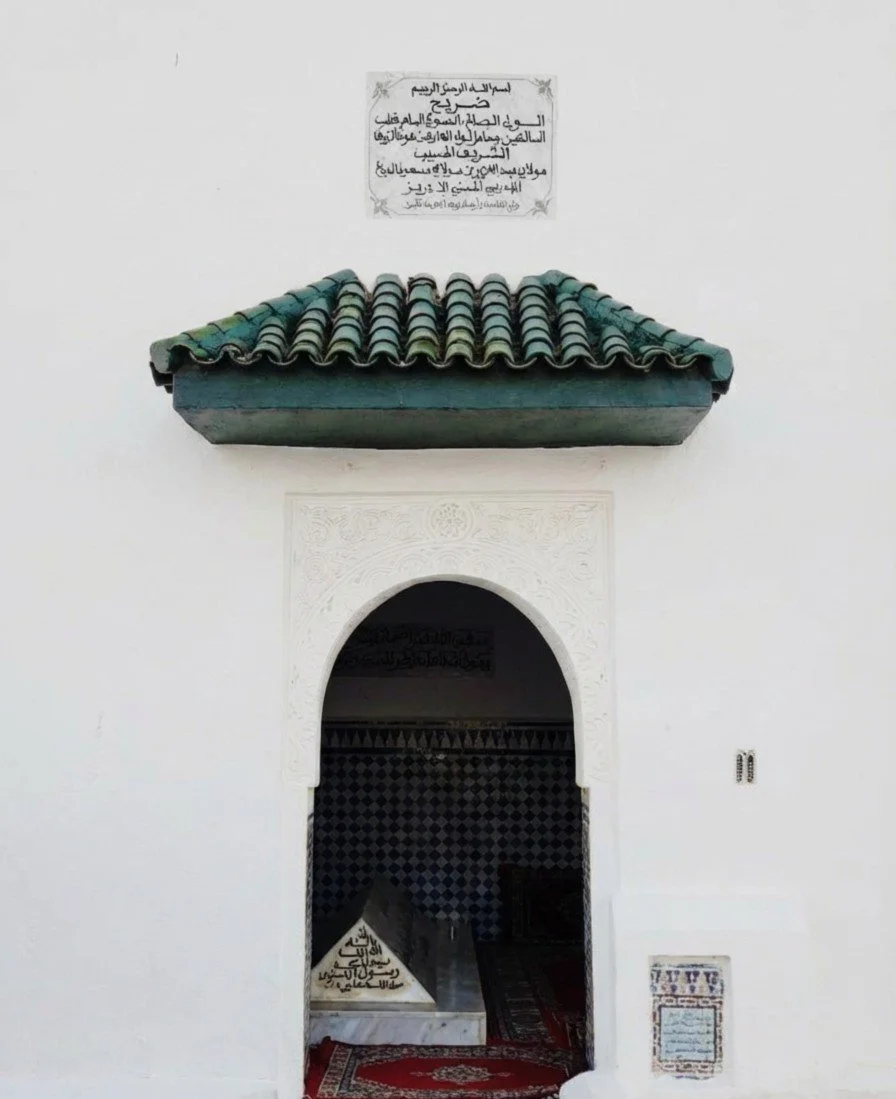
Figure 6. The threshold of the rawḍa of Mawlāy ʿAbd al-ʿAzīz al-Dabbāgh, Bāb al-Futūḥ, Fez. Above the carved stucco archway, the marble inscription names him in full: al-walī al-ṣāliḥ, al-ṣūfī al-bāhir, quṭb al-sālikīn wa-ḥāmil liwāʾ al-ʿārifīn, qūt al-zawwān — the righteous walī, the brilliant Sufi, the Pole of the sālikīn and bearer of the banner of the ʿārifīn, the nourishment of those who visit. The colorful prayer rugs at the threshold mark the place where visitors pause before entering — the moment of intention before the ziyāra begins.
رِثَائِي عَلَيَّ بَعْدَمَا خَانَنِي صَبْرٌ * وَأَصْلَى النَّوَى قَلْبِي عَلَى لَهَبِ الجَمْرِ
My elegy falls upon me after patience has betrayed me
and separation has set my heart upon the flame of embers.
وَهَيَّجَ أَحْزَانِي وَهَمِّي حَادِثٌ * بِأَشْرَفِ أَعْيَانِ العُيُونِ غَدَا يَسْرِي
What stirred my grief and my anguish is an event
that moves through the noblest of eyes like a night journey.
أَقُولُ وَدَمْعُ العَيْنِ فِي الخَدِّ سَائِلُ * وَذَا سَائِلٌ أَمْسَى يُقَابَلُ بِالنَّهْرِ
I speak while the tear on the cheek flows
and this stream is met by a river.
إِلَى اللهِ كُلُّ الأَمْرِ فِي كُلِّ خَلْقِهِ * وَلَيْسَ إِلَى المَخْلُوقِ شَيْءٌ مِنَ الأَمْرِ
To God belongs all affair in all His creation
and to the creature belongs nothing of the affair.
يَحِقُّ لَنَا نَبْكِي مَسَاءً وَبُكْرَةً * وَظُهْراً عَلَى شَمْسِ الدُّنَا وَاحِدُ العَصْرِ
It is right that we weep — at evening, at dawn, and at midday
for the sun of this world, the singular one of the age.
أَقَامَ الهُدَى كَنْزُ المَعَارِفِ سَيِّدِي * وَغَوْثُ البَرَايَا غَيْثُهُ لَمْ يَكْدُرِ
He upheld guidance — the treasury of gnosis, my master
the Ghawth of creation, his rain never muddied.
شَرِيفٌ إِلَى خَيْرِ الخَلاَئِقِ يَنْتَمِي * بِهِ أَقْسَمَ الرَّحْمَانُ فِي مُحْكَمِ الذِّكْرِ
A sharīf who traces his lineage to the best of creation
by whom the All-Merciful swore in the perfected remembrance.
عَلَيْهِ صَلاَةُ اللَّهِ ثُمَّ سَلاَمُهُ * وَأَصْحَابِهِ مَعَ آلِهِ الأَنْجُمِ الزُّهْرِ
Upon him the prayer of God and then His peace
and upon his companions and his family, the bright stars.
سَلِيلُ العُلَى عَبْدُ العَزِيزِ أَخُو التُّقَى * عَنَيْتُ بِهِ الدَّبَّاغُ ذَا المَجْدِ وَالعِزِّ
The scion of nobility — ʿAbd al-ʿAzīz, brother of piety
I mean by him al-Dabbāgh, the one of glory and might.
فَمِثْلُ ابْنُ مَسْعُودٍ يَعِزُّ وُجُودُهُ * بِمَغْرِبِنَا الأَقْصَى وَفِي كُلِّ مَا قُطْرِ
One like Ibn Masʿūd — his existence is rare
in our far Maghrib and in every land.
كَرَامَتُهُ الكُبْرَى وَأَعْظَمُ حُجَّةً * بِحَالِ الصِّبَا لَمْ يَرْوِ عِلْماً وَلاَ يَدْرِي
His greatest karāma and most powerful proof
that in his youth he transmitted no learning and knew none.
فَكَمْ نُكْتَةً أَبْدَى وَكَمْ مِنْ لَطِيفَةٍ * وَكَمْ مُعْضِلٍ أَضْحَى كَمَا فَلَقُ الفَجْرِ
How many subtleties he revealed, how many fine points
how many a thorny problem became like the break of dawn.
وَيُبْدِي عُلُوماً مِنْ زَوَاخِرِ بَحْرِهِ * جَوَاهِرُهَا لاَحَتْ كَمَا الكَوْكَبُ الدُّرِّ
He brought forth sciences from the swelling of his sea
their jewels gleaming like the pearly star.
فَمَا العِلْمُ عَنْ كَثْرِ الرِّوَايَةِ نَاشِئَا * وَلَكِنَّهَا الأَنْوَارُ تُوقَرُ فِي الصَّدْرِ
Knowledge does not arise from the abundance of transmission
it is the lights that are lodged with reverence in the breast.
فَمَنْ مِثْلُهُ يَشْفِي الغَلِيلَ لِمَنْ غَدَا * يَرُومُ مِنَ العِرْفَانِ مُنْسَبِكَ التِّبْرِ
Who like him quenches the thirst of one who seeks
from gnosis the refined pure gold?
لَقَدْ خُصَّ ذَا المَوْلَى بِكُلِّ فَضِيلَةٍ * فَضَائِلُهُ جَلَّتْ عَنِ العَدِّ وَالحَصْرِ
This master was singled out for every virtue
his virtues are too great for counting or containment.
فَإِنْ شِئْتَ تَدْرِي ذَلِكَ رِدْ مَنْهَلَ الصَّفَا * كِتَاباً حَوَى التَّحْقِيقَ مِنْ خَفِيِّ السِّرِّ
If you wish to know this, go to the spring of purity
a book that holds the verification of the hidden sirr.
هُنَاكَ تَرَى المَوْهُوبَ مِنْ عِلْمِ رَبِّنَا * وَتَعْرِفُ قَدْرَ الشَّيْخِ بِالنَّظْمِ وَالنَّثْرِ
There you will see what was gifted from the knowledge of our Lord
and know the worth of the Shaykh in verse and in prose.
كَفَى شَاهِداً عَدْلاً لَنَا ابْنُ مُبَارِكٍ * مُرَصِّعُ تَاجِ العِلْمِ مِنْ خَالِصِ التِّبْرِ
Ibn al-Mubārak suffices us as a just witness
the one who set the crown of knowledge with pure gold.
هُوَ النَّاقِدُ النِّحْرِيرُ يَعْرِفُ قَدْرَ مَا * حَوَتْهُ فَلاَ تَسْأَلْ لِزَيْدٍ وَلاَ عَمْرِ
He is the discerning critic who knows the worth of what it contains
ask no one else, neither Zayd nor ʿAmr.
يَعِزُّ عَلَى كُلِّ الوَرَى فَقْدُ مِثْلِهِ * مِنْ أَهْلِ التُّقَى وَالعِلْمِ وَالفَضْلِ وَالخَيْرِ
The loss of one like him weighs upon all creation
one of the people of piety, knowledge, virtue, and goodness.
أَلَيْسَ ذَهَابُ الصَّالِحِينَ عَلاَمَةٌ * لِقُرْبِ زَمَانِ البَعْثِ وَالحَشْرِ وَالنَّشْرِ
Is not the departure of the righteous a sign
of the nearness of the time of resurrection, gathering, and rising?
لَنَا خَلَفٌ فِي اللَّهِ مِنْ كُلِّ هَالِكٍ * فَيَا لِصَبْرٍ نَحْظَى بِالجَزِيلِ مِنَ الأَجْرِ
In God we have a successor for every one who perishes
O what patience through it we attain the abundant reward.
وَفِي خَيْرِ خَلْقِ اللَّهِ أَحْمَدَ أُسْوَةً * عَلَيْهِ سَلاَمُ اللَّهِ كَالعَنْبَرِ الشَّحْرِ
In the best of God's creation, Aḥmad, is our example
upon him the peace of God, like the ambergris of Shiḥr.
فَقَدْ قَالَ رَبُّ النَّاسِ إِنَّكَ مَيِّتٌ * فَمَا مِنْ مَحِيدٍ عَنْهُ لِلْعَبْدِ وَالحُرِّ
For the Lord of mankind has said: you shall die
and there is no escape from it for slave or free.
عَلَى أَنَّ هَذَا المَوْتَ لاَ يَرْتَضِي الفِدَا * وَلاَ يَخْتَشِي طَعْنَ المُثَقَّفَةِ السُّمْرِ
Yet this death accepts no ransom
and fears no thrust of the straightened darkened lance.
سَقَى اللَّهُ قَبْراً ضَمَّهُ غَيْثُ رَحْمَةٍ * يَفُوقُ شَذَاهَا عَاطِرُ المِسْكِ وَالزَّهْرِ
May God water the grave that holds him with a rain of mercy
whose fragrance surpasses the perfume of musk and blossom.
وَفِي مُنْتَهَى العِشْرِينَ مِنْ قِعْدَةٍ مَضَى * بَعَامٍ بَدَا فِي عَدَدِهِ الأَحْرُفُ الغُرِّ
At the end of the twentieth of Dhū al-Qaʿda he departed
in a year whose number shines in its noble letters.
Adūsh closes not with grief but with a prayer for the tomb — saqā Allāhu qabran ḍammahu — may God water with mercy the grave that holds him. The tomb is already a source of baraka, already a place toward which rain is directed, already fragrant with musk and blossom. The man who never reached al-Dabbāgh in life ends his elegy facing his grave.
The Anonymous Rāʾiyya
The third elegy in al-Murābiṭī's collection was composed by a faqīh and lover of Sīdī ʿAbd al-ʿAzīz from Zurāra — a man who chose to remain anonymous, entrusting his verses to al-Murābiṭī to preserve without his name. What he left is a rāʾiyya of raw grief: a young shaykh, thirty-six years old, three children left behind, a community torn open by a loss it had not prepared itself to survive.
رَوَوْا نَبَأً فَالعَيْنُ مِنْ أَجْلِهِ تَذْرِي * دُمُوعاً تُحَاكِي الدَّرَّ أَوْ وَاكِفَ القَطْرِ
They brought a piece of news and for it the eye sheds tears
that rival pearls or the pour of rain.
وَصُكَّ سَمَاعُ السَّامِعِينَ وَأُضْرِمَتْ * بِهَا نَارُ الجَوَانِحِ وَالصَّدْرِ
The hearing of those who heard was struck
and by it the fire of the ribs and the chest was set ablaze.
بِأَنَّ الرِّضَى عَبْدُ العَزِيزِ إِمَامُنَا * تَوَارَى عَنِ الأَعْيَانِ شَخْصُهُ فِي القَبْرِ
That al-Riḍā, ʿAbd al-ʿAzīz, our Imām
his person has gone into concealment in the grave.
سَلِيلُ التُّقَى مِنْ خَيْرِ ضِئْضِئِ هَاشِمِ * وَسِبْطُ رَسُولِ اللَّهِ حَقًّا بِلاَ نُكْرِ
Scion of piety from the best root of Hāshim
and grandson of the Messenger of God, truly, without denial.
إِمَامُ الهُدَى وَالعِلْمِ وَالدِّينِ وَالصَّفَا * وَخِدْنُ الوَفَا وَالحِلْمِ وَالجُودِ وَالصَّبْرِ
Imām of guidance, knowledge, religion, and purity
intimate companion of loyalty, forbearance, generosity, and patience.
وَلِيُّ إِلَهِ العَرْشِ مِنْ دُونِ مِرْيَةِ * وَغَوْثٌ لِخَلْقِ اللهِ فِي السِّرِّ وَالجَهْرِ
Walī of the God of the Throne without doubt
and Ghawth for the creation of God, in secret and in the open.
خَبِيرٌ بِأَسْرَارِ الدِّيَانَةِ مَاهِرٌ * عَظِيمُ المَزَايَا وَالفَضَائِلِ وَالفَخْرِ
Deeply knowing the secrets of the faith, masterful
immense in his qualities, his virtues, his pride.
فَكَمْ مِنْ عَوِيصٍ فِي العُلُومِ وَمُشْكِلِ * عَلَى كُلِّ ذِي فَهْمٍ سَلِيمِ الحَجَا حَبْرِ
How many a thorny question in the sciences, how many a difficulty
for every sound-minded scholar of understanding
أَصَارَهُ بَيْنَ الخَلْقِ شَمْسًا مُضِيئَةً * تُضِيءُ قُلُوبَ السَّالِكِينَ مَدَى الدَّهْرِ
He turned into a blazing sun before creation
illuminating the hearts of the sālikīn for all of time.
وَمَا لَهُ بَيْنَ العَالَمِينَ دَفَاتِرٌ * وَلَمْ يَرْوِ شَيْئًا مَا لِزَيْدٍ وَلاَ عَمْرِ
He had no books among the people of the world
and transmitted nothing from Zayd or ʿAmr.
وَمَا أَنْ قَرَا فِي مَجْلِسِ الدَّرْسِ سَاعَةً * وَلاَ حِزْبًا يُحْفَظْنَ مِنْ مُحْكَمِ الذِّكْرِ
He never read for an hour in a lesson circle
nor memorized a portion from the perfected remembrance.
وَلَكِنَّ سِرَّ اللَّهِ يَسْرِي بِقَلْبِ مَنْ * أَرَادَ بِهِ نَهْجًا إِلَى سُبُلِ الخَيْرِ
But the sirr of God flows through the heart of one whom
He willed to be a path toward the ways of good.
وَذَاكَ مِصْدَاقُ الحَدِيثِ الَّذِي رُوِي * عَنِ المُصْطَفَى المَبْعُوثِ لِلْعَبْدِ وَالحُرِّ
And that is the confirmation of the hadith transmitted
from al-Muṣṭafā, sent to slave and free alike.
فَيَا سَائِلاً بِالشَّيْخِ يَكْفِي المُحِقُّ ذَا * لَقَدْ كَرَعَ الصِّدِّيقُ وَاللَّهِ فِي البَحْرِ
O you who ask about the Shaykh this suffices the truthful one:
by God, the Ṣiddīq himself drank from this sea.
فَلِلَّهِ مِنْ غَوْثٍ وَفَرْدٍ بِوَقْتِهِ * مَنَاقِبُهُ تُرْبِي عَلَى العَدِّ وَالحَصْرِ
God's own Ghawth, the singular one of his time
whose virtues exceed all counting and containment.
فَيَا لَسَقَامِ القَلْبِ مِنْ فَقْدِ مَاجِدٍ * شَرِيفٌ عَفِيفٌ بَاهِرُ الصَّيْتِ
O what sickness of the heart at the loss of a noble one
a sharīf, pure, of dazzling renown.
فَمَنْ لِلْيَتَامَى وَالأَرَامِلِ بَعْدَهُ * وَمَنْ لِلرِّجَالِ المُعْدَمِينَ ذَوِي الفَقْرِ
Who will be for the orphans and the widows after him?
Who for the destitute men, the people of poverty?
وَمَنْ لِقُلُوبِ الغَافِلِينَ إِذَا صَدَتْ * جَلاَهَا بِأَنْوَارِ المَعَارِفِ وَالذِّكْرِ
Who for the hearts of the heedless when they rusted
he who polished them with the lights of gnosis and remembrance?
فَوَاللَّهِ لَوْلاَ اللَّهُ وَابْنُ مُبَارَكٍ * سَلِيلُ الرِّضَا صِهْرُ الرَّسُولِ أَبِي بَكْرِ
By God — were it not for God, and Ibn al-Mubārak,
scion of al-Riḍā, son-in-law of the Prophet through Abū Bakr
كَذَا ابْنُ حَنِينِي الذَّكِيُ مُحَمَّدُ * لِإِخْمَادِ مَا قَدْ ثَارَ مِنْ لَهَبِ الجَمْرِ
And the perceptive Muḥammad ibn Ḥanīnī
to extinguish what blazed of the embers' flame
لَقَدْ نَشَبَتْ لِلْمَوْتِ فِينَا أَظَافِرٌ * وَعَرَضْنَا الدَّهْرَ المَشُومَ إِلَى الخُسْرِ
The claws of death would have sunk into us
and we would have been exposed to ruinous time and loss.
فَحَمْدًا وَشُكْرًا لِلْعَلِيِّ الهَنَا * رَحِيمُ البَرَايَا مَلِكُ الخَلْقِ وَالأَمْرِ
Praise and gratitude to the Most High, the Gracious
Merciful to creation, King of all beings and affairs.
وَفِي مُنْتَهَى العِشْرِينَ مِنْ قِعْدَةٍ غَدَا * رَاحِلاً يَوْمًا إِلَى رَوْضَةِ القَبْرِ
At the end of the twentieth of Dhū al-Qaʿda he departed
one day a traveler toward the garden of the grave.
The anonymous elegy argues directly for al-Dabbāgh's posthumous presence and availability. It defends his sharīfian genealogy against implicit criticism — the suggestion, apparently circulating in some circles, that an illiterate weaver could not be a legitimate descendant of the Prophet ﷺ. And it addresses al-Dabbāgh directly in the intercessory mode: the dead saint as living interlocutor, capable of hearing petition and responding to need.
Al-Tāzī's Qaṣīda
The fourth and final elegy is by Muḥammad ibn al-Ḥasan ibn ʿAbd Allāh ibn ʿAlī al-Tāzī — a Fāsī scholar whose qaṣīda is the most architecturally elaborate of the four. It opens not with grief but with a question: is that lightning on the horizon, or the full moon, or the sun rising from its setting toward the Day of Resurrection? The answer comes in the third bayt — it is none of these. It is the dome.
أَبَرْقٌ لاَحَ مِنْ غَرَبِ الغَمَامِ * أَمِ البَدْرُ المُجْلِي لِلظَّلاَمِ
Is that lightning appearing from the west of the clouds
or the full moon dispersing the darkness?
أَمِ الشَّمْسُ المُنِيرَةُ حَانَ مِنْهَا * طُلُوعٌ مِنْ غُرُوبٍ لِلْقِيَامِ
Or the luminous sun — has its rising come from its setting, toward the Day of Standing?
بَلِ القُبَّةُ المَنِيفَةُ قَدْ تَجَلَّتْ * فَأَزَرَتْ بِالْكَوَاكِبِ الجِسَامِ
No — it is the magnificent dome that has revealed itself, outshining the greatest stars.
The dome precedes the death in the poem's logic. Al-Tāzī begins with the built monument — the community's declaration that this man deserved a permanent mark on the face of the earth — and only then moves to who lies within it. The shrine is not the consequence of the saint; the saint is the explanation of the shrine.
وَكُلُّ غَادَةٍ فَاقَتْ جَمَالاَ * عَنَتْ لِحُسْنِ ذَلِكَ الْقِوَامِ
Every beauty that surpasses in loveliness
submits to the grace of that form.
وَكُلُّ زَبَرْجَدٍ زُهِيَ بِهَا * لِتَاجِهَا يُلَجْلِجُ فِي الكَلاَمِ
Every emerald that takes pride in itself
stammers before her crown.
وَكُلُّ شَدَا وَإِنْ غَلاَ أَثْمَانَا * فَعِنْدَهَا يَذِلُّ كَمَا القَتَامِ
Every precious thing, however high its price,
is humbled before her like dust.
فَمَا العَنْبَرُ وَالمَسُوكُ إِلاَّ * لَدَا أَرْيَحِ تُرْبِهَا ذُو انْعِدَامْ
Ambergris and musk
at the fragrance of her soil they cease to exist.
وَمَا القُلُوبُ إِذَا تَفِي فَنَاهَا * إِلاَّ مَقُودَةٌ بِلاَ زِمَامْ
And hearts, when they arrive at their annihilation
are led without a bridle.
تَرَى الأَقْيَالَ وَالعُظَمَاءَ فِيهَا * عَلَى قَسْرٍ كَأُحَادِي الطَّغَامْ
You see kings and great men before it compelled
like solitary commoners.
وَكَيْفَ لاَ وَقَدْ حَمَلَتْ بِبَدْرْ * أَنَارَ الكَوْنَ مُلْغَى اللِّثَامْ
And how could it be otherwise when it holds a full moon
that illumined all existence, his veil lifted.
The nasab dissolves into the portrait. Al-Tāzī moves from the beauty of the dome to the beauty of the one within it — and then to the genealogical chain, which he runs in full, link by link, from al-Dabbāgh back through his ancestors to al-Ḥasan al-Sibṭ and thence to the Prophet ﷺ.

ِفَهْوَ عَبْدُ العَزِيزِ الَّذِي أُعِزَّ * بِسِرٍّ نَالَهُ بِلاَ ازْدِحَامِ
He is ʿAbd al-ʿAzīz — made mighty by a sirr he attained without crowding.
وَبِالدَّبَّاغِ يُدْعَى لِزِقٍّ كَانَ * لَهُمْ بِدَارِ دَبْغِ سَلاَ مُنَامِ
And al-Dabbāgh he is called — for a lane in Saléthat bore their name,
they who held the levy of its tannery by (Marinid) grant.
وَمَسْعُودٌ أَبُوهُ الَّذِي سَعِدْنَا * بِنَجْلِهِ سَعَادَةَ الدَّوَامِ
And Masʿūd is his father — through
whose son we attained an enduring felicity.
فَأَحْمَدٌ مُحَمَّدٌ مُحَمَّدٌ * وَأَحْمَدُ الجَوَادُ بِلاَ سَئَامِ
Then Aḥmad, Muḥammad, Muḥammad
and Aḥmad the generous, without wearying.
وَمَنْ أُضِيفَ لِلرَّحْمَانِ عَبْداً * وَقَاسِمٌ أَخُو الفَضْلِ العَبَامِ
And one named servant of the All-Merciful
and Qāsim, brother of overflowing virtue.
وَزِدْ مُحَمَّداً سَلِيلُ أَحْمَدٍ * كَقَاسِمٍ مُحَمَّدُ الهُمَامِ
Add Muḥammad, scion of Aḥmad
like Qāsim: Muḥammad the resolute.
وَإِبْرَاهِيمُ ثُمَّ عُمَرُ وَيَتْلُوْ * إِلَى عَبْدُ الرَّحِيمِ أَقْهَى كَلاَمِ
And Ibrāhīm, then ʿUmar, and following
to ʿAbd al-Raḥīm, in the most commanding words.
وَمِنْدِيلٌ عَلِيُّ ثُمَّ عَبْدٌ * لِرَحْمَانِ البَرَايَا ذِي الأَيَّامِ
And Mindīl, ʿAlī, then the servant of
the All-Merciful of creation, Lord of the days.
وَعِيسَى أَحْمَدُ كَذَا مُحَمَّدُ * وَعِيسَى خُذْهُمْ عَلَى التَّمَامِ
And ʿĪsā, Aḥmad, and likewise Muḥammad — and ʿĪsā — take them in their completion.
وَإِدْرِيسُ وَإِدْرِيسُ وَكَامِلُ * كَذَا الحَسَنُ المُثَنَّى ذُو العُرَامِ
And Idrīs, and Idrīs, and Kāmil
and al-Ḥasan al-Muthannā, the one of might.
وَسِبْطُ عَلِيٍّ الحَسَنُ الجَلِيلُ * سَلِيلُ المُصْطَفَى الهَادِي التِّهَامِ
And the grandson of ʿAlī — al-Ḥasan the majestic
scion of al-Muṣṭafā, the guide of Tihāma.
عَلَيْهِ صَلاَةُ رَبِّي مَا تَغَنَّى * بَاكِيَةٌ مُطَوَّقُ الحَمَامِ
Upon him the prayer of my Lord
as long as the mourning dove with its collar sings.
The genealogical chain is the poem's longest movement — and its most deliberate. Al-Tāzī names every link from al-Dabbāgh back to al-Ḥasan al-Sibṭ, grandson of the Prophet ﷺ. This is not decoration. The baraka that made Sīdī ʿAbd al-ʿAzīz what he was flows through the same blood that flows through the Prophet ﷺ. The lineage is the conduit. To name every link is to trace the baraka back to its source.
هُمُ الأَنْوَارُ وَالبَرُّ الظَّلاَمُ * هُمُ البِحَارُ وَالوَرَى كَجَامِ
They are the lights — and the land in its darkness.
They are the seas — and all people are like a cup.
كَوَاكِبُ الهُدَى عِنْدَ الضَّلاَلِ * مَنَاهِلُ الرَّدَى فِي الاِلْتِحَامِ
Stars of guidance in the time of misguidance,
springs of redemption in the thick of conflict.
فَفَخْرُهُمْ فَخَارٌ لاَ يُوَازَى * وَلاَ بِالكَسْبِ نَالَهُ ذُو اهْتِمَامِ
Their pride is a pride beyond comparison
no one attains it through effort or ambition.
تَمَسَّكَنَّ بِحُبِّهِمْ فَفِيهِ * رِضَى الإِلاَهِ كَالحَبَا المُدَامِ
Hold fast to love of them
for in it is God's pleasure, like a gift that never ceases.
This is a significant structural choice. Al-Tāzī begins with the physical shrine — the built response to the death, the community's assertion that al-Dabbāgh's presence deserves a permanent architectural marker. By opening with the dome rather than with the death, the poem asserts that the saint's legacy is already secured before the elegy has begun its work. The grief comes after; the monument is already there.
The genealogical section names every link in the Dabbāgh Idrīsid chain, from al-Dabbāgh back through his ancestors to al-Ḥasan al-Sibṭ and thence to the Prophet ﷺ. This is not decoration. In the context of Moroccan political theology, the sharīfian lineage is not merely a mark of honor — it is a claim about the nature of the authority that passes through the body. The baraka that made al-Dabbāgh what he was flows through the same blood that flows through the Prophet ﷺ; the lineage is the conduit.
The poem's most analytically significant passage concerns Ibn Ḥanīnī. Al-Tāzī names him as khalīfa — successor — and states that he saw al-Dabbāgh's designation written in his own handwriting in a formal register. This is documentary evidence of a written succession document. Al-Tāzī saw the paper. The poem's insistence on this detail — 'I saw it written in his own handwriting' — suggests that the question of succession was contested enough to require documentary proof, and that al-Tāzī understood his role as providing poetic testimony for a legal-historical claim.
ثُمَّ أَمِّ مُحَمَّدَ ابْنَ حَنِينِي تَجِدْ * شَيْخَنَا حَوَى قِوَى الإِمَامِ
Then make for Muḥammad ibn Ḥanīnī you will find
our Shaykh, who gathered the powers of the Imām.
إِمَاماً عَارِفاً بِاللَّهِ بَرّاً * هُمَاماً وَارِثاً سِرَّ الإِمَامِ
An Imām, a knower of God, righteous,
resolute, the inheritor of the sirr of the Imām.
لَهُ خُلُقٌ عَظِيمٌ وَحُسْنُ سَمْتٍ * وَصِدْقُ لَهْجَةٍ بِلاَ اسْتِعْجَامِ
His is a noble character and a beautiful bearing
and a truthfulness of speech without obscurity.
فَمَا الرِّيَاحُ وَالسُّيُولُ عِنْدَ * عَطَايَاهُ الجِسَامِ سِوَى رُهَامِ
The winds and the floods, before
his great gifts, are nothing but a drizzle.
وَمَا البِحَارُ وَالطُّوفَانُ عِنْدَ * غَوَادِي عِلْمِهْ إِلاَّ عُجَامِ
And the seas and the flood,
before the morning rains of his knowledge, are mere silence.
سَمِعْتُ الشَّيْخَ يَذْكُرُ مِنْ حَلاَلٍ * مَنَاقِبَاً شَدِيدَةَ اللِّزَامِ
I heard the Shaykh mention — lawfully —
virtues of binding and compelling necessity.
وَأَنَّهُ لِكُلِّ الإِرْثِ حَاوٍ * فَمَا سِوَاهُ يُدْرِكُ مِنْ مَقَامِ
And that he encompasses the entirety of the inheritance
none other attains his maqām.
وَكَوْنُهُ خَلِيفَةُ رَأَيْتُهُ * بِخَطِّهِ مَرْقُوماً فِي الزِّمَامِ
And his being the successor — I saw it myself,
written in his own hand in the register.
وَكُلُّ ذَا رَأَيْنَاهُ عِيَانَا * لَقَدْ صَدَقَ الصَّدُوقُ فِي الأَنَامِ
All of this we witnessed with our own eyes
the truthful one has spoken truth among mankind.
The poem ends not with a chronogram but with testimony. Al-Tāzī was present. He heard. He saw the written designation with his own eyes. The final bayt is a legal declaration — ra'aynāhu ʿiyānan — we witnessed it in person. The elegy closes as a document.
Come to Fez: Al-Murābiṭī's Poem of Visitation
The fifth and final voice in this collection belongs to the compiler himself. Muḥammad ibn ʿAbd al-ʿAzīz al-Murābiṭī al-Sijilmāsī — the man who gathered these testimonies, verified them with al-Dabbāgh, and spent years assembling the archive of Taysīr al-Mawāhib — did not only record. He also sang. His elegy is a poem of visitation, addressed to the traveler who has not yet come to Fez, urging him toward the shrine. It is the only elegy in the collection that speaks in the imperative — come, turn, arrive — because al-Murābiṭī understood that the poem's work was not only to mourn but to direct.
عُجْ بِالرَّكَائِبِ وَاغْتَنِمْ مَا تَرْتَجِي * قَبَلَ الحَمَامِ وَسِرْ بِشَوْقٍ مُزْعِجِ
Turn your mounts and seize what you hope for before death
and travel with a yearning that disturbs.
وَاصْرِفْ نَجَائِبَهَا بِعَزْمٍ صَادِقِ * وَعَلَى المَقَامِ المَوْلَوِيِّ عَرِّجِ
Direct your noble camels with sincere resolve
and make your way to the lordly maqām.
فَتَرَى بِفَاسِ مَا تُحِبُّ وَتَشْتَهِي * عِنْدَ الضَّرِيحِ المُسْتَتِرِ الأَبْهَجِ
You will find in Fez what you love and long for
at the concealed and most radiant shrine.
قَبْرُ الوَلِيِّ الصَّالِحِ الشَّيْخُ الَّذِي * فَاضَتْ فَوَاضِلُهُ بِمَا يَسْقِي الشَّجِ
The grave of the righteous walī, the Shaykh whose
overflowing virtues water even the grief-stricken.
غَوْثُ الوَرَى عَبْدُ العَزِيزِ بِغَيْثِهِ * تَحْيَا قُلُوبُ السَّالِكِينَ بِمَنْهَجِ
The Ghawth of creation — ʿAbd al-ʿAzīz — by whose rain
the hearts of the sālikīn come alive upon the path.
أَعْنِي بِهِ الدَّبَّاغُ مِنْ بَيْتِ التُّقَى * آلُ النَّبِيِّ العَاطِرِ المُتَأَرِّجِ
I mean by him al-Dabbāgh, of the house of piety
of the family of the Prophet, fragrant and perfumed.
وَرِثَ المَكَارِمَ كَابِرٌ عَنْ كَابِرِ * وَبِتَاجِ جَمْعِ الجَمْعِ قِدَماً مُتَوَّجِ
He inherited noble qualities, elder from elder
and was crowned of old with the crown of the supreme union.
فَبِوَجْهِهِ يُسْقَى الحَيَا وَبِجُودِهِ * تُحْدَى مَطِيُّ مُصْبِحٍ ثُمَّ مُدْلِجِ
By his face the rain is drawn — and by his generosity
the mounts of the morning traveler and the night traveler are urged on.
وَبِحِلْمِهِ وَبِعِلْمِهِ أُولُو النُّهَى * وَالرُّشْدِ قَدْ تَاهُوا فَدَعْ سَفَهَ الهَمَجِ
By his forbearance and his knowledge, the people of reason
and right guidance were lost in wonder — leave aside the folly of the ignorant.
أَنْعِمْ بِهَا مَرْتَبَةً قَدْ نَالَهَا * وَكَرَامَةً أَثْوَابُهَا لَمْ تُنْسَجِ
How fine a station he attained
and a karāma whose garments were never woven by human hands.
وَلاَّهُ رَبُّ العَالَمِينَ عِنَايَةً * عَطَفَتْ بِبَحْرِ لُجَّى مُتَمَوِّجِ
The Lord of the worlds granted him a care
that bent like a surging, billowing deep sea.
لَعَوَالِمٌ فِي قُطْبِ ذَاتٍ تَجَمَّعَتْ * مَرَجَ البَقَا مِنْ بَعْدِ أَيِّ تَمَرُّجِ
Worlds gathered in the pole of his essence
the meadow of eternity after every mingling.
وَعَرَايِسٌ مِنْ مَعَارِفٍ طَارَتْ بِهَا * عَنْقَاءُ مُغْرِبَةٌ إِلَى مُتَعَوِّجِ
Brides of gnosis — the far-flying
ʿAnqāʾ carried them to the winding and the distant.
The opening movement of al-Murābiṭī's jīmiyya is a sustained call to sulūk. Every bayt operates on two levels simultaneously — the outer journey to Fez and the inner journey of the murīd toward the source of baraka. Shawq muzʿij — a yearning that disturbs — names the spiritual state that makes the journey possible: not comfort but the restlessness the tradition calls shawq, the longing that will not let the murīd remain where he is. The destination is named with precision — al-maqām al-mawlawī — the lordly maqām, not a grave but a living station of spiritual authority. The shrine is mustatir and abhaj simultaneously — concealed and most radiant — carrying the central paradox of al-Dabbāgh's wilāya: the highest presence takes the form of hiddenness. He is named immediately as Ghawth — his rain waters the hearts of the sālikīn even from the grave — and his sharīfian baraka is olfactory, a fragrance that reaches the visitor before he arrives. The poem then ascends: jamʿ al-jamʿ, the supreme station beyond fanāʾ, written in eternity before his birth — qidaman, of old; the wajh that draws the cosmic rain; the ʿināya of God surging toward him like a deep sea; worlds gathered in the pole of his essence; and finally the brides of gnosis carried by the mythical ʿAnqāʾ to the winding and the distant — al-Dabbāgh's maʿārif do not settle into possession, they fly, they lead further, every arrival the beginning of a new departure.
لَمَّا تَوَارَى شَخْصُهُ أَلْفَيْتَنَا * مَا بَيْنَ أَرْمَلَةٍ وَيُتْمٍ مُحْوِجِ
When his person went into concealment we found ourselves
between widowhood and needing orphanhood.
يَا حَسْرَتَى كَمْ مُشْكِلٍ أَبْدَى وَكَمْ * مِنْ مُسْتَقِيمٍ بَعْدَ حَالٍ أَعْوَجِ
O my grief — how many a difficulty he resolved,
how many a crooked state he made straight.
وَلَنَا قَدُّ العُلَمَاءِ نَجْلُ مُبَارَكِ * فِي التَّاجِ مَا يُشْفِي الصُّدُورَ وَمُثْلِجِ
And we have — the paragon of scholars — the son of Mubārak:
in al-Tāj what heals the breasts and cools them.
فَكَأَنْ يَقَّضَتْ مِنَّا مَا خُيِّلَتْ * أَوَانَ صَحْوَتِهِ عَشِيَّةَ مُرْتَجِ
It is as though what had seemed a dream awoke in us
at the hour of his sobriety, at the evening of expectation.
فَلِنَجْلِ مَسْعُودٍ عَلَيْنَا لَفَقْدُهُ * حُزْنٌ وَكَرْبٌ مَا لَهُ مِنْ مُفَرِّجِ
For the son of Masʿūd — his loss upon us
is a grief and an anguish that has no relief.
إِلاَّ رَزِيَّةَ أَحْمَدَ الهَادِي الَّذِي * اقْتَبَسَ البُدُورِ مِنْ نُورِهِ المُتَوَهِّجِ
Except the calamity of Aḥmad the Guide
who kindled the full moons from his blazing light.
فَسَقَى الإِلَهُ ثَرَاهُ مِنْ مُزْنِ الرِّضَى * غَيْثاً شِعَابُ هِضَابِهِ فِي تَهَيُّجِ
May God water his soil from the clouds of divine pleasure
a rain whose mountain ravines surge and stir.
أَبِطِيبِ مِسْكِ السِّرِّ قُلْ فَاحَ عَصْرُنَا * وَرِيَاضُ أَزْهَارِ المَعَارِفِ فِي لَهَجِ
By the fragrance of the musk of the sirr — say it: our age has bloomed,
and the meadows of the flowers of gnosis are in full utterance.
Al-Murābiṭī closes not with a date but with a declaration: our age has bloomed. The compiler of the archive, the man who spent years gathering what the death threatened to scatter, ends his elegy in the present tense — fāḥa ʿaṣrunā — our age has become fragrant. The shrine is the source of that fragrance. The book he wrote is its vessel. The meadows of gnosis are still speaking.
7. The Shrine: Orthodoxy as Fidelity
The shrine of al-Dabbāgh outside Bāb al-Futūḥ has existed for three centuries. In a city where saint shrines have historically generated organized visitation economies, hereditary custodianship with financial dimensions, accumulated popular practices of varying orthodoxy, and the kind of cultural elaboration that turns a grave into a pilgrimage complex — the Dabbāgh family's stewardship of their ancestor's shrine has been marked by conspicuous restraint.
The visitation (ziyāra) at al-Dabbāgh's shrine has remained orthodox across the generations: the Fātiḥa, the salutation of the Prophet ﷺ, personal supplication, and departure. No ḥaḍra, no elaborate mawsim complex with music and collective trance, no institutionalized collection of offerings, no hereditary custodians claiming exclusive access to the saint's baraka on behalf of visitors. The shrine is visited. It is not performed.
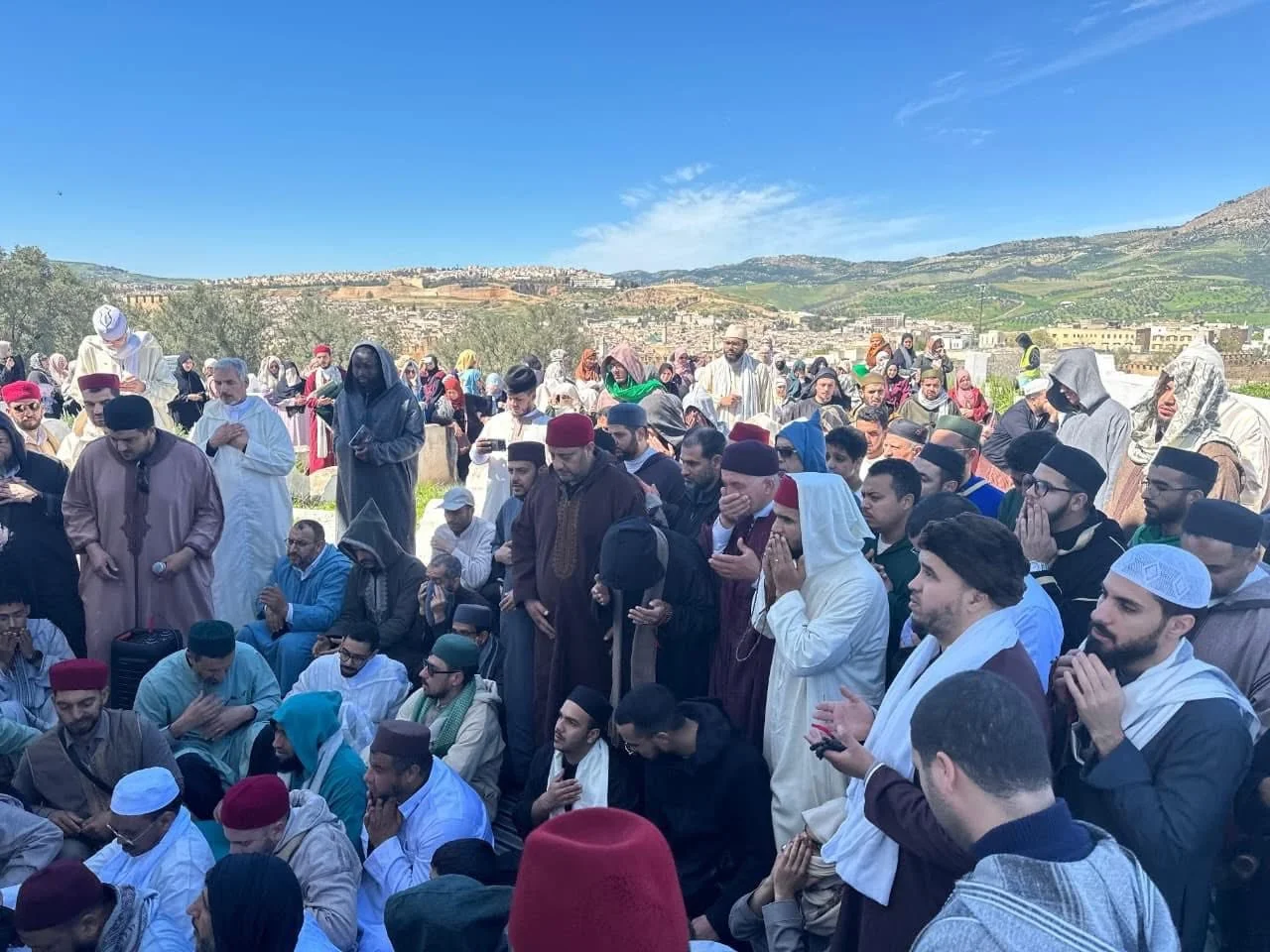
Figure 7. A large gathering of men and women in collective duʿāʾ at the rawḍa of Mawlāy ʿAbd al-ʿAzīz al-Dabbāgh, outside Bāb al-Futūḥ, Fez. Hands raised, faces turned inward — the entire city spread behind them, the hills of Fez closing the horizon. Moroccans, Africans, visitors from across the Muslim world, young and old, scholars and ordinary believers — all gathered at the same threshold, performing the same act. No innovation, no elaboration. The Fātiḥa, the ṣalāt ʿalā al-nabī, the duʿāʾ. Three centuries of the same grammar, repeated by different generations at the same place.
This restraint is not accidental. It is a direct consequence of al-Dabbāgh's own teaching. In multiple testimonies preserved in Taysīr al-Mawāhib, al-Dabbāgh warned against seeking karāmāt from awliyāʾ — not because the karāmāt were false, but because the seeker's motivation corrupted the seeking. He said explicitly: the visitor who comes to the walī seeking wonders is the visitor whose love is 'on a blade's edge' — contingent, conditional, useful to neither the visitor nor the saint. If the saint accommodates this craving, he 'confirms the visitor in his immaturity and leaves him in his blindness.'
The Dabbāgh family's three centuries of orthodox shrine maintenance is the longest possible argument for the fidelity of their inheritance. They kept what al-Dabbāgh gave them: not an institution, not a revenue stream, not a popular cult. A grave, a prayer, a lineage, and the book.
The theological basis for the shrine's orthodoxy is found in al-Dabbāgh's explicit teaching, recorded in multiple places in both primary sources. The warning appears in its most developed form in a passage al-Murābiṭī records in Taysīr al-Mawāhib: after al-Dabbāgh had described the geography of a distant village to a visitor who assumed he must have traveled there, al-Dabbāgh turned to Ibn al-Mubārak after the visitor left and said:
'People love kashf, and in it there is great harm — to the walī and to the one who seeks it from him. The harm to the walī is that it requires him to descend from the witnessing of the Real to the witnessing of creation — and that is a descent from the highest summit. The harm to the one who seeks it is that no one comes to the walī seeking kashf and karāmāt except one whose love is on a blade's edge; and if the walī accommodates him, he has confirmed him in his condition and left him in his blindness.'
This is a sophisticated critique, not of karāmāt as such, but of the relationship between seeker and saint when the karāma becomes the object. Al-Dabbāgh does not deny his kashf — he had just demonstrated it to the visitor. What he denies is that the demonstration of kashf is what the relationship between saint and disciple is for. The saint who performs for audiences confirms those audiences in their spiritual superficiality. The shrine that performs for visitors does the same.
The Dabbāgh Sharīfs and Continuity of Care
The Dabbāgh Idrīsid sharīfs have maintained a presence in Fez across the three centuries since al-Dabbāgh's death. Their continuity is itself a form of saintly visibility — each generation of descendants is a living proof of the lineage's persistence, an embodied argument that what al-Dabbāgh represented has not been exhausted.
The modern muḥaqqiq of al-Ibrīz and Taysīr al-Mawāhib — El Hassane Debbarh — is himself a descendant of the saint, continuing the family's archival work in the form of critical scholarly editions. That the most rigorous modern editions of the primary sources come from within the family is not coincidental. It is the family performing its inheritance in the idiom available to the twenty-first century: not popular custodianship of a shrine economy, but scholarly custodianship of a textual legacy.
This continuity — from Ibn Ḥanīnī's designation at the graveside to El Hassane Debbarh's editorial apparatus three centuries later — is the unbroken thread of the family's fidelity to what al-Dabbāgh left them. The shrine is orthodox. The archive is alive. The lineage continues.
Al-Dabbāgh's own statements about the value of proximity to him — preserved in Taysīr al-Mawāhib — establish a hierarchy of visitation that goes beyond the conventional understanding of shrine practice. When Sīdī ʿAlī ibn ʿAbd Allāh al-Ṣabbāghī came from four days' journey to die beside al-Dabbāgh, and died in a state of beatitude that moved al-Dabbāgh to tears, al-Dabbāgh said: “God had mercy on him — had he remained in Ṣabbāghāt ninety years, he would not have reached the state in which he died.”
This is al-Dabbāgh's own assessment of what proximity to him gives: more, in a single deathbed encounter, than ninety years of independent spiritual effort could provide. The statement is not a claim about the inefficacy of independent effort — it is a statement about the specific gift that the saint's proximity provides in the moment of death, the spiritual support that smooths the passage and elevates the dying person beyond what their own practice could achieve alone.
For the visitor to al-Dabbāgh's shrine, this theology operates in a minor key. The grave is not the living presence — al-Dabbāgh himself insisted that his presence was not confined to the grave. But the grave is the center, the primary locus of his earthly life's meaning, the place where the living chain was sealed and the textual inheritance was confirmed. To visit it is to visit the founding event. To pray at it is to participate, across centuries, in the community's ongoing act of recognition.
8. Al-Ibrīz as Ambassador: Textual Visibility and Sufi Memory
Al-Dabbāgh never left Fez. He spoke in the dialect of his quarter. He received visitors in a modest house in Ḥūmat al-ʿUyūn. He could not write his name. The scholars who came to him carried their knowledge to him and left carrying something they had not brought.
Without Ibn al-Mubārak, al-Dabbāgh's authority would have remained exactly as it found him: local, oral, powerful within its circle and invisible beyond it. The scholars of Sijilmāsa would never have known of him. The Sufi circles of Tāza and Meknès would have heard rumors, at most. Al-Tījānī would have had no ground for the invocation of his madad. The very possibility of the Moroccan Sufi tradition recognizing al-Dabbāgh as an authoritative figure depends entirely on the existence of al-Ibrīz.
Ibn al-Mubārak understood this. His textual labor — twelve chapters, 139 citations, years of compilation and verification — was a gift to posterity on behalf of a man who could not make himself legible to posterity in any other way. The book is al-Dabbāgh's voice in every library it entered, every circle where it was read, every scholar who encountered it and recognized in al-Dabbāgh's answers to theological questions an intelligence that surpassed the formal training of every credentialed scholar he had known.
The scholarly apparatus of al-Ibrīz is not decoration. It is argument. By cross-referencing al-Dabbāgh's theological positions against 139 works of Islamic scholarship — and finding that the illiterate weaver's answers consistently aligned with, and often exceeded, what the tradition's greatest scholars had said — Ibn al-Mubārak constructed a proof that al-Dabbāgh's knowledge was not aberrant but superlative.
This is the book's central rhetorical and theological move. The reader who comes skeptical — who believes that legitimate Islamic knowledge requires legitimate Islamic education — encounters page after page of evidence that al-Dabbāgh said what the best scholars said, without having read them. The only explanation the tradition itself can offer for this is the one al-Dabbāgh offered: ʿilm ladunī, the knowledge that comes directly from God, bypassing the human chain of transmission.
Al-Murābiṭī makes this point explicitly in Taysīr al-Mawāhib, directing readers who want to see the best of what al-Dabbāgh knew to go to al-Ibrīz: the book is the best ambassador of al-Dabbāgh's intellectual and spiritual authority. The term is exact. An ambassador speaks on behalf of one who cannot be present; carries the authority of one who cannot travel; makes legible to a foreign audience what would otherwise remain inaccessible.
By the nineteenth century, al-Ibrīz had circulated widely enough to be a reference point for the major Sufi orders operating in Morocco. Al-Tījānī's invocation of al-Dabbāgh's madad in his letter to the grandson presupposes familiarity with al-Dabbāgh's authority — and that familiarity, in written form, means familiarity with al-Ibrīz.
The book achieved what few hagiographic texts achieve: it entered the active working library of practicing Sufis rather than remaining in the category of pious historical record. Shaykhs read it. Disciples were directed to it. Al-Murābiṭī cites it within Taysīr al-Mawāhib as the primary reference for anyone seeking al-Dabbāgh's theological positions. The elegists cite it. Al-Tāzī directs readers to it in his qaṣīda.
Al-Ibrīz is unusual in the Moroccan hagiographic tradition for one additional reason: it records a living theological mind in action, not a catalogue of miracles. The reader of al-Ibrīz does not primarily encounter a list of karāmāt; he encounters a thinker working through the hardest questions in Islamic theology from a position of direct spiritual knowledge. This gives the book a different relationship to its reader than the standard manāqib text — it invites intellectual engagement, not merely pious admiration. That invitation is part of why it traveled.
If al-Ibrīz is al-Dabbāgh's textual presence to the wider Sufi world, Taysīr al-Mawāhib is the inner circle's archive of everything that al-Ibrīz left out. Al-Murābiṭī was explicit about his purpose: to collect what the companions had witnessed and what al-Ibrīz had not recorded — the karāmāt of daily life, the domestic texture of al-Dabbāgh's relationships with his disciples, the death and burial that al-Ibrīz suppressed, and the elegies that the community composed in response.
Together, the two texts constitute a complete archive. Al-Ibrīz provides the theology and the intellectual authority. Taysīr al-Mawāhib provides the human life and the communal response to its end. A tradition that had only al-Ibrīz would know al-Dabbāgh as a theological intelligence but not as a person. A tradition that had only Taysīr al-Mawāhib would know the person and the community but lack the systematic theological demonstration that justifies the authority being claimed. Both texts are necessary. Both circulated. Together they gave the tradition everything it needed to make al-Dabbāgh's authority permanent.
The most rigorous modern editions of both texts come from El-Ḥassane Debbarh — a descendant of the saint, a trained scholar, and the editor who has done more than anyone to make the primary sources accessible to contemporary readers. His muqaddima to the edition of al-Ibrīz is itself a scholarly contribution: a careful reconstruction of al-Dabbāgh's biography, a genealogical chart tracing the Dabbāgh Idrīsid line, a chronological table of key dates, and a contextualization of al-Dabbāgh within the broader history of Moroccan Sufism.
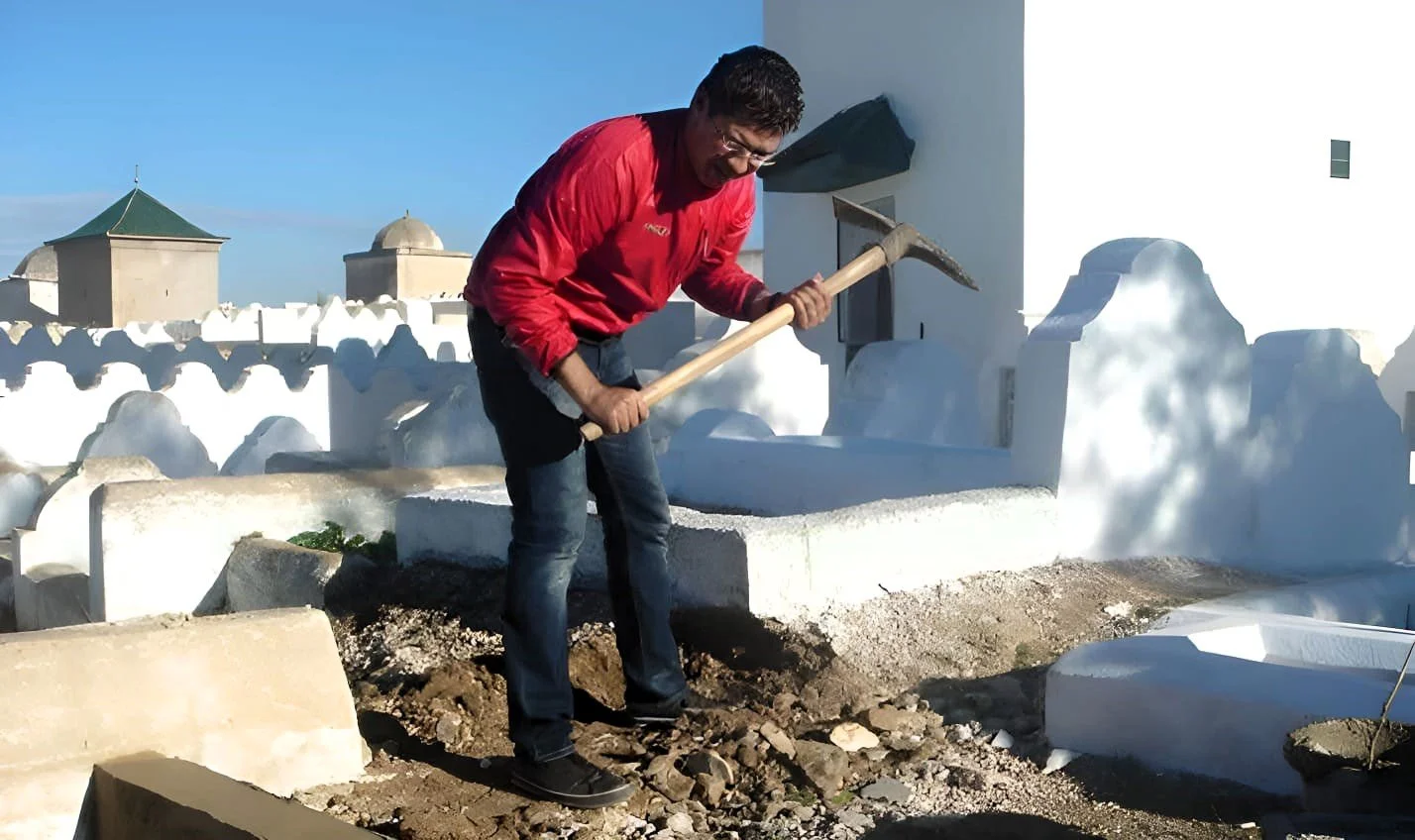
Figure 8. El-Ḥassane Debbarh, descendant of Mawlāy ʿAbd al-ʿAzīz al-Dabbāgh, working on the restoration of the shrine complex outside Bāb al-Futūḥ, Fez (2010). The image captures what three centuries of family stewardship looks like in practice.
That the family produces its own archive — that the descendants of the saint are also the editors of the texts about the saint — is not a conflict of interest. It is the tradition working as it was designed to work: the living lineage maintaining the textual inheritance, the progeny serving as custodians of the ancestor's legacy in every form that legacy takes. The same family that maintained the orthodox shrine for three centuries is now maintaining the critical edition. The fidelity is continuous.
9. Al-Dabbāgh and the Fāsī Patronal ِCulture
By the time al-Dabbāgh died in 1132/1720, Fez had been accumulating its sacred topography for nearly nine centuries. The city's awliyāʾ were not a flat list of honored dead; they formed a structured hierarchy of spiritual authority, each saint occupying a specific position in relation to the city's sacred geography, its intellectual history, and its ongoing Sufi life.
At the apex stood Mawlāy Idrīs II — the son of the dynasty's founder, buried at the heart of the medina since the ninth century, the city's walī al-madīna in the fullest sense: the saint whose presence sanctifies the city itself, not merely a quarter of it. His shrine is the gravitational center around which all other Fāsī sacred geography organizes itself.
Beyond Mawlāy Idrīs II, the deepest roots of Fāsī sanctity ran through Abū Yaʿazzā Yalannūr (d. 572/1177) — the Amazigh mountain saint of the Middle Atlas who never lived in Fez but whose disciples defined it. Abū Yaʿazzā's line produced ʿAlī ibn Ḥirzihim (d. 559/1163) and his son Muḥammad ibn Ḥirzihim, both buried outside the city's eastern walls in the shrine complex that the Dabbāgh family maintained connection to across the generations. It also produced Abū ʿAbd Allāh Muḥammad al-Tāwudī ibn Sūda (d. 580/1184) — the shams al-balad, the sun of the city — student of both Abū Yaʿazzā and Ibn Ḥirzihim, of whom Ibn Ḥirzihim declared that he had traversed the stations of Abū Yazīd al-Bisṭāmī in forty days. Al-Tāwudī is buried outside Bāb al-Jaysa, the southern gate — another threshold between city and necropolis, another saint marking the city's sacred perimeter.
These are the awliyāʾ among whom al-Dabbāgh took his place. Their tradition had been built over five centuries by Almoravid mystics, trained Mālikī jurists, and Sufi scholars of the highest formal credentials. Every major figure among them had studied. Every major figure in it had a silsila, a chain of transmission, a position in the hierarchy of Islamic scholarship. Every major figure in it was, in the formal sense, what al-Dabbāgh was not.
Al-Dabbāgh does not take his place among Fez's awliyāʾ by pushing anyone out. He enters by occupying a position that no one in it had occupied — the non-institutional saint, the saint without credentials, the saint whose authority rests entirely on what the tradition itself calls the highest possible source: direct divine gift.
The tradition has always acknowledged this category in theory. Every formulation of Islamic sainthood reserves space for the walī whose knowledge comes directly from God, bypassing the human chain of transmission. But in practice, the awliyāʾ who occupy recognized positions are almost always those who also held formal credentials — who combined the divine gift with the scholarly formation, who embodied both the irruption of grace and the institution of learning. Al-Dabbāgh's recognition is the tradition correcting its own practice in the direction of its own theory.
He does not displace Mawlāy Idrīs II or Ibn Ḥirzihim or al-Tāwudī. He completes them. Fāsī sacred memory, which held all of them but not him, had not yet proven it could recognize radical spiritual authority arriving without institutional support. Al-Dabbāgh's entry proves it can.
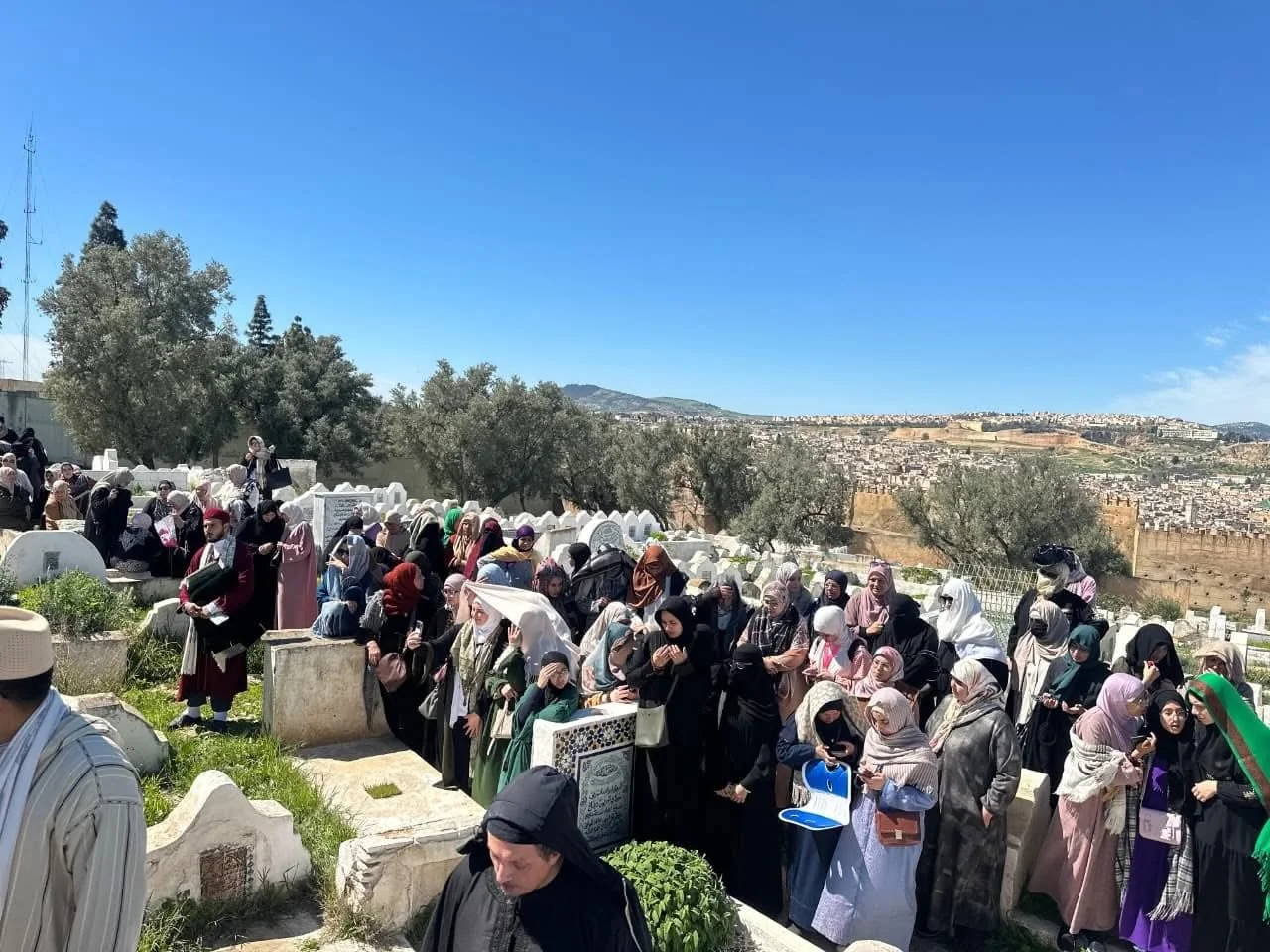
Figure 9. A large gathering of women in ziyāra at the necropolis outside Bāb al-Futūḥ, Fez, with the medina and ancient city walls visible in the background. The scene is unchanged in its essential grammar across three centuries. The city walls behind them are the same walls that enclosed al-Dabbāgh's Fez. The duʿāʾ continues.
The contrast between Sīdī ʿAbd al-ʿAzīz and the awliyāʾ who surrounded him is not incidental. It is the argument. Abū ʿAbd Allāh al-Tāwudī had studied under Ibn Ḥirzihim, who had studied under Abū Yaʿazzā. ʿAlī ibn Ḥirzihim was a trained Mālikī jurist before he became a Sufi. Mawlāy Idrīs II was the son of a prophet's descendant who had founded a city and a dynasty. Every figure in the tradition arrives carrying something that justifies the attention the tradition gives him.
Al-Dabbāgh arrives carrying nothing except what God had placed in him directly. No teacher. No silsila. No scholarly formation. No family political authority. A weaver's hands and an illiterate's memory and the direct divine gift that had opened in him at Bāb al-Futūḥ in 1125/1713.
That the tradition accepted this — that within a generation of his passing Sīdī ʿAbd al-ʿAzīz was being placed alongside Mawlāy Idrīs II and Ibn Ḥirzihim among the patron awliyāʾ of Fez — is the most important thing about his maqām in the city. It is not the individual miracle of his knowledge. It is the collective recognition of his authority by a tradition that had every reason to be skeptical and was not.
The Dabbāgh family's sustained connection to the shrine complex of ʿAlī ibn Ḥirzihim and Muḥammad ibn Ḥirzihim outside the city is analytically significant. It suggests that the family understood its ancestor's place in the Fāsī sacred hierarchy not as a rupture with the existing tradition but as a continuation of it from within. By maintaining connection to the shrine of the figure who brought Abū Yaʿazzā's line into Fez, the Dabbāgh sharīfs situate themselves within the deepest layer of Fāsī Sufi legitimacy — the layer that predates the formalized orders, the layer that connects directly to the normative Mālikī-Sufi synthesis that defines Moroccan Islamic practice.
Al-Dabbāgh's authority was not institutional. But his family's stewardship is institutionally aware — aware of where the tradition's roots run, aware of which connections to maintain, aware of how to position a non-institutional saint within an institutional landscape without either subordinating him to it or rupturing with it. The connection to the Ḥirzihim complex is the family's testimony: Sīdī ʿAbd al-ʿAzīz belongs here, in this tradition, in this city, in this lineage of baraka — even though his fatḥ came by a path no preceding walī had walked.
The founding of the Tījāniyya in the late eighteenth century — by Aḥmad al-Tījānī, who established his order in Fez and whose tomb is among the city's major sacred sites — represents the next major reorganization of Fāsī sacred authority after al-Dabbāgh. Al-Tījānī's letter to al-Dabbāgh's grandson, invoking his madad, is evidence of the connection between the two traditions — and of al-Tījānī's recognition that al-Dabbāgh's authority was a resource worth invoking even for the founder of a new order.
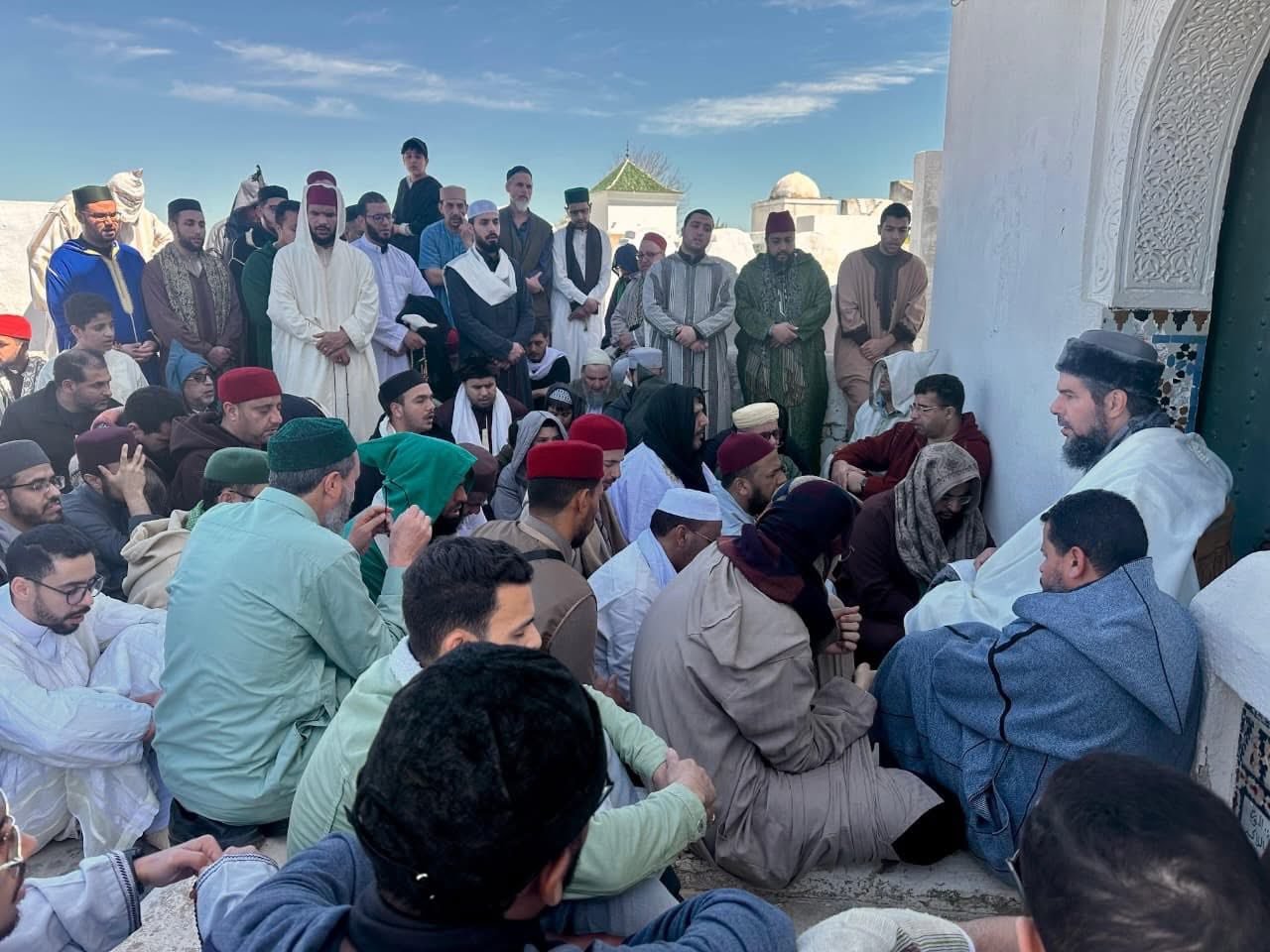
Figure 9. A gathering of visitors at the threshold of the rawḍa of Mawlāy ʿAbd al-ʿAzīz al-Dabbāgh, organized by the tourist guide operating under the name Muḥammad al-Qabiti, based in Andalusia. The baraka is the attraction.
The Tījāniyya and the Dabbāgh legacy are not in competition. They represent successive moments in the same ongoing process: the Fāsī sacred authority expanding to accommodate new forms of spiritual authority while maintaining its connection to the foundational figures who gave it its structure. Al-Dabbāgh's entry in the early eighteenth century created the precedent for a non-institutional saint of the highest rank. Al-Tījānī's entry later in the same century extended that precedent in a different direction — toward a formally institutionalized order whose founder nonetheless reached toward al-Dabbāgh's non-institutional legacy for confirmation.
The two together — al-Dabbāgh and al-Tījānī, the non-institutional saint and the order-founding saint — represent the full range of Moroccan Sufi authority in its eighteenth-century Fāsī form. And al-Dabbāgh's position in this range is the more radical: the one who arrived with nothing external and was recognized anyway.
Conclusion: The Event That Revealed What the Tradition Already Knew
Ibn al-Mubārak was buried in 1156/1743, twenty-three years after al-Dabbāgh. He died of plague, on a Friday, the 12th of Jumādā al-Ūlā. His body was lowered into the ground by al-Tāwudī ibn Sūda — a name that carries its own weight in the Fāsī sacred community. He was buried directly in front of his shaykh, mutaṣṣilan bihi min jihat al-qibla — connected to him from the direction of prayer. Facing him, for eternity, from the side of the qibla.
The man who had given al-Dabbāgh his textual form — who had cross-referenced the illiterate weaver's knowledge against 139 works of Islamic scholarship, who had stepped back at the graveside and given his permission for the student to go forward, who had carried al-Dabbāgh's voice into every library that al-Ibrīz entered — now rests at his feet. Facing him in prayer. The scholar oriented toward the saint, for as long as the earth holds both of them.
This is the image the article has been moving toward. Not the death, not the graveside inversion, not the elegies or the dome — though all of these matter and all of these have been the article's argument. The image it closes with is simpler and more final: two men in the ground outside Bāb al-Futūḥ, oriented toward each other in the direction of prayer, the division of their inheritances complete.
Ibn Ḥanīnī received the living chain and became al-Dabbāgh. Ibn al-Mubārak received the textual voice and made al-Dabbāgh permanent. Together they gave a community built around a single irreplaceable center the structure to survive the loss of that center. Together they gave the Fāsī sacred tradition its most radical member — the saint who arrived without credentials and was recognized anyway, who filled the world after his death as he had filled a room in his life, who can be reached from anywhere by anyone who seeks him with a heart from which the craving for karāmāt has been cleared.
The grave is orthodox. The book is alive. The lineage continues. Three centuries ago a young Idrīsid sharīf entered the sacred hierarchy of this city and was recognized. He remains recognized. These are the awliyāʾ among whom al-Dabbāgh took his place. Their tradition had been built over five centuries by Amazigh mystics, trained Mālikī jurists, and Sufi scholars of the highest formal credentials. Every major figure among them had studied.