Abu al-ʿAbbas al-Tijani: Seal of Saints, and the Final Flowering of a Moroccan Civilization
No Sufi path founded in Morocco conquered less of Morocco and more of the world beyond it than the Tijāniyya — and yet no path remained more essentially Moroccan in its spirit, its chains, its literature, and the blessed prayer that opens every royal ceremony in the Sharifian Kingdom to this day. Some fifty million Muslims across Senegal, Mali, Niger, Nigeria, and Sudan trace their spiritual lineage to Abū al-ʿAbbās Aḥmad ibn Muḥammad ibn al-Mukhtār al-Tijānī al-Ḥasanī, a man from the Eastern Sahara who died in Fez in 1230/1815 with his zāwiya unfinished. In Morocco itself the Tijāniyya never achieved the cultural celebrity it earned across the Sahel — yet its mark on Moroccan religious life, on its scholars, its court, and its spiritual geography, has been quietly decisive. The paradox is the man: born in the Moroccan Sahara, buried in Fez, and celebrated everywhere in between.
Morocco did not produce the Tijāniyya from nothing. It produced it from a civilization that had been layering its spiritual inheritance for a thousand years — wave after wave, each one building on the last, until the late eighteenth century delivered its final great proliferation: the generation that produced simultaneously the Tijāniyya and the Darqāwiyya, the last flowering of classical Moroccan Sufism before modernity arrived to ask different questions. Abū al-ʿAbbās was not an interruption of this tradition. He was, or so he claimed, its culmination.
Into this saturated world the Hidden Pole brought a claim unlike any his predecessors had made. In 1197/1782, in the Saharan oasis of Abī Samghūn, he announced that the Prophet ﷺ had appeared to him in full wakefulness and dictated a new path, a new wird, and a cosmological station that placed him above every saint who had ever lived — the Khātim al-Awliyāʾ al-Muḥammadiyyīn, whose feet rested upon the necks of all saints from Adam to the Day of Resurrection. He had traversed the Moroccan empire and the Ottoman world, sat at the feet of masters from Fez to Cairo to Mecca to Medina, absorbed their secrets — and then, on the Prophet's command, abandoned them all. What he founded at Abī Samghūn was not a reform of Moroccan Sufism. It was an annunciation.
The Tijāniyya spread by activating what Morocco had already built across the Grand Sahara for centuries. When al-Ḥājj ʿUmar al-Fūtī, a former member of the Kuntiyya ṭarīqa of Timbuktu, received the Tijānī wird in Medina at the hands of Muḥammad al-Ghālī — a Fāsī Idrīsī Sharīf who had led the funeral prayer over Shaykh al-Tijānī before choosing exile in the city of the Holy Prophet ﷺ — the Moroccan empire's long Saharan reach found its most explosive spiritual expression. The jihād states, the literacy movements, the transformation of Islam across the Sahel — all passed through a Moroccan chain, carried by men who had never ceased to be Moroccan in their formation.
The greater part of what we know of Abū al-ʿAbbās al-Tijānī comes from two companions of extraordinary intimacy. ʿAlī Ḥarāzim Barrāda al-Fāsī, a merchant of no formal scholarly training, produced Jawāhir al-Maʿānī wa-Bulūgh al-Amāni fī Fayd Abī al-ʿAbbās al-Tijānī — the canonical text of the tradition, authorized in the Shaykh's own account by the Prophet ﷺ himself. Muḥammad ibn al-Mishri al-Sibāʿī of Takrāt produced Rawḍ al-Muḥibb al-Fānī and al-Jāmiʿ li-Durar al-ʿUlūm al-Fāʾiḍa min Biḥār al-Quṭb al-Maktūm — less celebrated, more faithful, the most direct portrait of the man the tradition possesses. The man who knew the Hidden Pole most intimately is the one the tradition remembers least. A third source, al-Kunnāsh al-Maktūm, the concealed notebook of Ḥarāzim, records the interior visionary architecture of the path and remains outside public circulation. These sources are read here critically, historically, and without apology.
1. The Eastern Sahara: A Moroccan World
When Aḥmad al-Tijānī was born in 1150/1735, the map that matters is not the one that exists today. The region known now as western-central Algeria was then the eastern extension of a sovereign Moroccan empire that stretched from Tangier to the Senegal River, from the Atlantic coast to the Saharan depths of Tuwāt and Adrār. Morocco in the eighteenth century was not a kingdom under pressure — it was a civilization at the height of its Sharifian confidence, entirely independent from the Ottoman empire that administered everything to its east. The Ottomans had never penetrated it. Its eastern Saharan territories — the region of al-Aghwāt, the oases of the deep south — were Moroccan by culture, by spiritual orientation, and by political allegiance. To call Abū al-ʿAbbās Algerian is an anachronism the nineteenth century invented and the twentieth century institutionalized. He was Moroccan. So was his world.
Within this world, ʿAyn Māḍī was a Saharan oasis town of some consequence — located some thirty miles from the city of al-Aghwāt, embedded in the tribal geography of the Eastern Sahara, and home to the Tijāna confederation from which the Shaykh's family had taken their name. It was neither a great city nor an isolated outpost but something characteristic of the Moroccan Sahara: a settlement dense with Islamic learning, tribal memory, and the particular piety of communities that live at the edge of the desert and know what water means. The Tijāna were its people and Abū al-ʿAbbās was born among them — though his family had not always been.
The name ʿAyn Māḍī carries its own history. In the Arabic of the Sahara, ʿayn designates a natural spring — a gift of the earth, not a human construction — and Māḍī preserves the name of a Fāṭimid military lieutenant, Māḍī ibn Sulṭān, who camped beside this spring during the Fāṭimid westward campaigns of the tenth and eleventh centuries. The spring was there before him; the name came after. It is a small but telling detail: ʿAyn Māḍī was old enough to have witnessed the passage of the Fāṭimid armies, old enough to have absorbed the memory of a world in which the Maghrib was a contested civilizational frontier, and old enough to carry that memory in its name into the eighteenth century when Aḥmad was born beside it.
The family of al-Tijānī had not always been of ʿAyn Māḍī. His grandfather al-Mukhtār had migrated there from ʿAbdah — a region on the Atlantic coast of Morocco between Dukkāla and Shiyāẓma, a Jazūlite tribal zone of extraordinary spiritual productivity that had given the Islamic world figures of the magnitude of the founder of the Almoravid movement and the author of Dalāʾil al-Khayrāt. What brought al-Mukhtār east to the Sahara, and what his family had been in ʿAbdah before he left, the sources do not say. Jawāhir al-Maʿānī is silent on everything before al-Mukhtār, and a genealogical silsila circulated by later Tijānī descendants carries no historical authority that Ali Ḥarāzim would have recognized. What we know is that al-Mukhtār settled among the Tijāna, married among them, and adopted a practice that the sources note with quiet curiosity: he wore his turban in the manner of the mulatthamūn — the veil-wearing Ṣanhāja Berber nomads of the Sahara, the same tradition from which the Almoravids had emerged. He had come from the Atlantic coast and learned to dress like the desert. That turban habit became a family tradition, worn by his descendants, and carried by Abū al-ʿAbbās himself into Fez.
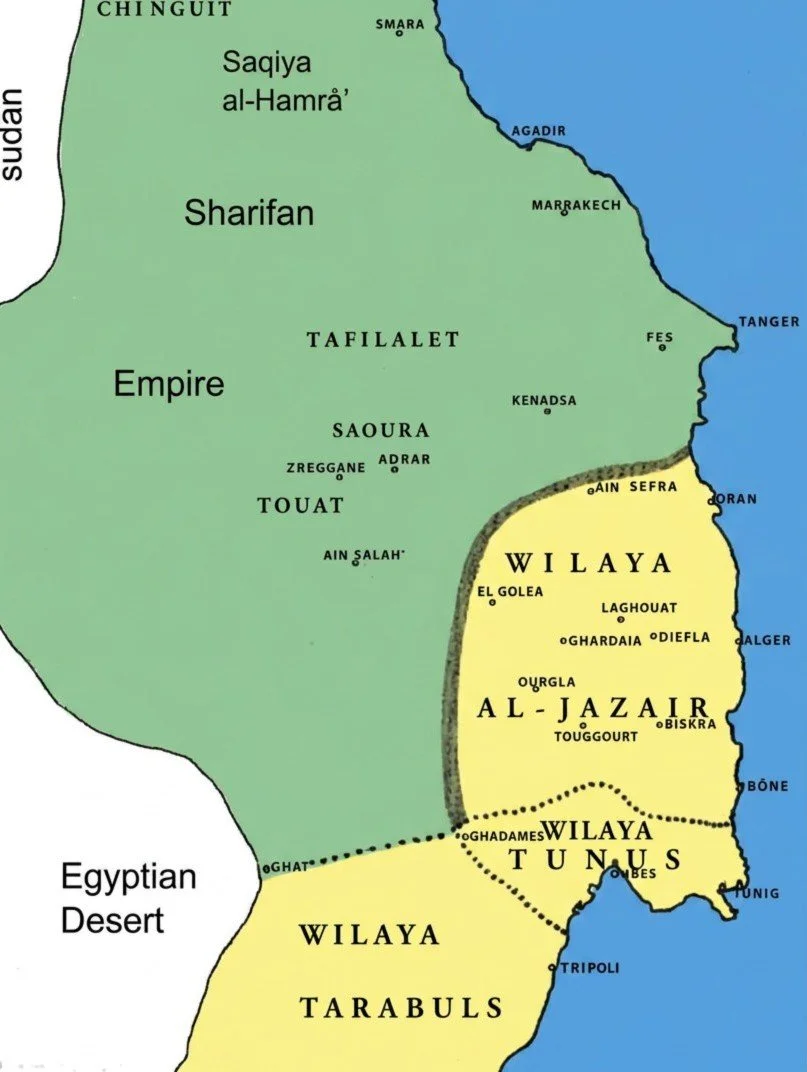
The Moroccan Sharifian Empire — As it viewed itself
Fez — where al-Tijānī spent his final nineteen years and died. ʿAyn Māḍī and Abī Samghūn — his birthplace and the site of the founding revelation, both within Moroccan sovereign territory.
The question of sharīfian descent from the Prophet ﷺ was, in the Morocco of al-Tijānī's time, never merely spiritual. It was institutional, documented, and administered. Every major zāwiya in the empire was led by a Sharīf whose genealogy had been verified by the naqīb al-ashrāf and confirmed by sultanic ẓahīr — Idrīsī Sharīfs overwhelmingly, with the Ḥusaynī lines holding their own specific territories. Abū al-ʿAbbās claimed descent from al-Ḥasan al-Sibt through Muḥammad al-Nafs al-Zakiyya — a noble and specific line — but Sulaymān al-Ḥawwāt, the naqīb al-ashrāf of Fez, never issued him a nasab ẓāhir, and no Alawite sultan ever confirmed his lineage through a ẓahīr. The institutional apparatus of Moroccan sharīfian recognition, in other words, never formally received him. His response to this silence was characteristically direct: he had asked the Prophet ﷺ himself, in full wakefulness, and received the answer anta waladī — you are my son — three times. For Abū al-ʿAbbās, that was the only document that mattered. For Fez, it was the only document that could not be filed.
His father, Muḥammad ibn al-Mukhtār, was by all accounts a God-fearing figure — a man who had communications with the world of spirits but preferred to keep his distance from their requests, directing them back toward the divine rather than entertaining their solicitations. His mother, ʿĀʾisha al-Sanūsī, bore several children of whom most did not survive. The future Hidden Pole memorized the Qurʾān before the age of seven under the tutelage of Muḥammad ibn Ḥammū al-Tijānī, a righteous teacher of the Nāfiʿ mode of recitation, and began his formal studies in Mālikī jurisprudence with local scholars of the oasis. In 1171/1756, when Abū al-ʿAbbās was twenty-one years old, both his parents died on the same day — taken by plague, buried together in ʿAyn Māḍī. He was an orphan. He was also, from that moment, entirely free to move.
2. The Moroccan Sufi Empire He Was Born Into
When Abū al-ʿAbbās left ʿAyn Māḍī for Fez in the years following his orphaning, he was not entering a spiritual marketplace open to new arrivals. He was entering a civilization that had already decided, over the course of a thousand years, what its spiritual architecture looked like — and that architecture was dense, hierarchical, and saturated with living presence. Every major city had its poles, every major zāwiya its documented Sharīf, every major ṭarīqa its established network of transmission reaching back through generations of verified masters. Morocco in the eighteenth century was not a world waiting to be transformed. It was a world that had already transformed itself, repeatedly, and knew it.
The Fez that Abū al-ʿAbbās first encountered was above all the city of al-Dabbāgh — or rather, the city still living in the aftermath of al-Dabbāgh. Sīdī ʿAbd al-ʿAzīz al-Dabbāgh, the ummī saint of Bāb al-Futūḥ who had died in 1131/1719, had reshaped what Fāsī scholars understood about the relationship between formal learning and direct prophetic inheritance. His Al-Ibrīz, recorded by his companion Aḥmad ibn al-Mubārak, remained the most provocative text in Fāsī spiritual culture — a direct challenge to the assumption that the highest knowledge required the highest formal training. Across the city, the Zāwiya al-Makhfiyya, led by Aḥmad ibn ʿAbd Allāh Maʿan al-Andalusī, carried this legacy forward at the height of its influence. The Dabbāghī phenomenon was not a historical memory in Fez that al-Tijānī encountered. It was the living standard against which every new spiritual claimant was measured.
Beyond Fez, the empire's spiritual geography was equally formidable. The Wazzāniyya held the Rīf with the quiet authority of an Idrīsī house whose baraka had been accumulating since the seventeenth century. The Nāṣiriyya of Tamgrūt — whose founder Muḥammad ibn Nāṣir had built the most important Saharan zāwiya in Moroccan history — continued to govern the spiritual life of the deep south, their network stretching from the Anti-Atlas across the Saharan trade routes that connected Sijilmāsa to Timbuktu and beyond. Marrakesh was full of saints. The pattern was consistent across every region of the empire: spiritual authority was Sharifian, documented, and Shādhilī in its ultimate genealogy. The empire did not merely tolerate this arrangement — it depended on it. The Alawite sultans were themselves Sharīfs, and their legitimacy was inseparable from the spiritual landscape they presided over.
What makes this landscape more complex — and more directly relevant to understanding Abū al-ʿAbbās al-Tijānī — is that the Ottoman Sufi world had already sent its tendrils into Fez before he arrived. The Khalwatiyya, the primary Ottoman spiritual instrument, had reached Morocco not through conquest but through the hajj and the rihla — the pilgrimage and scholarly journey that Moroccan intellectuals had always made eastward. Aḥmad al-Ṣiqillī, a Ḥusaynī Sharīf of Fez, had taken the Khalwatiyya directly from al-Ḥifnāwī himself — the master of Cairo whose student al-Kurdī would later become al-Tijānī's own primary master. Al-Ṣiqillī thus held a higher position in the very chain that Abū al-ʿAbbās would bring back from Egypt — and he was already in Fez, established and recognized, when the Hidden Pole arrived. More striking still, ʿAbd al-Wahhāb al-Tāzī — the spiritual milk-son of al-Dabbāgh himself, the most intimate heir of the great Fāsī ummī saint — had also met al-Ḥifnāwī in Cairo. The Ottoman Sufi network and the Moroccan one had already touched, already exchanged, already recognized each other across the Mediterranean before al-Tijānī made his eastern journey.
Morocco and the Ottoman world were, in every other sense, different civilizations. East of Morocco's borders, the empire of the Ottomans administered a vast Arabic-speaking world through Turkish institutional frameworks — and the Khalwatiyya was one of those frameworks, most of its masters Turkish or Turkicized, deployed deliberately to shape the spiritual life of Arab populations from Cairo to the Ḥijāz. The Naqshbandiyya served a similar function. Al-Sammān in Medina, caretaker of the Prophet's ﷺ grave, was Khalwatī. The great masters al-Tijānī sought in Egypt and the Ḥijāz were, without exception, operating within or adjacent to this Ottoman spiritual infrastructure. When Abū al-ʿAbbās crossed from Tlemcen eastward, he crossed from a sovereign Moroccan civilization into a world administered by a different empire — and the spiritual networks he encountered there were not politically innocent. They carried Ottoman weight whether their individual masters intended it or not.
What space, then, was available for a new path in this world? The answer the Tijāniyya eventually gave was precise and unexpected: not in Morocco, where every available spiritual position was already occupied by an established Sharīf with documents al-Tijānī did not have, but in the vast territories beyond Morocco where the empire's civilizational reach had prepared the ground without filling it. The Tijāniyya did not conquer the Sahel despite Morocco. It conquered the Sahel because of Morocco — because the networks, the axes, the genealogies, and the spiritual vocabulary it carried were recognizably Moroccan in a world that had been receiving Moroccan Islam for centuries. But that answer was still decades away when the young man from ʿAyn Māḍī first arrived in Fez, sat at the feet of its masters, and began the long search that would take him across two civilizations before he found what he was looking for in the silence of the Sahara.
3. The Journey: Two Worlds
The search began in Morocco and it began seriously. Al-Tijānī was not a young man dabbling in spiritual networks — he was a seeker of extraordinary intentionality who approached each master with specific questions and left when the answers ran out. In Wazzān he met Mawlāy al-Ṭayyib, the head of one of the most powerful Idrīsī houses in the country, who initiated him and authorized him to transmit — an authorization he never exercised, too absorbed in his own formation to play the role of master before he understood what mastery meant. He encountered ʿAbd Allāh ibn al-ʿArabī al-Andalusī, the head of the Zāwiya al-Makhfiyya, from whom he received no wird but whose parting words — spoken three times — carried the weight of a blessing that the tradition remembered long after the encounter itself was forgotten. He took the Nāṣiriyya from Muḥammad ibn ʿAbd Allāh al-Tūzānī, held it, and released it. He sat with Aḥmad al-Ṭawwāsh al-Ḥasanī of Tāza, who counselled khalwa and dhikr — conditions Abū al-ʿAbbās declined, already sensing that withdrawal from the world was not his path. And then, in the mountains east of Fez, he met a man of kashf — Muḥammad ibn al-Ḥasan al-Wanjālī — who looked at him and said, before a word had been exchanged: you will reach the maqām of Abū al-Ḥasan al-Shādhilī. He sent him home. The promise traveled with him.
Before the eastern journey and before Abī Samghūn, there was al-Bayyiḍ — a Saharan stopping point on the route south, within the civilizational orbit of Figuig, the Moroccan oasis town on the sultanate's eastern edge. Here Abū al-ʿAbbās spent years in retreat, and here the Moroccan Sufi world reached him through channels that most accounts of his life pass over in silence. From al-Ḥājj Faraj — a Tunisian intermediary carrying a Moroccan chain — he received the ijāza in the recitation of al-Fātiḥa through a transmission that ascended through Muḥammad al-Sharīf al-Mashraqī and Muḥammad al-Filālī to Muḥammad Muṣṭafā and ultimately to Shāmhārūsh — the king of the Muslim jinn of the Atlas, whose connection to the Filālī-Jazūlī spiritual network was well established in Moroccan esoteric tradition. From Muḥammad ibn Fāris al-Filālī he received the ijāza in the recitation of the basmalah, transmitted through Saʿīd Aḥasnal — the famous Atlas Sufi of the Jazūlī ṭarīqa. Both chains were Moroccan. Both were Filālī in origin. The deep Saharan retreat was not a withdrawal from the Moroccan spiritual world. It was the moment that world found him through its most ancient and interior channels — the same Jazūlī lineage that had shaped ʿAbda, the very region from which his grandfather al-Mukhtār had once migrated west to east.
Tlemcen was where the first signs appeared. Abū al-ʿAbbās settled there for an extended period of ascetic practice, teaching ḥadīth, engaging in Qurʾānic commentary, and pressing further into the interior life than any of his previous stations had allowed. It was here that the veils began to thin — that what the tradition calls the signs of spiritual upliftment became visible to those around him, and that the gifts of kashf began to manifest with a consistency that marked a genuine threshold. And it was here, in Tlemcen, before he had ever turned his face east, that the first great confirmation came — not from a living master, but from one of the supreme poles of the Moroccan Sufi tradition across the barrier of death. In a dream, Abū al-ʿAbbās saw Abū Madyan al-Ghawth presiding over a gathering, offering to fulfill the wish of whoever brought him something of value. He offered four mithqāls. His price: a guarantee of the supreme qutbāniyya. Abū Madyan accepted without hesitation — you will not die until you reach it. The dream might have remained a private consolation had it not been confirmed, independently and without any possibility of collusion, by a man who communicated with the spiritual world in wakefulness and had never met al-Tijānī and knew nothing of his dream. When asked to divine the concealed wish of this stranger, he answered: the qutbāniyya.
In 1186/1771 Abū al-ʿAbbās al-Tijānī crossed east — out of the Moroccan world and into the Ottoman one. The difference was immediately legible. Tlemcen, Tunisia, Egypt, the Ḥijāz: these were territories administered by a Turkish imperial power whose spiritual networks were instruments as much as they were inheritances. In Tunisia he met al-Ḥājj Faraj al-Tūnusī, who gave him permissions in the Dumyāṭiyya qaṣīda and the Asmāʾ al-Idrīsiyya. He spent a year moving between Tunis and Sousse, teaching al-Ḥikam al-ʿAṭāʾiyya, declining an offer from the ruler of Tunis — salary, accommodation, the Zaytūna mosque as a classroom — and boarding a ship for Egypt instead. In Cairo he found his primary master: Maḥmūd al-Kurdī, the leading figure of the Khalwatiyya in Egypt, who addressed him at their first meeting as a beloved of God in this world and the next, turned the question back to its source when asked how he knew, and over the following months gave him the full Khalwatī ijāza, the silsila, and the complete authorization to transmit — an authorization al-Tijānī initially declined and then accepted. Al-Kurdī recognized what he was receiving as much as what he was giving.
From Egypt Abū al-ʿAbbās traveled to the Ḥijāz, arriving in Mecca in 1187/1772. There he encountered Muḥammad ibn ʿAbd Allāh al-Hindī — a Naqshbandī shaykh of such interior intensity that he received no visitors, having taken a vow of concealment that excluded even his own children from his presence. Yet through a trusted intermediary he transmitted to Abū al-ʿAbbās something that went far beyond the conventional currency of Sufi exchange. What al-Hindī gave was not a silsila or a commentary or a set of litanies — it was knowledge of the rūḥāniyya: the science of the angelic and jinn hierarchies, the oaths and covenants that govern the hidden governors of the cosmos, the interior architecture of a world that operates beneath and within the visible one. This was the knowledge that the tradition of the Tijāniyya would later guard most carefully — the Asrār proper, the concealed dimension that sits beneath the wird and the waẓīfa and that the elite Tijānī companions would be consumed by. Al-Hindī also offered a seven-day practice that would have opened this world fully — on condition that whoever performed it withdraw permanently from ordinary society afterward. Abū al-ʿAbbās refused the condition. He took the secrets without the seclusion — a refusal entirely consistent with the prophetic instruction he would later receive at Abī Samghūn: no khalwa, no withdrawal, hold to the world while carrying what the world cannot see. Al-Hindī declared him his spiritual heir, foretold his station, and died before they could meet face to face.
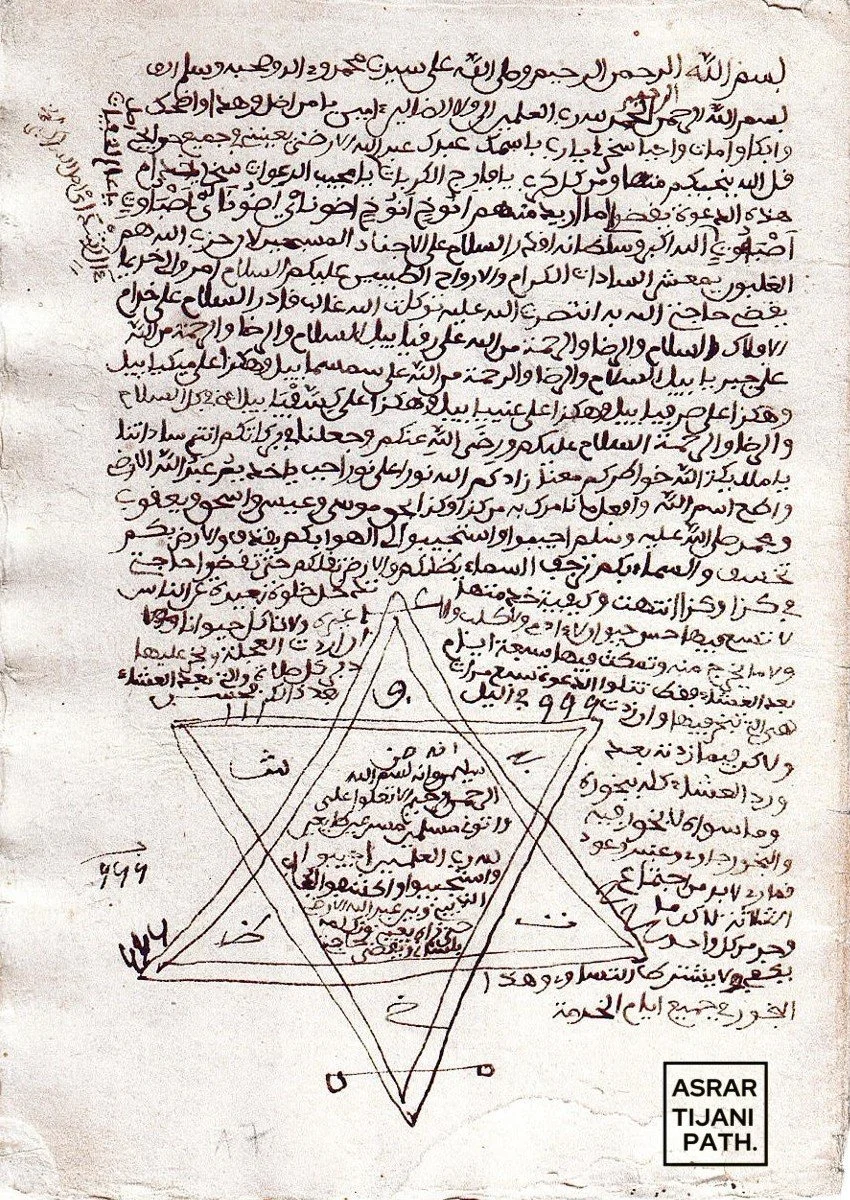
The Istikhdām of ʿAbd Allāh al-Jinnī
A page in the hand of Abū al-ʿAbbās al-Tijānī himself, from the collection of the Kunnāsh al-Maktūm, recording the istikhdām of ʿAbd Allāh al-Jinnī — the Muslim jinn-servant whose science was transmitted to al-Tijānī by Muḥammad ibn ʿAbd Allāh al-Hindī in Mecca. The six-pointed geometric seal bears inscribed divine names and the conditions of the invocation. One of the hidden sciences of the path, preserved in al-Tijānī's own script. The page features a six-pointed geometric seal with inscribed divine names and angelic hierarchies, surrounded by the ritual instructions and conditions of the invocation in Maghrebi script. Part of the Asrār of the Tijānī path — the hidden sciences transmitted only within the inner circle.
In Medina, Muḥammad ibn ʿAbd al-Karīm al-Sammān — Khalwatī, caretaker of the Holy Prophet's ﷺ grave, and founder of the Sammāniyya — received him with recognition that preceded any formal introduction. Al-Sammān was himself the product of multiple converging chains: Khalwatī through al-Bakrī, and Shādhilī through a lineage that connected him to the broader current of North African and Ḥijāzī Sufism that had been accumulating silsilas across the Ottoman world for generations. It was common practice in this milieu for masters to transmit not one chain but several — and al-Sammān gave Abū al-ʿAbbās precisely this: permissions in the Aḥzāb of al-Shādhilī, the Waẓīfa of Zarruq, the Dalāʾil al-Khayrāt, the Durr al-Aʿlā of Ibn ʿArabī, and the totality of the divine Names and Named Things across their various chains of transmission. He recognized him as the Dominant Pole and gave him the glad tidings of the Absolute Qutbāniyya. He requested three days of seclusion to complete the transmission — Abū al-ʿAbbās declined, for the same reason he had declined al-Hindī: he would not disappear from the human world to receive what was being offered. The Sammāniyya that al-Sammān founded would itself go on to become one of the dominant spiritual forces of the Nile Valley and Sudan — where it would later compete with the Mīrghaniyya for the same constituencies that the Tijāniyya was simultaneously claiming from the west. The eastern journey had delivered everything it could deliver. Abū al-ʿAbbās returned to the Moroccan world carrying more than he had taken.
What the tradition of the Tijāniyya prefers not to foreground — and what historical honesty requires stating plainly — is the chain that stands behind all of this. The primary line of transmission that shaped the interior architecture of what would become the Tijāniyya passed from Muṣṭafā al-Bakrī to Muḥammad al-Ḥifnāwī to Maḥmūd al-Kurdī to Abū al-ʿAbbās. Al-Bakrī was a Syrian master who had traveled to Egypt, Arabized the Khalwatī chain, and composed — among other works — Ṣalāt al-Fātiḥ: the prayer that the Prophet ﷺ would later give to Abū al-ʿAbbās as the central litany of the Tijāniyya, the prayer that today seals every royal ceremony in the Sharifian Kingdom, the prayer whose rewards the tradition declares beyond all measure. But to reduce the eastern journey to its silsila is to miss what was actually happening in the man who made it. Abū al-ʿAbbās al-Tijānī traveled east with an ambition that did not stay still. He had first sought the station of the Afrād — the Solitary Ones, holders of the keys of the treasures, whose rank stands above the Quṭb itself. Then, guided by the Abū Madyan dream and the confirmations that multiplied around him, he turned toward the Quṭbāniyya instead. Then the masters he met — al-Wanjālī in the mountains east of Fez, al-Hindī in Mecca — told him he would reach the maqām of Abū al-Ḥasan al-Shādhilī, the founder of the entire tradition within which every master he had ever met was operating. And beyond al-Shādhilī lay something that Ibn ʿArabī had claimed — the station of Khātim al-Awliyāʾ, the Seal of Sainthood, whose full and absolute manifestation Ibn ʿArabī had acknowledged was reserved for him. Each station absorbed the previous one. The ambition did not replace itself — it escalated.
Behind this escalation lay a civilizational logic that Morocco had already begun to articulate. Al-Ibrīz had upgraded Moroccan Sufi thinking a generation earlier: al-Dabbāgh's silsila passed through al-Khiḍr directly to the Prophet ﷺ, eliminating the chain of human masters and making the Muḥammadan presence the immediate source of spiritual authority. Moroccan Sufism became more Muḥammadan as a result. Abū al-ʿAbbās al-Tijānī went further — eliminating even al-Khiḍr, claiming the Prophet ﷺ alone as master, with no intermediary in the silsila whatsoever. The irony the Hidden Pole could not escape was structural: having eliminated every intermediary in the chain of transmission, he then installed two human intermediaries of his own — al-Damrāwī first, then Barrāda— not as masters in a silsila but as wāsiṭas, correspondents between himself and the Prophet ﷺ in the channel of ongoing communication. The silsila went directly to the Prophet ﷺ. The daily conversation with the Prophet ﷺ went through a human being. This was not contradiction. It was the inevitable consequence of the claim itself: if the Muḥammadan presence is constant and overwhelming — if direct prophetic communication generates a heat the body can barely sustain — then a buffer is not a concession. It is a necessity. The wāsiṭa is the price of the claim.
4. Abī Samghūn and the Fatḥ
The village of Abī Samghūn carries its own sacred geography before al-Tijānī arrived in it. Named after and consecrated by the presence of a great Moroccan pole whose baraka had already made the ground what it was, it sits in the Eastern Sahara — the same Moroccan civilizational world from which Abū al-ʿAbbās had come, a world his eastern journey had temporarily suspended but never replaced. When he returned to it he returned as a man who had crossed two civilizations, absorbed the Khalwatī secrets of Ottoman Egypt, the rūḥāniyya sciences of Naqshbandī Mecca, and the multi-silsila permissions of the caretaker of the Prophet's ﷺ grave in Medina — and found at the end of all of it that what had been promised since Tlemcen was waiting not in Cairo or the Ḥijāz but in a Saharan village already hallowed by a saint he had never met.
The road back from the east passed through Wajda (Oujda). It was here, on this road, that the first of the two great meetings of the final chapter of his life occurred — and it occurred in a manner that inverted every expectation of how a master finds a student. ʿAlī Ḥarāzim Barrāda — a Fāsī merchant of no formal scholarly training, named after the great Fāsī saint Sīdī ʿAlī ibn Ḥarāzim whose shrine outside Bāb al-Futūḥ neighboured that of Mawlāy ʿAbd al-ʿAzīz al-Dabbāgh — had seen a dream two years earlier that he had since forgotten, a dream that foretold this exact encounter. When the two men met on the road at Wajda, Abū al-ʿAbbās recognized ʿAlī Ḥarāzim before any introduction, described the forgotten dream back to its dreamer, and said: "Are you not afraid of Allah — you have exhausted me traveling from my place to you. I had no need but to meet you." The initiative had been entirely the Shaykh's. He had been moving toward Ḥarāzim before Ḥarāzim knew he was being sought. They continued together to Fez — Abū al-ʿAbbās had come to visit the shrine of Mawlāy Idrīs II, the Idrīsī patriarch at the heart of the city that would later become his final home — and there, in Fez, the Shaykh transmitted to Ḥarāzim the Khalwatī ṭarīqa and certain asrār and sciences, told him to hold to the covenant and love until the fatḥ came, and departed. He returned to Tlemcen. Then he departed for the Eastern Sahara in 1196/1781.
He settled at Abī Samghūn — but not before a journey to Tuwāt, the great Saharan oasis network to the south, where the Wazzāniyya had established a zāwiya presence. The same Idrīsī Shādhilī house whose master Mawlāy al-Ṭayyib had authorized him in his earliest Moroccan years had followed the Saharan trade routes into this desert world. He met some awliyāʾ in Tuwāt, exchanged asrār and sciences with them, and returned to Abī Samghūn to settle permanently. There he began building a house. The Prophet ﷺ — through al-Damrāwī, who would later carry the message — gave him a specific architectural command: "When you build the house, make in it a room and name it Bayt al-Sirr — the Room of the Secret — and make all your awrād, adhkār, and everything I have commanded you in it, and let no one enter it but you, and you will find all good and blessings and reach all your aims." The house became Dār al-Sirr — the House of the Secret. Its innermost room, divided by wooden panels, was where Abū al-ʿAbbās worshipped on one side and al-Damrāwī on the other — the most interior sacred space of the entire founding history of the Tijāniyya, carrying a name that would echo across centuries.
In Dār al-Sirr the fatḥ came. In 1196/1781 — yaqaẓatan lā manāman, in full wakefulness and not in dream — the Prophet ﷺ appeared to Abū al-ʿAbbās and spoke the words that founded a path. The command was total: no human master has any claim over you from all the shaykhs of the path — I am your intermediary and your support in truth — leave all the paths you have taken, all of them, entirely. And then the instruction that would become the defining characteristic of the Tijāniyya and the answer to every question about its difference from every other path: "Hold to this path without khalwa and without withdrawal from people, until you reach your promised station — as you are, without hardship, difficulty, or excessive striving." The wird was given: istighfār and Ṣalāt al-Fātiḥ — the prayer composed by Muṣṭafā al-Bakrī, now transmitted directly from the Prophet ﷺ as a divine gift rather than a human inheritance. This was the wird of the path from 1196/1781 until the turn of the century, when in Rajab 1200/1785 the Prophet ﷺ completed it by adding the haylala — lā ilāha illā Allāh — one hundred times. The architecture of the daily litany was now complete. The ṭarīqa was founded. It had no silsila but the Prophet ﷺ. It had no required retreat, no penances, no conditions of seclusion. The very instruction given at its founding — no khalwa, no withdrawal — was addressed to the followers who would come after, guaranteeing them a path designed for presence in the world rather than withdrawal from it. The great irony that the tradition prefers not to dwell on is that this instruction was delivered inside Dār al-Sirr, whose innermost room was a khalwa — and that the inner circle of the path, from al-Damrāwī to Ḥarāzim to Ibn al-Mishri, all practiced intensive khalwas under the Shaykh's direct guidance and correspondence.
After the fatḥ, Abū al-ʿAbbās traveled to Tāza. There he found Muḥammad ibn al-ʿArabī al-Tāzī al-Damrāwī — a young Sharīf of Idmār near Tāza, a man of extraordinary interior gifts who met the Prophet ﷺ in wakefulness up to twenty-four times in a single day, and whom the Prophet ﷺ had specifically commended to Abū al-ʿAbbās's care with the words "ḥaqq ʿalayya" — he has a claim upon me. Al-Damrāwī became the first wāsiṭa — the intermediary through whom Abū al-ʿAbbās formally addressed questions to the Prophet ﷺ that the overwhelming intimacy of direct encounter made difficult to voice. Ibn al-Mishri explains the logic with precision: the greatest of the Muḥammadan Afrād use intermediaries with the Prophet ﷺ not because their access is limited but because his presence is so overwhelming — so consuming in its beauty and light — that they forget themselves and all their requests entirely in the moment of encounter. The wāsiṭa held the question while Aḥmad was absorbed in the presence. Al-Damrāwī was escorted to ʿAyn Māḍī, settled there, and the two maintained an extraordinary correspondence across the Saharan distance during the periods of separation. He died at ʿAyn Māḍī — murdered, the sources record without elaboration — before Abū al-ʿAbbās departed for Fez. His grave at ʿAyn Māḍī became a place of visitation. The Prophet ﷺ had promised him. The path that forbade visiting the shrines of saints did not forbid visiting the shrine of its own first wāsiṭa.
It was only after al-Damrāwī's death — by prophetic command — that Ḥarazim was elevated to the role of second wāsiṭa. The man met on the road at Wajda, who had received the Khalwatī transmission in Fez years before the fatḥ, who had been told to hold to the covenant until the opening came — was now summoned to fill the vacancy left by a murder. His elevation was not the natural unfolding of an existing relationship. It was a replacement, sought deliberately, at the Prophet's ﷺ instruction, after a loss the tradition never fully mourned. What Ḥarazim became — the author of Jawāhir al-Maʿānī, the sole heir declared by the Shaykh, the institutional foundation of the Tijāniyya in Fez — was built on a foundation that began with a forgotten dream, a meeting on a road, and a vacancy that grief had opened.
5. Fez — Capital, Court, and the Limits of Conquest
When Abū al-ʿAbbās entered Fez on the sixth of Rabīʿ al-Thānī 1213/September 1796, he was sixty-one years old. He had been carrying the fatḥ for fourteen years. He arrived not as a fugitive or a petitioner but as a recognized Moroccan man of God — a Saharan sharīf whose ṭarīqa had already been spreading through the eastern Moroccan world for over a decade, whose companions included scholars and Sharīfs of standing, and whose reputation had preceded him to the city that had shaped him as a young man. He stayed first in the house of ʿAlī Ḥarazim Barrāda al-Fāsī — the merchant he had recognized on the road at Wajda twenty-two years earlier, whose forgotten dream he had narrated back to its dreamer, and who had been waiting since that encounter for the fatḥ that would give their meeting its meaning. Two months after his arrival, by prophetic command, al-Tijānī instructed his wāsiṭa to begin composing Jawāhir al-Maʿānī — but only after first ordering the destruction of all the notes the khalīfa had collected, a jalālī act of spiritual severity that the companions resisted, some managing to preserve fragments that would later be recovered. The book was completed in al-Tijānī's lifetime, authorized by the Prophet ﷺ himself in Ḥarazim's account — "it is my book and I composed it" — and destined to become the most widely read Sufi text of sub-Saharan Africa. The book that would travel furthest from Fez was written in Fez, in the first months of the Shaykh's residence, by a man named after the saint buried outside Bāb al-Futūḥ.
The city Abū al-ʿAbbās entered was not the stable imperial capital that a straightforward account of his reception might suggest. The Morocco of Mawlāy Sulaymān's reign was a civilization under sustained assault from multiple directions simultaneously. The plague of 1213/1798 — arriving just two years after al-Tijānī — decimated the Makhzan's army and its intelligentsia, depopulated the Atlantic coastal provinces, left villages without inhabitants and grain standing unharvested in fields with no one to cut it. Repeated famines followed. The Berber confederations of the Middle Atlas pressed the plains with a consistency that Mawlāy Sulaymān's weakened army could not match. The Atlantic trade was contested not only politically but legally — Fāsī scholars consuming months of jurisprudential energy debating whether imported European sugar was contaminated with lard in the Christian refining process and therefore ḥarām, dividing jurists, generating competing fatwās, occupying the same learned city that was simultaneously receiving a man claiming to be the cosmological seal of all sainthood from Adam to the Day of Resurrection. Fez in al-Tijānī's time was a city where plague and famine and the question of whether the sugar in a merchant's tea was permissible coexisted with the most audacious spiritual claims in the history of Islamic mysticism. The mundane and the sublime pressed against each other in the streets of the same city with a density that made every spiritual claim immediately political and every legal debate immediately existential.
The sultan who received him was one of the most complex figures in Moroccan history. Mawlāy Sulaymān offered Abū al-ʿAbbās Dār al-Mirāya — the House of the Mirror, located in Zuqāq Rawāḥ in the Qarawiyyīn quarter, in the heart of the very neighborhood whose great madrasa housed the scholars who would debate his legitimacy — not a palace but a decent Fāsī house of the kind Mawlāy Sulaymān routinely extended to distinguished guests of the realm. Al-Tijānī initially declined — something in the offer troubled him — and accepted only after the Prophet ﷺ confirmed it in his account, on the condition that he give the equivalent of the rent in bread to the poor every day until his death. He did so without interruption for nineteen years. When Mawlāy Sulaymān sent two purses of a thousand riyāls each for the construction of the zāwiya, al-Tijānī returned them — not as ingratitude but as a deliberate statement about the nature of his relationship with political authority. He then accepted after Mawlāy Sulaymān's insistence and distributed the money to the poor. The zāwiya was built through other means, slowly, and remained unfinished when he died. This sequence — the return of the money, the bread given daily in lieu of rent, the unfinished building — was not incidental. It was al-Tijānī maintaining independence from sultanic patronage in a city where every Sufi institution was defined by its relationship to political authority. He would live inside Mawlāy Sulaymān's hospitality without becoming its creation.
The Sultan's relationship with al-Tijānī was genuine and contested simultaneously. He took the wird. He received an encounter with the Muḥammadan presence through the secret of Jawharāt al-Kamāl that al-Tijānī prepared for him with prophetic instruction — fainting at the intensity of the light that filled the prepared space, being revived by the Shaykh's palm on his chest, hearing the Prophet's ﷺ guarantee for his affairs in this world and the next. He corresponded with al-Tijānī, who transmitted prophetic instructions about the wird and the Ḥizb Sayfī in a letter that reads as a document of genuine spiritual relationship. Ṣalāt al-Fātiḥ has been recited at royal ceremonies in the Sharifian Kingdom ever since. And yet Mawlāy Sulaymān's deepest ideological commitments ran in a different direction. Like his father Sīdī Muḥammad ibn ʿAbd Allāh before him, he had corresponded with the first Saudi house when they entered Mecca — and Moroccans were the only people the Wahhābī-Saudi movement permitted to perform the Ḥajj, a diplomatic alignment that signals ideological proximity. His closest chronicler, Abū al-Qāsim al-Zayyānī — notoriously anti-Sufi in his own orientation — narrated the sultan's secret acceptance of the Wahhābī daʿwa. The man who received al-Tijānī in Fez was in secret sympathy with the movement that was at that very moment demolishing Sufi shrines across the Ḥijāz — including sites the Hidden Pole had visited on his eastern journey. These two commitments were not theologically reconcilable. They were politically reconcilable — because Mawlāy Sulaymān found in the Tijāniyya a Sufism structurally compatible with his anti-popular Sufism program. The prohibition on visiting saints' shrines — the clause that made al-Tijānī most unpopular in Fez — was the clause that made him most compatible with Mawlāy Sulaymān's religious policy. The sultan who was fighting the zawāya lords found in the man from ʿAyn Māḍī a Muḥammadan Sufism he could respect, politically use, and perhaps personally need.
The inner circle that gathered around the stranger in Fez was remarkable in its composition. ʿAlī Ḥarazim who would compose Jawāhir al-Maʿānī, be declared the absolute spiritual heir, and die buried alive near the Prophet's ﷺ city in Badr after reciting the Ism al-Aʿẓam within one station of the Prophetic presence. Muḥammad ibn al-Mishri — the faithful Algerian recorder of Rawḍ al-Muḥibb, who served as al-Tijānī's personal imām in prayer until a painful crisis of correspondence between companions led to separation and a journey of reconciliation that ended in death at ʿAyn Māḍī in 1224/1809. Maḥmūd al-Tūnisī — who came seeking the science of alchemy, was rebuked and sent away, returned divested of every worldly attachment, entered a fourteen-year khalwa at the site of al-Damrāwī's juniper tree near Mostaganem, inherited some of al-Tijānī's asrār at the moment of the Shaykh's death, and died himself one month and eighteen days later, buried at Bāb al-Futūḥ. Muḥammad ibn Abī al-Naṣr al-ʿAlawī — an Alawite sharīf of Sijilmāsa origin — who never missed a single obligatory prayer behind al-Tijānī for sixteen years, and became after Ḥarazim's departure the primary spiritual axis of the ṭarīqa's Fāsī presence. Al-Ṭayyib al-Ṣufyānī — an Idrīsī sharīf, long devoted to the Wazzāniyya, converted by reading Jawāhir al-Maʿānī in Egypt on the way to Ḥajj, author of al-Ifāda al-Ahmadiyya whose some sayings are inscribed on the marble facing the door of the zāwiya. Muḥammad al-Ghālī Abū Ṭālib — the Fāsī Idrīsī sharīf, grandson of Sīdī ʿAlī Abū Ghālib whose shrine stood at Bāb al-Futūḥ, who led the second funeral prayer over al-Tijānī and then chose Medina over the city that had never fully received his master — the man through whom the path would reach West Africa. Aḥmad al-Banānī — the most intellectually scholar of the circle, who had refused to visit al-Tijānī out of scholarly pride, was finally persuaded by al-Ṣufyānī, and left the encounter saying he had heard one sentence he would not exchange for the earth filled with gold — buried at Bāb al-Futūḥ, in the same quarter as Maḥmūd al-Tūnisī.
Among this circle, the Prophet ﷺ had guaranteed the grand opening — the fatḥ al-akbar — to ten companions specifically. Their composition is a precise map of the Tijāniyya's civilizational geography. Muḥammad ibn Abī al-Naṣr al-ʿAlawī, placing Mawlāy Sulaymān's own dynastic house inside the innermost prophetically guaranteed circle. Abū Yaʿzā Barrāda — son of Ḥarazim, carrying the Barrāda family's connection to both the great khalīfa and the Bāb al-Futūḥ sacred geography into the next generation. Al-Ḥājj ʿAbd al-Raḥmān Barrāda — a man al-Tijānī addressed exclusively with the title of Sayidī, one of the nine of the protective circle. Al-Ḥājj ʿAbd al-Wahhāb ibn al-Aḥmar — who never slept again after al-Tijānī's death until his own, buried at Bāb al-Futūḥ alongside Maḥmūd al-Tūnisī and Aḥmad al-Banānī. Mūsā ibn Maʿzūz — a man of explicit kashf. Muḥammad al-Ghālī — the axis of the global expansion. Muḥammad ibn Aḥmad al-Jabbārī — the royal court's own judge among the ten, the most institutionally distinguished of the Fāsī companions. Al-Damrāwī. Ḥarazim. Ibn al-Mishri. Eight of the ten were Fāsī. The city that never institutionally received al-Tijānī produced the majority of the companions whose spiritual realization was prophetically guaranteed. Fez resisted the path as an institution. It produced its most realized members as individuals.
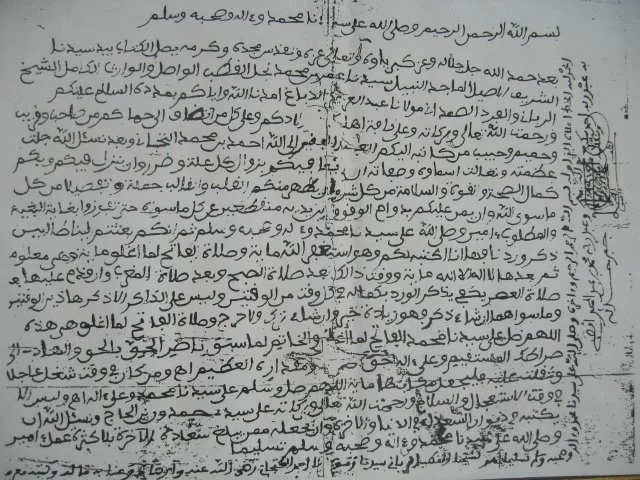
The Letter of Shaykh al-Tijānī to Sīdī ʿUmar al-Dabbāgh
A rare autograph letter from al-Tijānī to al-Dabbāgh, transmitting the Tijānī wird and closing with a supplication for the poet Ḥamdūḥ ibn al-Ḥājj — one of the few surviving holograph documents of the Fāsī chapter.
The protective circle that the Prophet ﷺ commanded in the Mashāhid of Ḥarazim's private diary reveals something the surface courtesy of the Fāsī chapter conceals — that the relationship with political authority required constant spiritual calibration and that beneath the hospitality of Dār al-Mirāya ran an undercurrent of genuine political anxiety. The Prophet ﷺ instructed Abū al-ʿAbbās to assemble nine specific companions, each reciting a designated litany, to form a spiritual shield against any aggression Mawlāy Sulaymān might direct toward him. Ibn al-Mishri recited Ḥizb al-Sayfī seven times between night and day. Al-ʿAbbās al-Sharqāwī recited Bismillāh alladhī lā yaḍurru... five hundred times morning and evening. ʿUmar ibn Idrīs al-Dabbāgh — the descendant of Mawlāy ʿAbd al-ʿAzīz al-Dabbāgh, appointed by Mawlāy Sulaymān himself as imām and khaṭīb of the Mosque of al-Dīwān where al-Tijānī held his collective waẓīfa — recited Ḥasbunā Allāhu wa-niʿma al-Wakīl ten thousand times morning and evening, the most intensive formula of the nine. Abū Masʿūd recited Lā ḥawla wa-lā quwwata illā billāh five hundred times alongside Āyat al-Kursī one hundred times. Abū Ḥafṣ ibn ʿAbd al-Raḥmān recited Yā Ḥafīẓ yā Manīʿ yā Laṭīf five hundred times. Abū Samāḥa recited Yā Laṭīf a thousand times. ʿAbd al-Wāḥid Abū Ghālib recited Jawharāt al-Kamāl one hundred times daily. ʿAlī Āmillās recited Āyat al-Kursī fifty times alongside an extended formula morning and evening. ʿAbd al-Raḥmān Barrāda recited the long supplication of Iḥtajabtu bi-nūr wajh Allāh... twenty-one times morning and evening. And Abū al-ʿAbbās al-Tijānī himself recited Ḥizb al-Baḥr of al-Shādhilī alongside all nine — the man who had told Fez that all paths would eventually be absorbed into the Shādhilī current except his, protecting himself with the greatest litany that current had produced.
The litanies were not enough. When the zāwiya walls rose, al-Tijānī had the Supreme Name engraved on a stone and buried in its foundation — "protect my companions from Qāf to Qāf" sealed inside forever. ʿUmar al-Dabbāgh was among the handful present. Al-Tijānī had written to him with full genealogical honor — preserved in his own handwriting, "the noble Sharīf, the grandson of the great pole and celebrated ghawth, our master ʿAbd al-ʿAzīz al-Dabbāgh" — is one of the most intimate letters of the Fāsī chapter, transmitting the wird with full instructions and closing with a specific prayer for the poet Ḥamdūh ibn al-Ḥājj — ʿUmar’s father-in-law, embedding the descendant of al-Dabbāgh within the literary and scholarly elite of Fez through a family connection al-Tijānī himself acknowledged and blessed. Warm in address, identical in terms. The method sharpened when a Nāṣirī disciple came hesitating out of fear of Ibn Nāṣir's authority — the man in question was Muḥammad ibn Aḥmad al-Sanūsī, a scholar of distinction, khaṭīb and teacher at the Idrīsī Shrine, a man of the first rank in ḥadīth — and al-Tijānī told him plainly: "if Ibn Nāṣir were here and I told him to step back, he would have no choice."
The Fāsī scholarly establishment resisted the Tijāniyya on grounds that were epistemologically coherent and institutionally consistent. The Jawāhir problem was real and acknowledged within the tradition itself — al-ʿArabī ibn al-Sāyiḥ, its most careful later consolidator, declined to rely on al-Ifāda al-Aḥmadiyya except where independently corroborated, and the structural parallels between Jawāhir al-Maʿānī and the biographical literature of the Zāwiya al-Makhfiyya — the very institution whose tradition had formed Fāsī spiritual culture before al-Tijānī's arrival — were known to the companions themselves. Ḥarazim's initial compositions had been burned on al-Tijānī's orders before prophetic authorization came. These were not polemical objections from hostile outsiders. They were the natural response of a scholarly culture trained in precisely the kind of discriminative epistemological reasoning that the Tijānī corpus demanded and complicated. Beyond the textual questions, the cosmological claims pressed against every boundary that al-Qarawiyyīn had defined as inviolable — the legal equivalence of al-Tijānī's companions with the Ṣaḥāba, the daily prophetic presence at the Jawharāt al-Kamāl, the assertion that opposing al-Tijānī led to hell. Al-Ḥawwāt never verified the sharīfian genealogy. Al-Ṣiqillī — who occupied a higher position in the very Khalwatī chain al-Tijānī had brought from Egypt — was already present and recognized. The city had not been waiting for the Tijāniyya. It had its own versions of everything the Tijāniyya offered, documented, verified, and institutionally embedded.
What makes the Fāsī chapter analytically complex is that al-Tijānī did not simply receive this resistance — he returned it, constructing his own deliberate distance from the city's religious infrastructure while simultaneously contesting its authority on its own scholarly terrain. The sharpest moment of that contest came in Mawlāy Sulaymān's own gathering, where al-Ṭayyib ibn Kīrān — shaykh al-jamāʿa, the most authoritative religious voice in Fez — was holding the floor on Qurʾānic exegesis when the sultan invited al-Tijānī to respond. What followed was not a refusal of debate but a decisive entry into it — al-Tijānī dismantling Ibn Kīrān's interpretation before the assembled court with transmitted and rational proofs until every dissenting voice fell silent, telling Ibn Kīrān directly: "the argument is not with you — you are only carrying what others loaded on you." The sultan's verdict was unambiguous: "in the outward sciences you know his standing — in the inward sciences he is their source." Ibn Kīrān left carrying a grievance that would later erupt. But the withdrawal from Fez's sacred spaces was equally deliberate and operated in a different register entirely.
Beyond the scholarly contest lay a more intimate form of refusal. When al-Ṭayyib al-Ṣufyānī reported that three hundred women spent Laylat al-Qadr inside al-Qarawiyyīn bringing the soiled garments of nursing infants, al-Tijānī declared the mosque dishonored and suspended prayer there for four months — returning only when the governor ordered its physical renewal, and even then only to Friday prayer on his own terms. On the twenty-seventh of Ramaḍān, when every mosque in Fez blazed with celebration, he ordered the zāwiya's lamps extinguished, its doors locked, and the key brought to him personally. He stood at his door waiting until he had it. The city's religious life continued around him. He had chosen not to participate in it. This double movement — winning the scholarly debate at the sultan's court while withdrawing from the city's liturgical spaces — was not inconsistency. It was the precise logic of a path that engaged Fez's intellectual tradition on its own terms while refusing to be absorbed into its institutional forms.
The political crisis of Mawlāy Sulaymān's reign placed al-Tijānī in a position from which there was no neutral exit. The Fez rebellion of 1235-1237/1819-1821 — in which Mawlāy Ibrāhīm ibn al-Yazīd was proclaimed counter-sultan with the support of the Darqāwiyya, the Wazzāniyya, and the Fāsī merchant elite — forced every spiritual figure in the city to declare a position. Al-Tijānī sided with Mawlāy Sulaymān. When Amhawish's forces camped outside Fez, a Saharan figure named Abū Yaʿazzā al-Barbarī entered the city seeking a saint of God, found his way to al-Tijānī's residence, received the wird, and watched the Shaykh turn toward the direction of the enemy forces, stretch out his hand, and blow. The forces of Amhawish collapsed in confusion the following morning — their defeat arrived at the precise moment of al-Tijānī's gesture. The Tijāniyya was not politically neutral in Fez. It was the spiritual arm of Alawite legitimacy against the maraboutic-mercantile alliance. The enemies this generated were structural and would outlast al-Tijānī himself.
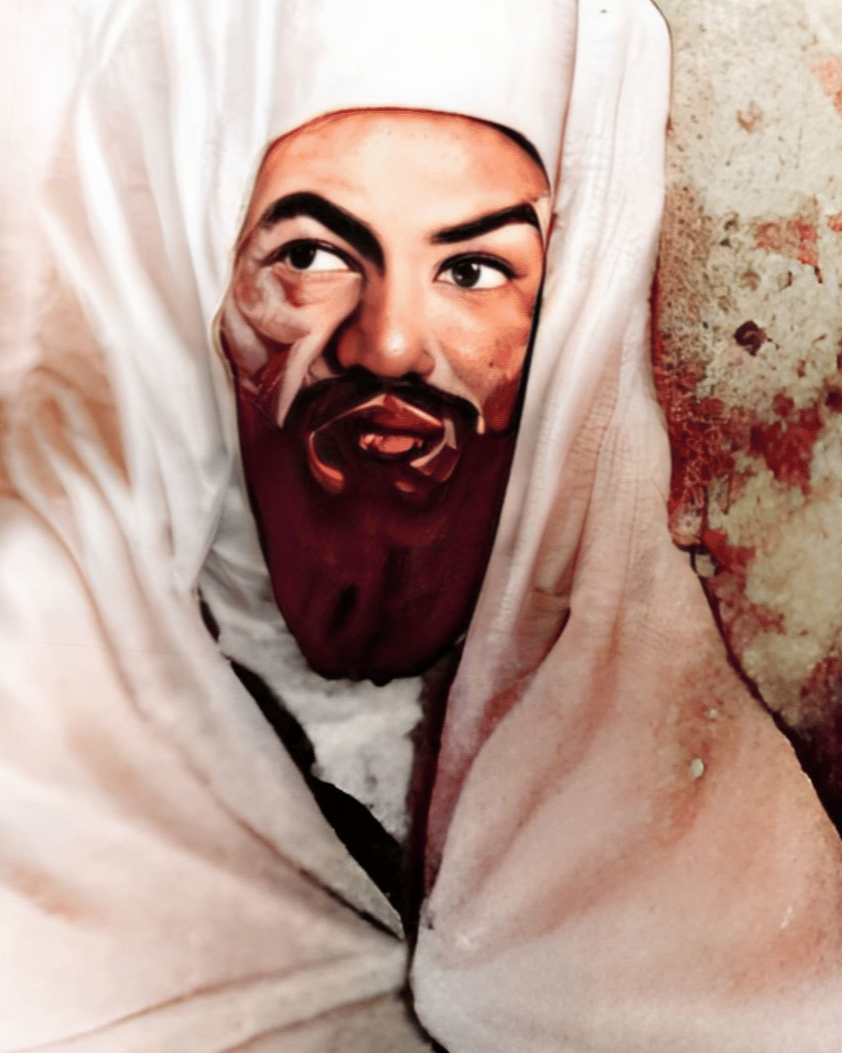
Sultan Mawlāy Sulaymān (r. 1206–1238/1792–1822)
A colorized portrait of Mawlāy Sulaymān, Alawite Sultan of Morocco, depicted in white Sharifian robes and turban. It was Mawlāy Sulaymān who received al-Tijānī in Fez, provided Dār al-Mirāya, took the Tijānī wird, and fainted at the Muḥammadan light — while simultaneously corresponding with the first Saudi house and pursuing a program of religious reform that made him the most theologically complex sultan in Alawite history.
The contrast with the Darqāwiyya — al-Tijānī's exact contemporary, born the same generation, rooted in the same Shādhilī civilization — is the sharpest lens through which to read the limits of the Tijānī political position. While al-Tijānī held his waẓīfa in borrowed mosques in Fez, Shaykh al-ʿArabī al-Darqāwī was moving — through the Rīf, through the Atlantic cities, through today’s western Algeria. When the Karāghlī revolution brought the scholars of Tlemcen, Wahrān, and Mustaghanam to the door of the Sharifian empire seeking incorporation, Mawlāy Sulaymān sent al-Darqāwī to pacify them — and al-Darqāwī joined the revolution instead, delivering a collective bayʿa from the major cities of western Algeria to the Moroccan throne. The empire was being offered its eastern extension on a plate. Mawlāy Sulaymān refused it — imprisoned al-Darqāwī, returned the Tlemcenis, and chose doctrinal propriety over territorial expansion. Within a generation the Ottomans collapsed in the Mediterranean, France seized Algiers in 1246/1830, and ʿAbd al-Qādir took up the resistance that Mawlāy Sulaymān had declined to lead — before handing the French his sword, accepting their money, and spending the rest of his life in Damascus on a French pension. The sultan who had accepted the Wahhābī daʿwa in secret and allied with al-Qarawiyyīn's most conservative voices — scholars who refused quarantine in plague-struck ports, who prioritized juridical conservatism over institutional adaptation — had simultaneously missed the last strategic opportunity to extend the Sharifian empire before European colonialism arrived to close that door permanently. Al-Tijānī had been in Tlemcen when its scholars resisted him and moved to the Sahara. He had watched the Darqāwiyya do politically in Tlemcen and Wahrān what his path never attempted in the Sharifian sultanate. The path that would conquer fifty million souls in Western Africa could not conquer the city where it was founded — and the destiny who kept its founder bound to that city presided over an empire that was already contracting toward its colonial horizon.
The stations came in the years of the Fāsī chapter with a quiet regularity that belied the turbulence surrounding them. The quṭbāniyya on 12 Muḥarram 1214/16 June 1799. The khatmiyya, days later. The katmiyya, on 18 Ṣafar 1214/22 July 1799. Each station arrived in Fez like a declaration addressed to the city's spiritual establishment — and each was received with the same combination of private acknowledgment and public silence that had characterized the relationship from the beginning. The inner circle knew. Lallā Mannāna al-Misbāḥiyya knew. Mawlāy Sulaymān knew. The scholars of al-Qarawiyyīn continued their debates about sugar and quarantine and the Mukhtasar of Khalīl. And Abū al-ʿAbbās continued holding the waẓīfa in borrowed mosques — the Mosque of al-Dīwān where ʿUmar al-Dabbāgh led the prayer, Bāb al-Jīsa, the courtyard outside Dār al-Mirāya in the shadow of al-Qarawiyyīn itself — giving bread to the poor in lieu of rent every day for nineteen years, watching the zāwiya remain incomplete, carrying the claim of the supreme pole of all creation in a city he had never chosen.
Fez never made permanent institutional room for Abū al-ʿAbbās. But it never let him go either. In the last years of his life he had prepared to leave for Syria — bags packed, companions devastated, the departure imminent — when the Holy Prophet ﷺ informed him that the saints of Morocco had interceded for his remaining among them, and the permission to leave was withdrawn. The civilization he claimed to seal had kept him in its capital through the intercession of its own saints. In his darker moments, when the city's indifference pressed hardest, he would say: "Were it not for the fear of God, I would call down against the saints of the Maghrib" — for it was they who had bound him to a city that resisted him for nineteen years. The ten guaranteed the grand opening were overwhelmingly Fāsī. The nine of the protective circle were the city's own scholars and Sharīfs standing guard over the man whose claims most challenged everything the city stood for. And when the political protection ended — when Mawlāy Sulaymān's reign collapsed under plague, famine, Berber insurgency, and the Fāsī rebellion — the children were expelled from Dār al-Mirāya, the zāwiya stood unfinished, and the most realized companions scattered: Ḥarazim to Badr, al-Ghālī to Medina, al-Tūnisī to his grave at Bāb al-Futūḥ. The city exhaled. And the path conquered a continent.
6. The Path, the Doctrine, and the Living Tradition
The Tijānī path rests on a cosmological claim so total that its own primary source handles it with deliberate ambiguity. Jawāhir al-Maʿānī wa-Bulūgh al-Amānī fī Fayḍ Abī al-ʿAbbās al-Tijānī was composed by Ḥarazim, and modeled architecturally on al-Maqṣad al-Aḥmad fī al-Taʿrīf bi-Sayyidinā Ibn ʿAbd Allāh Aḥmad —ʿAbd al-Salām ibn al-Ṭayyib al-Qādirī's biography of Aḥmad ibn ʿAbd Allāh al-Andalusī al-Fāsī, head of al-Makhfiyya zāwiya — whose grandson ʿAbd Allāh ibn al-ʿArabī the young al-Tijānī had sat with during his first Fāsī period, and whose institution's biographical architecture Ḥarazim would later appropriate for the canonical text of the tradition that came to supersede it. The core text of the new path was built on the biographical model of the tradition it was replacing, in the same city, a few streets from its zāwiya. Yet this text does not explicitly assert the khatmiyya, the station of the Seal of Muḥammadan Sainthood— it buries a single word in its title that announces what it will not say: fayḍ, the Plotinian overflow, the necessary cosmic intermediary, the source through whom all divine emanation reaches creation from the origin of the world to the blowing of the trumpet. The title of Ibn al-Mishri's al-Jāmiʿ li-Durar al-ʿUlūm al-Fāʾiḍa min Biḥār al-Quṭb al-Maktūm confirms in its title alone what Jawāhir withholds: the Hidden Pole, the Sealed Isthmus. The Mashāhid records it directly. The path whose founder denied having written anything, whose greatest text was ordered destroyed before prophetic authorization, whose canonical source maintains deliberate silence on its most explosive claim — is built entirely on that claim. The khatmiyya is the foundation that Jawāhir will not name and that every other source cannot stop naming.
The intellectual genealogy of the khatmiyya, runs through the deepest channels of Islamic metaphysics — al-Ḥakīm al-Tirmidhī (d. 320/905), who first theorized the Seal of Saints in Khātim al-Awliyāʾ as the one upon whom the leadership of the saints is incumbent, whose intercession all saints need as prophets need the Prophet ﷺ; Ibn ʿArabī (d. 636/1221), who claimed the station in ʿAnqāʾ Maghrib and the Futūḥāt; al-Shaʿrānī (d. 905/1490), who stated in Durar al-Ghawwāṣ that Islam has two comprehensive Seals, one for the elite sainthood and one for the common, every wali receiving only through these two. Al-Tijānī stood at the end of this genealogy and claimed its most complete expression — "the absolute, full appearance in the maqām of the khatmiyya" — in the formulation of Sukayraj, who spent years demonstrating it was not a claim of uniqueness but of degree. The Plotinian architecture of emanation — fayḍ flowing from the Divine through the Muḥammadan Reality to the natures of the Prophets to al-Tijānī's nature and from him to all creation — is present throughout al-Jawāhir without being named. Al-Fārābī's cosmic intellect, Ibn ʿArabī's Perfect Man, the Neoplatonic chain of being — all are operative in the structure of the Barzakh al-Barāzikh, the Isthmus of all Isthmuses, the station al-Tijānī claimed as his own and his alone.
The stations arrived sequentially, each more total than the last. The Quṭbāniyya — reached through two rakʿāt with Āyat al-Kursī, a specific prayer al-Tijānī is reported to have made before the station arrived: "O God, do not take my soul until You make me reach the ultimate Poleship of Sīdī such and such..." — naming more than fifty poles of the Salaf, asking for the poleship of every pole from the Prophet ﷺ to the blowing of the trumpet, asking that all poles, solitaries, ghawths, and viceregents dissolve before him. The Khatmiyya followed days later. The Katmiyya, the station of the Concealed Sainthood, on 18 Ṣafar 1214/22 July 1799. Each station in Fez. Each arrived in the city that resisted him. Al-Tijānī mixed in his maqām what had never been combined before — the stations of the Afrād and the Ghawth simultaneously, the solitary and the succoring pole in one person, a combination the tradition had no precedent for and no framework to evaluate.
The Tijānī wird is the most precisely calibrated spiritual instrument in the history of Moroccan Sufism. Given by the Prophet ﷺ in three stages — istighfār one hundred times, Ṣalāt al-Fātiḥ one hundred times, haylala one hundred times, morning and evening — it contains within the Ṣalāt al-Fātiḥ a claim that saturates the entire devotional economy of the path. Ṣalāt al-Fātiḥ — "O God, bless our master Muḥammad, the Opener of what was closed, the Seal of what came before, the Helper of truth with truth, and the Guide to Your straight path" — was composed by al-Bakrī, transmitted through al-Ḥifnāwī and al-Kurdī, and received by al-Tijānī with the prophetic guarantee that a single recitation equals every dhikr uttered by every creature from the origin of creation to the Day of Judgment — plus six hundred thousand times the reward of every dhikr said by every person who has ever existed. When recited with the intention of the Ism al-Aʿẓam — the Greatest Name of Allah — the rewards multiply beyond calculable measure. The Fātiḥa itself, recited with this intention, contains a separate and equally extraordinary scale of reward. Jawharāt al-Kamāl — recited one hundred times daily by ʿAbd al-Wāḥid Abū Ghālib in the protective circle — is the most esoteric of the three litanies: the Prophet ﷺ and the four rightly-guided caliphs present at every recitation, a claim that places every gathering of Jawharāt al-Kamāl in direct prophetic proximity.
The merits promised to those who love al-Tijānī and follow his path constitute the most comprehensive spiritual guarantee in the Sufi tradition — and the most legally precise. Whoever receives the wird, enters Paradise without reckoning and without punishment, together with his children, his wives, his wife's parents, and his descendants. The guarantee extends even to those who never received the wird but loved al-Tijānī — the Prophet ﷺ informed him that everyone who loves him is a beloved friend of the Prophet ﷺ and will not die until he becomes a saint. A companion who had killed seventy souls and repented would not be consumed by hellfire. The cord of connection was personal, immediate, and unconditional in its scope — "Your paupers are my paupers, your students are my students, your companions are my companions, everyone who receives your litany is emancipated from the Fire of Hell." The legal equivalence of al-Tijānī's companions with the Ṣaḥāba — stated by the Prophet ﷺ in wakefulness — is the most epistemologically explosive claim in the tradition: "Tell your companions: do not offend me by offending one another" — the same words the Prophet ﷺ had used for his own Companions. Whoever offends a Tijānī companion offends the Prophet ﷺ.
The hierarchy of promised reward was structured in three levels — the close, the intermediate, and the distant — all within the prophetic guarantee of salvation. The intermediate level was the rank of the muqaddams. The close level was subject to a warning: "If you contradict me in a single passing thought, you will die a disbeliever." Most extraordinarily, al-Tijānī stated that the greatest poles of Islam assembled together would not equal the weight of a hair from the ocean of a single companion of his — and that one such companion had appeared, or would appear, born of a Fāsī father and Fāsī mother. Whether this companion has appeared or not remains unknown. His identity was concealed by al-Tijānī himself, carried in silence by the greatest pole of his age, and has never been established.
The conditions of the path generated more opposition in Morocco than any theological claim. Three pillars: commitment to the wird until death, commitment to the path until death, and non-visitation of living or dead saints. The third condition — the prohibition on visiting saints' shrines — was not a peripheral rule but a structural consequence of the cosmological claim. If al-Tijānī was the Barzakh of all Barāzikhs, the channel through which all fayḍ flows, the one through whom every wali from Adam to the Day of Resurrection receives — then visiting another wali for spiritual benefit was not merely redundant but a form of metaphysical infidelity. The Prophet ﷺ himself had told al-Tijānī's companions directly: "No creature among the shaykhs of the paths has any benefit to bestow upon you, for I am your intermediary and your supporter in actual fact." In Morocco — where Mawlāy Idrīs II was the civic heart of Fāsī identity, where the shrine of Ibn Mashīsh was the patron saint of Moroccan Sufism, where the entire civilizational structure of baraka ran through shrine visitation and hereditary saintly genealogy — this condition was not a spiritual inconvenience. It was an amputation. A Moroccan Tijānī could not visit Mawlāy Idrīs II. He could not go to Mawlāy ʿAbd al-Salām ibn Mashīsh. He could not enter the shrines that constituted his civilization's founding geography. No other Sufi path had ever asked this of its Moroccan followers. None ever would.
The angelic economy surrounding the recitation of the wird is equally staggering in its scale. Every time al-Tijānī himself recalled any dhikr, seventy thousand angels joined him in the recitation, each angel's dhikr worth seven thousand words, each word worth ten deeds. Seventy thousand angels associate with every companion of al-Tijānī from the moment of initiation until death, without interruption. Whoever recites Ṣalāt al-Fātiḥ once is freed from hellfire, his sins forgiven even if he were a hundred thousand years old; and the full bounty reserved for its reciters was so vast that al-Tijānī said: "If I were to express what Allah has bestowed upon me and my companions of the bounty of Ṣalāt al-Fātiḥ, the great gnostics would be unanimous in having me killed." Jawharāt al-Kamāl recited twelve times with the gift-intention to the Prophet ﷺ is equivalent to visiting him in his noble tomb and visiting every saint from the beginning of existence to the present — which is precisely why Ḥarazim identified it as the theological reason for the prohibition on shrine visitation: the path already contains within its daily litanies what every saint's shrine might offer, and infinitely more. One trillion students — men, women, and jinn — are destined to reach the most sublime gnosis through al-Tijānī's hands by the Day of Judgment. The path that the greatest poles would have wept to possess if they had known what it contains — "Our Lord, You have given us nothing" — was given freely, without conditions of khalwa or withdrawal, to anyone who asked
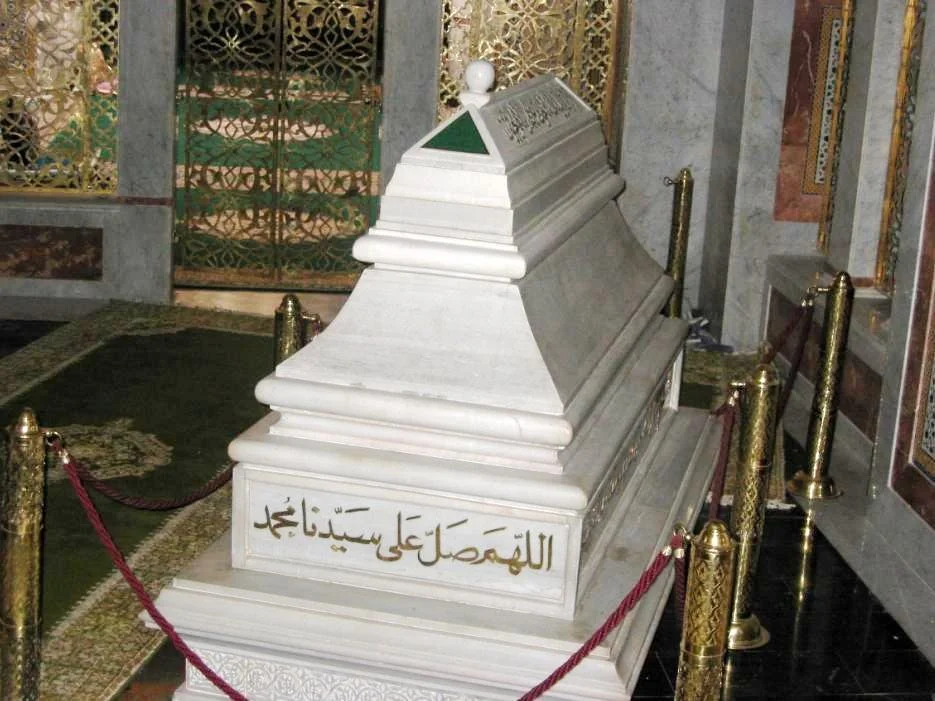
Figure 4. Shrine of Aḥmad al-Tijānī in Fez—a sultan-like resting place marked by serene grandeur. The elevated, tiered marble tomb rises with balanced symmetry, evoking both authority and spiritual stillness. Inscribed upon the structure is the formula of Ṣalāt al-Fātiḥ, regarded as the backbone of Tijānī litanies, integrating the devotional identity of the order into the very architecture of the shrine.
The institutional architecture al-Tijānī built to transmit the path was the most carefully calibrated in Moroccan Sufi history. At the apex stood al-Tijānī himself — the only living authority, the only living shaykh, a principle that extended beyond his death in the form of the prohibition on claiming mashyakha after him: "whoever claims authority after my passing is a liar." Below him were khalīfas — companions of the highest spiritual realization, entrusted with transmitting the full tarbiya. Below them were muqaddams with graded permissions: some could transmit only the obligatory wird, some could transmit the asrār, some were limited to three muqaddams beneath them, some had unlimited authorization. The graduated system was designed to prevent dilution — the spiritual quality of transmission was meant to be maintained through chains of verified authorization rather than the hereditary baraka networks that characterized popular saint veneration. The sources of the primary literature are themselves a reflection of this architecture: Jawāhir al-Maʿānī (Ḥarazim), Rawḍ al-Muḥibb (Ibn al-Mishri), al-Jāmiʿ (Ibn al-Mishri), Risālat al-Faḍl wa-l-Imtinān (Ḥarazim), Rimāḥ Ḥizb al-Raḥīm (al-Fūtī), Bughyat al-Mustafīd (al-ʿArabī ibn al-Sāyiḥ), Kashf al-Ḥijāb (Sukayraj) — each generation consolidating, expanding, and in some cases correcting the transmission. Al-ʿArabī ibn al-Sāyiḥ's critical distance from the Ifāda al-Aḥmadiyya is the most important internal corrective in the literature — a muqaddam applying discriminative scholarship to his own tradition's sources.
The Mashāhid of Ḥarazim's private diary — the Kunnāsh al-Maktūm — is not a chronicle of events but a cosmological register. Organized into four chapters, it records the rewards and angelic systems reserved for those who recite the Supreme Name, the Fātiḥa, the Qurʾān, and Ṣalāt al-Fātiḥ — each structured across three ascending levels: the outer rank (ẓāhira), the inner rank (bāṭina), and the innermost of the inner (bāṭin al-bāṭin). The rewards of the Supreme Name recited with the intention of the Fātiḥa, the angelic hierarchies that serve the reciter of Ṣalāt al-Fātiḥ, the divine visions (al-Mashāhid) that open to the one who approaches the Fātiḥa through the intention of the Ism al-Aʿẓam — these are its primary subjects. It also records the stations as they arrived — quṭbāniyya, khatmiyya, katmiyya— in the voice of direct prophetic announcement rather than the mediated transmission of al-Jawāhir. It records al-Tijānī's habitual seat beside the Column of Gold, where the Supreme Name was buried, where companions after his death reported seeing him sitting in vision. The Kunnāsh of al-ʿIrāqī — a twentieth-century muqaddam of the Fāsī zāwiya — transmits the inner oral tradition of the zāwiya's custodians across the gap between the companions' generation and the modern period, including the body theft and the incorrupt body, the rebuilding of ʿAyn Māḍī, the vision of the three tents. Together these documents constitute a stratum of the tradition's self-knowledge that is distinct from its public literature and more revealing of what the companions actually understood themselves to be living through.
Al-Tijānī's claims about the Muḥammadan Sciences place the entire architecture of Islamic learning in a new hierarchy. The 111 Muḥammadan Sciences — each containing 111,000 units, each unit containing 111,000 sub-sciences — were never fully possessed by any saint. Ibn Mashīsh, al-Jīlānī, and Ibn ʿArabī possessed seventy-two each. Abū al-Ḥasan al-Shādhilī possessed seventy-one. Al-Tijānī requested from the Prophet ﷺ all 111 and was guaranteed them. The numerical significance of 111 in the science of ʿilm al-ḥurūf — the numerical value of the word Quṭb — is not accidental. The claim is not merely one of spiritual superiority but of a qualitatively different relationship to the Muḥammadan Reality itself: "Allah has never revealed to a prophet or a saint the interiors and secrets and obscures and sciences of these characters except to the Chieftain of the Universe and me alone." Abū Yazīd al-Bisṭāmī had searched for the Muḥammadan Reality and found a thousand veils of light between himself and it, each one capable of burning him. Al-Tijānī claimed to have passed through all of them — not by his own spiritual effort but by prophetic gift, in wakefulness not in sleep.
The claims al-Tijānī made in Fez — the sword hanging over the sky, the partition between heaven and hell, the feet on the necks of every saint from Adam to the trumpet — were not made from a position of institutional triumph. They were made from a borrowed house in the Qarawiyyīn quarter, by a man whose zāwiya was unfinished, whose genealogy was unverified, whose followers in the city that mattered most to him numbered in the dozens rather than the thousands, whose relationship with the sultan in Morocco was warm but never formally committed, and whose greatest companions were — with few exceptions — not Fāsī scholars of standing but merchants, sharīfs from the Saharan network, and men who had come to him from outside Fez. The cosmological maximalism of the claims — I am what ʿAlī was, I am the partition, whoever hates me enters hell — is most legible not as arrogance but as compensation: the architecture of a man who had conquered the invisible hierarchy of sainthood while failing to conquer the visible one. He named al-Jīlānī, al-Shādhilī, Ibn Mashīsh when speaking of the great poles — not to claim superiority over them for himself but to position his companions above them. The inversion is precise and psychologically revealing. He could not place himself above Ibn Mashīsh in a city that venerated Ibn Mashīsh as the patron of all Moroccan Sufism. But he could place his anonymous Fāsī companions above him — and by implication, place himself above the question entirely. The man who sought the maqām of al-Shādhilī arrived at something he claimed was beyond it, in a city that received al-Shādhilī's legacy as its own founding spiritual inheritance, and spent nineteen years watching that city decline to acknowledge what he had become.
The three journeys al-Tijānī made back to the Sahara after settling in Fez are among the most telling biographical details in the tradition. Having claimed the supreme pole of all creation, the man who never visited another Moroccan city after settling in Fez made three separate returns to the eastern Saharan world he came from. He never went to Marrakesh. He never went to Meknès. He never went to Taza or Tanja or any of the urban centers of the civilization he was claiming to seal. His axis was vertical — Fez and the Sahara — and the Sahara kept pulling. The Saharan temper is not a romantic category. It is a civilizational formation: the man of the desert does not negotiate with walls, does not accumulate slowly, does not build institutional patience. He arrives with the totality of what he carries and expects recognition or moves on. Al-Tijānī could not move on — Mawlāy Idrīs II had interceded to keep him. But the psychology of arrival never left him. The sword hanging over the sky is not a Fāsī image. It is a Saharan one — the absolute gesture, the unmediated claim, the refusal to soften the hierarchy into something the city could manage. He was eighty years old and preparing to leave the city because Fez had never given him what the desert had given him without asking: the simple fact of being received.
7. Death, Departure, and the Global Paradox
He died as he had lived — without announcement. On the morning of Thursday 17 Shawwāl 1230/22 September 1815, after the dawn prayer, he lay on his right side, called for water, drank, and did not rise again. He was eighty years old. The city turned out in numbers that overwhelmed the streets — scholars, notables, the poor, amirs, and the skeptical alike. The sources confirm that those who had spent years opposing him came to his funeral alongside those who had given everything for him. Mawlāy Sulaymān was in Marrakesh. The funeral prayer was led at al-Qarawiyyīn by Muḥammad ibn Ibrāhīm al-Dukkālī. The bier was broken into pieces afterward, kept for baraka. He was buried in the unfinished zāwiya, under the spot where the grapevine had stood on the ruined site he had bought against the city's resistance fifteen years before.
The zāwiya he left behind had its own history before he arrived and its own future after he died. Before a single stone was laid on the ruined site in Ḥawmat al-Dardās, the majdhūb Sīdī al-Luhbī would press his ear to the door of the empty ruin and tell passersby to stop — he heard dhikr inside. Al-Tijānī bought the site with his own lawful money from the descendants of the Agumī family, against the active resistance of the Fāsī establishment, overridden only by Mawlāy Sulaymān's forced intervention. The Supreme Name was buried in the Column of Gold. The prohibition on burial inside was sealed in marble. Al-Tijānī declared the prayer within it unconditionally accepted. He died before it was complete. What followed across two centuries of Alawite patronage — continuous renovation, expansion, royal maintenance — produced the third great religious infrastructure of Fez after al-Qarawiyyīn and the shrine of Mawlāy Idrīs II. Grand, maintained, honored in Sharifian state ceremony — Ṣalāt al-Fātiḥ, sealing every royal religious appearance. And largely empty. Its pilgrims come from Senegal, Nigeria, Sudan, and Mali, filling it with languages al-Tijānī never spoke. The city around it does not come.
The man al-Tijānī had chosen to manage what came after was not a Fāsī scholar. He was a Saharan— Abū al-Ḥasan ʿAlī ibn ʿĪsā al-Tamāsinī, from Tamāsīn in al-Jarīd, described by Sukayraj in Kashf al-Ḥijāb as the pole of his age and the carrier of the Tijānī tarbiya after the founder's death. His station in al-Tijānī's lifetime was singular and publicly demonstrated. When he visited Fez, al-Tijānī placed him as imām for the congregational prayer at the zāwiya — a Saharan put above the assembled Fāsī scholarly elite without explanation or apology. When al-Ṣufyānī suggested he could substitute for al-Tamāsinī in writing a ruqya for a sick servant, al-Tijānī refused repeatedly: "where is the like of Sīdī al-Ḥājj ʿAlī?" He had traveled to Fez by khaṭwa — spiritual traversal of distance — until al-Tijānī forbade it and told him to come only as ordinary people come, on foot, with companions, experiencing thirst and exhaustion on the road. He did not act without prophetic permission — he would not rise from his bed until the Prophet ﷺ instructed him. He was the axis around which the post-death Tijāniyya turned.
Al-Tijānī had instructed al-Tamāsinī before his death to take his children — Muḥammad al-Kabīr and Muḥammad al-Ḥabīb — along with their mothers Mubāraka and Mabruka, and the entire household, to ʿAyn Māḍī, and not leave them in Fez. When he died, the children refused to leave. Al-Tamāsinī departed for Tamāsīn without them. What followed was a political sequence that had nothing to do with the Tijānī family's wishes. Mawlāy Ibrāhīm ibn Sulaymān — a prince of the Alawite dynasty, saw Muḥammad al-Kabīr riding his mule through the streets of Fez and asked to borrow it. When the request was declined, he wrote to his father the sultan in Marrakesh on a matter of state: Dār al-Mirāya, a house belonging to the Makhzan, was occupied by the family of the late al-Tijānī. The family appeared to be preparing to leave. What was to be done with the house once they vacated it? The sultan — who had himself taken the wird, who had fainted at the Muḥammadan light in al-Tijānī's presence, who had corresponded with him about the Ḥizb Sayfī — ordered the house returned to the Alawite family. The order arrived on ʿĪd al-Aḍḥā. The family was to leave that day. They moved their belongings to the zāwiya, which could not contain them, and things were lost in the confusion. Humiliated and dispossessed on a feast day, they wrote to al-Tamāsinī.
He returned to Fez — and found the matter disputed at the highest level. The Fāsī fuqarāʾ brought the case before Mawlāy Sulaymān himself, arguing that the children had been born in Fez, had grown up in Fez, and that Fez was their home. Al-Tamāsinī argued from al-Tijānī's own words: their roots and their spiritual sustenance were not in this city but in the Sahara — "My children belong only in the Sahara, they will flourish and live there." Mawlāy Sulaymān ruled in al-Tamāsinī's favor, on condition the children consented. A reconciliation followed between al-Tamāsinī and the Fāsī companions. The fuqarāʾ withdrew their opposition. Al-Tamāsinī prepared the departure. The children consented. Every eye wept. Every heart burned. The fuqarāʾ of Fez were astonished — they had considered the departure of the Shaykh's children from the city an impossibility. It happened anyway.
The last night before their departure, the children asked to be left alone at the zāwiya — to bid their father farewell, or so the companions believed. What happened inside that night is recorded in the Kunnāsh of Idrīs al-ʿIrāqī. One man did not sleep, watching from above what was being prepared below. A wooden box was constructed. The body was exhumed from its fresh grave, unwrapped, examined. It was incorrupt — nothing had changed from crown to sole, light and fragrance filling the space. The children had intended to take their father to ʿAyn Māḍī — back to the Sahara he had always said his children belonged to, back to the land where al-Damrāwī was buried and the fatḥ had come. They had said nothing to the Fāsī companions. They had waited for the night. They had prepared the box. Al-Ṣufyānī and Mūsā ibn Maʿzūz intervened. Al-Ghālī — who had led the second funeral prayer fulfilling the prophecy, who had argued for leaving the body where it lay — prevailed. The body stayed. The children left for ʿAyn Māḍī in the morning. Fez held what it had never fully received.
The political frame that had sustained the Fāsī chapter dissolved at the same time. Mawlāy Ibrāhīm died in the catastrophic Mahalla against the Sharrādiyya zāwiya. Mawlāy Sulaymān abdicated in favor of his nephew Mawlāy ʿAbd al-Raḥmān ibn Hishām — leaving behind a testament of extraordinary desolation, comparing himself to Sulaymān ibn ʿAbd al-Malik choosing ʿUmar ibn ʿAbd al-ʿAzīz, admitting recurring illness, disillusionment, and the exhaustion of a man who had tried to govern an empire through piety alone and watched it contract around him. The sultan died broken, having been captured twice in his tent, his army decimated by plague, his city in rebellion, his program of religious reform rejected by the very scholars he had trained. He died in 1238/1822 — the year al-Tamāsinī finally brought the children to the Sahara. The two events were not unrelated. The sultanate that had protected the path lost its architect. The path lost its political shelter. France had seized Algiers in 1246/1830, opening the long colonial conquest that would consume the entire African continent within a generation. Morocco itself lost approximately seventy percent of its imperial territory over the course of the nineteenth century — the eastern Sahara, the western Sahara, Mauritania, the Moroccan Sudan, and the vast hinterland that Mawlāy Sulaymān had refused to defend when the Darqāwī moment in western Algeria offered it to the Sharifian throne. The world al-Tijānī had come from was being dismantled by the same civilization whose sugar the Fāsī scholars had debated whether to drink. The nephew who inherited the throne lost the Battle of Isly in 1260/1844 and signed the Treaty of Lalla Maghnia, surrendering to France the eastern Saharan territories where the fatḥ had come, where al-Damrāwī was buried, where ʿAyn Māḍī stood. Al-Tijānī had said it before any of this happened: my children belong only in the Sahara. Within a year of his death it was so. Within a generation the Sahara itself was gone.
In this contracting world, the Shaykh's sons did not survive long. Muḥammad al-Kabīr, taken to Tamāsīn and bound to the Tamāsinī family by the structural bond al-Tamāsinī had forged, was killed directly by Ottoman forces. Muḥammad al-Ḥabīb died in ʿAyn Māḍī — pressed by the Ottomans from the east, and by ʿAbd al-Qādir, the Algerian chieftain who had fought the French only to surrender to them in 1264/1847, and betray the Moroccan sultan who had backed him at the cost of the Battle of Isly and the Treaty of Lalla Maghnia. Before his capitulation, this same man had entered ʿAyn Māḍī with troops — pressing the founder's family in the very birthplace of the path that his own Darqāwī lineage claimed to supersede.
When al-Ḥabīb died, al-Ḥājj ʿAbd al-Wahhāb ibn al-Aḥmar arrived suddenly at ʿAyn Māḍī and led the funeral prayer, presiding over the burial of the founder's last son in the Saharan dust. The founder's grandson, ʿAmmār ibn al-Ḥabīb, married a French woman — daughter of a French lieutenant — in what appeared to be a calculated political arrangement. ʿUmar al-Fūtī's jihād state was by then threatening French colonial interests across the Sahel, and the marriage guaranteed a kind of protection, or surveillance, over the Tijānī bloodline at its Saharan source. She bore him children. The Tijānī lineage passed through this union. The marriages to the Tamāsinī family continued across generations, cementing what al-Tamāsinī had built — the Saharan pole's descendants becoming the custodians of the founder's blood and the living transmission of the path simultaneously.
The path moved south and east through channels that Morocco had been building for a millennium. The Almoravids had carried Mālikī Islam across the Sahara into the Sahel. The Saadians had destroyed the Songhay empire in 988/1589 and planted Moroccan authority in Timbuktu, leaving behind a Moroccan scholarly and spiritual presence that never fully withdrew. The Alawite sultans had maintained correspondence, trade, and religious networks with the Bornū sultanate, the Kunta scholars of Timbuktu, and the Shinqīṭī intellectual tradition of Mauritania for generations before al-Tijānī was born. West African scholars had been traveling to Fez for centuries — entering the circles of Sufis, studying at al-Qarawiyyīn. The Tijāniyya did not create this infrastructure. It activated it. When al-Ghālī transmitted the wird to ʿUmar al-Fūtī in Medina — a West African scholar of Kuntiyya formation, himself heir to the Timbuktu scholarly tradition that Moroccan imperial power had shaped, who had come east for the Ḥajj — a Moroccan spiritual inheritance found its continental instrument. The jihād states, the literacy movements, the transformation of Islam across the Sahel — all passed through a Fāsī Idrīsī Sharīf in exile, transmitted in the Prophet's ﷺ city, activated across the Bornū-Songhay-Shinqīṭī world by men who had never set foot in Fez but were carrying its inheritance without knowing it. Ibrāhīm Niasse (d. 1390/1975) — the second great wave, proliferating the path through Nigeria and beyond — multiplied its reach and its internal fractures simultaneously. Today the Tijāniyya is the largest organized Sufi presence in sub-Saharan Africa — disorganized, contested, exploited in places by those who traffic in false claims of spiritual station and extract money from suffering populations, alive and expanding everywhere. The Morocco-Algeria political rupture has become a Tijānī institutional war. The children of al-Tijānī are split between Fez, ʿAyn Māḍī, and Dakar. The path that was structured under al-Tijānī with khalīfas, graded muqaddams, and carefully calibrated permissions for transmitting the wird and the asrār now moves through networks that bear little resemblance to what he built.
He had come to Fez carrying the most audacious claim in the history of Moroccan Sufism — the Seal of Muḥammadan Sainthood, the Barzakh of all Barāzikhs, the pole whose feet rested on the necks of every walī from Adam to the Day of Resurrection. The city received him in a borrowed house, held him for nineteen years, and kept him when he tried to leave — the saints of Morocco interceding with the Prophet ﷺ for his remaining among them. Yet the civilization that kept him gave him something no other Sufi after Ibn Mashīsh had achieved in Morocco — a permanent and distinguished presence in the sacred geography of the country that produced him. He had always sought the maqām of Abū al-Ḥasan al-Shādhilī in society — the urban, sober, scholarly Sufism of the elite, separated from popular saint veneration, free from ecstatic movements, grounded in knowledge and tarbiya. He achieved it. The Tijāniyya in Morocco and the Maghreb is precisely that — urban, scholarly, orthodox in its visitation, distinguished from the shrine economies it prohibits its followers from entering. The shrine of al-ʿArabī ibn al-Sāyiḥ in Rabat — the capital — became the second great Tijānī attraction in Morocco after the zāwiya in Fez, drawing pilgrims in an orthodox register that al-Tijānī himself would have recognized. The African pilgrimage to Fez continues — tens of millions following a path transmitted through Medina and the Sahara, returning to a city that never fully received their founder and cannot contain what he left behind. The zāwiya stands as the third great religious monument of Fez — after the mosque that boycotted him and the shrine whose visitation he prohibited. In Sufi history he stands as the second most important figure Morocco produced after Mawlāy ʿAbd al-Salām ibn Mashīsh. The city does not enter. The world does. And the path endures.
Conclusion: The Last Flowering
Al-Tijānī did not know he was the last. No founding figure ever does. But the tradition that produced him — the thousand-year Moroccan Sufi civilization that the Idrīsīds had planted, the Almoravids had carried across the Sahara, the Almohads had systematized, the Marīnids had institutionalized in stone, al-Jazūlī had politicized, al-Dabbāgh had elevated to direct prophetic transmission, and the Shādhilī network had woven into the daily life of every city from Fez to Timbuktu — produced in him its most total and most audacious expression, and then stopped. After al-Tijānī no new founding figure of comparable stature emerged from Morocco. The colonial reorganization of the nineteenth century did not merely interrupt the tradition. It closed the conditions under which that kind of production was possible — the free movement between Fez and the Sahara and the East, the Moroccan imperial presence in the Sahel, the living connection between the urban scholarly elite and the Saharan spiritual networks, the political space in which a man from ʿAyn Māḍī could arrive in Fez and spend nineteen years making the most radical claim in the history of Islamic mysticism while the sultan took his wird and the scholars debated his genealogy. That world ended. It ended with the French seizure of Algiers in 1246/1830, with the Battle of Isly in 1260/1844, with the Treaty of Lalla Maghnia that surrendered the eastern Sahara — the world al-Tijānī had come from — to a colonial power that had no interest in what it contained.
What the tradition said at its end was not a summary. It was an escalation. The Seal of Muḥammadan Sainthood. The Barzakh of all Barāzikhs. The feet on the necks. The sword over the sky. The partition between heaven and hell. The most extreme claims of the entire tradition — claims that Ibn ʿArabī had approached and retracted, that al-Jazūlī had circled without fully stating, that al-Dabbāgh had gestured toward through the ummī model of direct prophetic transmission — were stated plainly, in wakefulness not in sleep, in a borrowed house in the Qarawiyyīn quarter, by a man who had come from the Sahara and could not get the city to fully receive him. Civilizations announce their completion the way individuals do — by saying everything at once, at the end, with an intensity that only makes sense if nothing comes after. Al-Tijānī sensed this, perhaps. He sought the maqām of al-Shādhilī in society and claimed to have exceeded it. He sought to leave for al-Shām at eighty. He said his children belonged only in the Sahara. He watched his zāwiya remain unfinished. He knew, at some level, that Fez was the end of something — not because the city was declining, but because everything the tradition had been building toward had arrived in him, and the city had nowhere to put it.
The path he left behind is the most globally proliferated expression of Moroccan Sufism in history — and the least present in Morocco itself. The civilization that produced it practices it in modest numbers. The world that received it through Medina and the Sahara carries it across a continent. Fifty million in the Sahel. Fifty thousand in Morocco. The zāwiya stands as the third great religious monument of Fez — renovated by kings, honored in royal ceremony, largely empty on ordinary days. Its founder sought to leave. His children were expelled. His body almost stolen. His path conquered a continent through a chain that bypassed the city entirely. And Ṣalāt al-Fātiḥ — the prayer composed in Mecca, transmitted through Cairo, received in the Sahara, carried to Fez, given to a sultan who fainted at its light — closes every royal religious ceremony of the Sharifian Kingdom to this day. The last saint of a thousand-year tradition left a prayer in the city that resisted him. The prayer stayed. Everything else moved.