
The Ribaṭs of Morocco: An Idrisīd Phenomenon
The history of ribāṭs in Morocco has long been framed through analytical lenses that obscure rather than illuminate their true origins, functions, and historical depth. Modern scholarship has often treated ribāṭs as derivative phenomena, whether as precursors to Sufi orders, military outposts of reformist movements, or juridical institutions shaped by Mālikī orthodoxy. Such readings are largely retrospective, projecting later institutional realities backward onto earlier periods and thereby flattening the complex processes through which Islamic authority first took shape in the western Islamic world. The result is a persistent misunderstanding of ribāṭs as secondary or transitional formations, rather than as foundational structures that predate and condition later developments in Moroccan religious, political, and social life.
This article advances a different thesis: that ribāṭs constitute the earliest form of institutional Islam in Morocco, emerging organically from the collapse of centralized authority following the Idrīsī moment and responding to local conditions of dispersal, instability, and territorial fragmentation. Far from being marginal or exceptional, ribāṭs provided the primary infrastructure through which Islamic norms, practices, and authority were sustained across the countryside at a time when neither the state nor urban institutions could reliably fulfill that role. They were not designed as fortresses, monasteries, or legal schools, but as sites of stationed presence where legitimacy was exercised through continuity, service, and moral vigilance.
At the core of this argument lies a methodological reversal. Instead of beginning with later institutions—mosques, madrasas, Sufi ṭarīqas, or dynastic states—and asking how ribāṭs fit within them, this study begins with ribāṭs themselves and examines how subsequent institutions entered a landscape already structured by their logic. Ribāṭs did not emerge to support Mālikī jurisprudence, dynastic authority, or organized Sufism; rather, these later formations adapted ribāṭ grammar to their own needs. Understanding Moroccan Islamic history therefore requires abandoning teleological narratives that move inexorably toward legalism or formalized mysticism, and instead attending to the spatial, functional, and relational foundations laid by ribāṭ networks.
The analytical framework adopted here combines Qurʾānic semantics, linguistic analysis, spatial geography, and network theory. Ribāṭ is first examined as a Qurʾānic and linguistic concept denoting disciplined stationing and moral endurance, rather than as an architectural or institutional form. This semantic foundation clarifies why ribāṭs initially appear in rural and liminal spaces, where ethical presence substitutes for absent authority. From there, the study traces how ribāṭs emerge historically in response to political rupture, how they multiply through proximity rather than hierarchy, and how they connect individuals and regions long before the introduction of formal Sufi orders or centralized administration.
Central to this inquiry is the recognition that Moroccan ribāṭs operated as networks rather than isolated sites. Their authority depended not on exclusivity or formal membership, but on circulation, recognition, and redundancy. Saints moved between ribāṭs, knowledge traveled along corridors of proximity, and legitimacy was reinforced through repeated presence across multiple localities. This horizontal configuration produced a resilient religious ecology capable of surviving dynastic collapse, doctrinal conflict, and political appropriation. It also explains why later attempts to institutionalize or monopolize religious authority—whether through Mālikī rābiṭas, Almoravid militarization, or Almohad ideology—could never fully displace ribāṭ logic.
By restoring ribāṭs to their proper historical and conceptual place, this article seeks to reframe Moroccan Islamic history around continuity rather than rupture, presence rather than abstraction, and territory rather than hierarchy. Ribāṭs are shown to be neither primitive precursors nor marginal survivals, but the deep structural layer upon which later religious, political, and Sufi institutions were built. In doing so, the study offers a new lens through which to understand not only the origins of Moroccan Islam, but the enduring patterns of authority, sanctity, and resilience that continue to shape it.
1. The Qurʾānic Concept of Ribāṭ and Its Idrīsī Reinterpretation
The term ribāṭ did not originate as an institutional category or architectural form, but as a Qurʾānic imperative carrying specific semantic and ethical weight. Before examining how ribāṭs emerged as spatial and social realities in Morocco, it is necessary to trace the concept back to its linguistic roots and Qurʾānic usage, and to understand how Idrīsī descendants reinterpreted this originally military vocabulary into a grammar of spiritual and territorial presence.
The Arabic root R-B-Ṭ denotes binding, tying, or holding firm. In its verbal forms, rabaṭa means "to bind" or "to station," while rābaṭa introduces a reciprocal or sustained dimension: "to station oneself continuously," "to remain bound to a position." The nominal form ribāṭ functions as a verbal noun indicating the act or site of such stationing. In early Islamic usage, ribāṭ referred primarily to frontier fortifications where Muslims stationed themselves (rābaṭū) in readiness for defensive jihād, and by extension to the horses kept ready for such purposes (ribāṭ al-khayl).
Two Qurʾānic verses establish the semantic foundation for this concept. The first, Surat al-Anfāl 8:60, commands: "Prepare against them whatever you can of force and of horses tethered (min ribāṭ al-khayl), striking fear into the enemy of God and your enemy." Here ribāṭ appears in its most concrete military sense: cavalry maintained in readiness, representing preparedness and deterrent capacity rather than active combat. The second and more semantically complex attestation appears in Surat Āl ʿImrān 3:200: "O you who believe, be steadfast (iṣbirū), excel in steadfastness (ṣābirū), and remain stationed (rābiṭū), and fear God, that you may succeed." The imperative rābiṭū—"station yourselves"—does not specify a particular location or enemy, leaving the nature of the "stationing" deliberately open. Medieval exegetes understood this verse primarily in military terms: maintaining presence at frontiers, holding defensive positions, enduring watch against hostile forces. Yet the semantic chain iṣbirū-ṣābirū-rābiṭū introduces an ethical progression—from patience to superior patience to stationed endurance—that exceeds purely martial connotations and opens the concept toward moral and spiritual discipline.
When Idrīsī descendants began establishing ribāṭs in rural Morocco during the early 3rd/9th century, they were not creating frontier fortresses in the classical sense. Morocco's frontiers were not with non-Muslim powers but with heterodox movements (Barghawāṭa), rival political centers (Aghlabids, Fatimids), and the persistent threat of Abbasid assassination networks. More fundamentally, the fragmentation of centralized Idrīsī authority after 213/828 meant that the primary challenge was not external conquest but internal coherence: how to maintain Islamic norms, Prophetic authority, and social order across dispersed territories without a functioning state apparatus.
The Idrīsī adaptation of ribāṭ reinterpreted the Qurʾānic imperative rābiṭū from military stationing to spiritual and ethical presence. "Station yourselves" came to mean: remain steadfast in teaching, maintain continuous presence among tribes, hold firm to Prophetic transmission, endure through moral vigilance rather than armed defense. The "frontier" was no longer a geographic border with non-Muslims but the liminal space between Islamic norms and their absence, between Prophetic authority and its dissolution, between order and chaos in territories beyond state reach. The "enemy" was not Byzantine armies or Berber rebels but ignorance, heresy, injustice, and the erosion of prophetic continuity.
This reinterpretation was not arbitrary but emerged from the specific circumstances of Idrīsī dispersal. When al-Qāsim ibn Idrīs II withdrew from the civil war between his brothers Muḥammad and ʿĪsā (215-221/830-836) and established what sources describe as the first Idrīsī ribāṭ near Tangier, he was not retreating from jihād but redefining it. His withdrawal represented a recognition that the Idrīsī house "could withstand external enemies, but not fratricidal war," and that survival required a form of authority that did not depend on political sovereignty or military dominance. The ribāṭ became a site where Prophetic authority could be "stationed"—made present, continuous, operative—without the apparatus of the state. It was governance through presence rather than coercion, legitimacy through genealogy and service rather than force.
Critically, this reinterpretation maintained the Qurʾānic legitimacy of the term. By grounding their practice in rābiṭū (Quran 3:200), Idrīsī founders could claim they were not innovating but fulfilling a divine command in changed circumstances. When political jihād became impossible—when Idrīsī princes lacked armies, treasuries, and secure capitals—they performed what might be called educational and ethical jihād: the patient, continuous work of transmitting the Qurʾān, teaching Arabic, adjudicating disputes, healing the sick, protecting travelers, and embodying Prophetic example. The ribāṭ was their ribāṭ al-khayl—not cavalry held in readiness, but ribāṭ al-baraka, the stationing of inherited sanctity across Morocco's landscape.
The semantic shift from military to spiritual stationing explains why Idrīsī ribāṭs emerged primarily in rural and liminal zones rather than urban centers. Cities like Fez had mosques, scholars, markets, and residual state structures that could, however imperfectly, maintain Islamic practice. The countryside—particularly areas distant from cities, transitional zones between tribal confederations, mountain passes, river crossings, desert edges, and coastal frontiers—lacked these institutions entirely. In such spaces, the presence of a sharīf who could teach the Qurʾān, mediate disputes, secure trade routes, and provide refuge constituted the primary or sole institutional embodiment of Islam.
Moreover, rural positioning offered strategic advantages for a lineage still vulnerable to assassination. Geographic dispersal made systematic elimination impossible; tribal embedding provided protection that urban courts could not; and distance from political centers reduced exposure to infiltration while maintaining moral authority. The ribāṭ's rural character was not a sign of marginality but of necessity and innovation: it represented the adaptation of Islamic authority to territories where conventional institutions could not reach, and the transformation of political vulnerability into spiritual resilience.
The Qurʾānic vocabulary of ribāṭ thus provided both legitimacy and semantic flexibility for this transformation. What began as a military term denoting frontier defense became, in Idrīsī hands, the conceptual foundation for a distributed network of educational, ethical, and genealogical authority that would prove more durable than any centralized state. The imperative rābiṭū—station yourselves—was fulfilled not through armed garrisons but through the patient, continuous presence of Prophetic descendants across Morocco's geography, holding firm to transmission, teaching, and service in places where no other authority remained.
2. The Six Functions of the Idrīsī Ribāṭ
The institutional power of Idrīsī ribāṭs derived not from specialization but from comprehensiveness. Unlike later Mālikī rābiṭas, which focused primarily on juridical training, or Sufi zāwiyas, which emphasized mystical discipline, early ribāṭs functioned as total institutions providing the full range of services that rural populations required and that neither the state nor urban centers could deliver. Understanding ribāṭs therefore requires moving beyond religious or spiritual categories to examine them as complex social infrastructures performing multiple, interconnected functions simultaneously. These functions were not accretions added over time but constituted the ribāṭ's operational logic from its inception, responding to the comprehensive needs of communities beyond the reach of centralized authority.
2.1. Transmission of Baraka and Prophetic Continuity
The foundational function—the one upon which all others depended—was the embodied presence of Prophetic descent. Idrīsī ribāṭs were not institutions that happened to be led by sharīfs; they were institutions whose authority derived fundamentally from the genealogical continuity they represented. This was not symbolic or honorific but operational: the sharīf's presence made the ribāṭ what it was. When Mawlāy Idrīs II explained to his companion Dāwūd, "What you have seen in me is what we have inherited from the baraka of our ancestor the Messenger ﷺ and from his prayers for us and blessings upon us," he was articulating a principle that would structure ribāṭ authority for centuries: baraka as inherited force, transmitted through blood, operational through presence.
This genealogical authority manifested in multiple registers. Pedagogically, it meant that teaching carried the weight of Prophetic transmission: when an Idrīsī sharīf taught Qurʾān, he transmitted not just text but a silsila stretching back to the Prophet ﷺ through ʿAlī and al-Ḥasan. Juridically, it meant that arbitration bore the authority of prophetic justice: when tribes brought disputes to the ribāṭ, they sought not merely legal expertise but moral certainty grounded in genealogy. Therapeutically, it meant that healing operated through proximity to Prophetic baraka: the sharīf's touch, his prayers, even physical objects associated with him (water, clothing, soil) could effect cure because they carried inherited sanctity. Politically, it meant that protection functioned through supernatural rather than military force: governors who violated ribāṭ sanctuary or tribes who harmed travelers under the ribāṭ's care risked supernatural consequences—illness, death, catastrophe—that contemporary sources document with remarkable consistency.
The ribāṭ was thus the spatial instantiation of Prophetic continuity. It made baraka present, accessible, and operative in places where it would otherwise be absent. This explains why ribāṭs could not be replicated by non-sharīfian scholars, however learned or pious. The case of Ribāṭ Nakūr illustrates this limitation precisely: the Banū Ṣāliḥ, despite producing a jurist who completed four pilgrimages to Mecca and engaged in constant jihād, could never achieve the stability that Idrīsī ribāṭs possessed through genealogy alone. Their authority required continuous reaffirmation through deeds; Idrīsī authority simply was, inherited and inalienable. When Nakūr's leader ʿAbd al-Raḥmān ash-Shahīd finally attained "uncontested nobility," it came through martyrdom—a heroic death that proved what Idrīsī baraka provided automatically: legitimacy beyond dispute. The contrast reveals the difference between ascribed and acquired authority: one endured across generations without effort; the other exhausted itself in a single lifetime.
2.2. Arabization and Linguistic Transformation
The second function, intimately connected to the first, was linguistic. Idrīsī ribāṭs were the primary mechanism through which Arabic became the language not merely of administration but of religious life in rural Morocco. This was not a byproduct of ribāṭ activity but a central mission: to make the Qurʾān accessible required making Arabic intelligible, and making Arabic intelligible required systematic, sustained pedagogical presence in Amazigh-speaking territories.
The process operated through a simple but profound mechanism: Qurʾānic memorization. Young boys from surrounding tribes were sent to the ribāṭ to memorize the Qurʾān under the sharīf's tutelage. Since the Qurʾān could only be memorized in Arabic, this necessarily entailed learning the language—not as a separate subject but as the medium of the sacred text itself. The student learned pronunciation, morphology, and syntax not through grammatical instruction but through embodied repetition, oral transmission, and correction by the sharīf who had learned the same way from his father or uncle, creating an unbroken chain back to the Prophet ﷺ.
This pedagogical method produced a specific kind of bilingualism. Students returned to their tribes fluent in Qurʾānic Arabic but not necessarily capable of composing administrative documents or engaging in complex theological debate—that would come later, for those who continued their studies. What they possessed was something more fundamental: the ability to recite, understand, and teach the foundational text of Islam in its original language. They became, in effect, nodes of Arabic literacy dispersed throughout Amazigh-speaking populations, capable of leading prayer, teaching children, and maintaining Qurʾānic transmission in their own villages.
The geographic evidence for this process is striking. Jabal al-ʿAlam in the Ghomāra highlands became known as a center from which "Arabization flowed"—not through conquest or administrative imposition but through the patient work of Qurʾānic education. Similarly, ʿAyn al-Fiṭr in Dukkala produced scholars capable of sophisticated Arabic theological writing: Abū Jaʿfar Isḥāq Amghār (d. 475/1082-83), trained at the ribāṭ, composed the earliest known ʿaqīda (creed) by a rural Moroccan religious figure, demonstrating mastery of Arabic theological discourse in a region that remained predominantly Amazigh-speaking. The ribāṭ thus created the linguistic infrastructure that later Mālikī scholarship would require: an Arabic-literate population capable of engaging with legal texts, hadith collections, and theological treatises. Without ribāṭs, Mālikī jurisprudence could not have spread beyond urban centers; with them, it found a prepared audience.
3. Qurʾānic Education and the Creation of Religious Literacy
While Arabization describes the linguistic outcome, Qurʾānic education constituted the actual pedagogical work. Every ribāṭ functioned as a Qurʾānic school (kuttāb), and for many rural communities, the ribāṭ was the only institution providing systematic religious instruction. The scale of this operation, though impossible to quantify precisely, was substantial: hagiographic sources regularly depict ribāṭs surrounded by dozens or hundreds of students, and the cumulative effect over decades produced Morocco's first mass-literate population.
The pedagogical model was intensive and corporeal. Students lived at the ribāṭ or in its immediate vicinity, spending hours each day reciting under the sharīf's supervision. The method was oral-aural: students heard the sharīf recite and repeated after him, committing verses to memory through repetition until the entire text—6,236 verses across 114 suras—was internalized. This was not rote memorization divorced from comprehension; the sharīf provided explanation (tafsīr), contextualization, and ethical instruction alongside textual transmission. Students learned not just what the Qurʾān said but what it meant, how to recite it properly (tajwīd), when to deploy specific verses, and how to live according to its commands.
The ribāṭ's educational function extended beyond Qurʾānic memorization to include basic jurisprudence (fiqh), Prophetic hadith, ritual practice, and moral formation. Students learned how to perform ablution, prayer, and other devotional acts; they internalized the ethical norms governing social relations, commercial transactions, and family life; they acquired the practical knowledge necessary to function as religious authorities in their own communities. When they returned to their tribes, they carried with them not just literacy but religious competence: the ability to lead prayer, perform marriages, adjudicate simple disputes, and teach the next generation.
This multiplication effect explains the ribāṭ network's rapid expansion and enduring influence. Each student trained at a ribāṭ became a potential teacher in his own locality, creating secondary nodes of religious instruction that extended the ribāṭ's reach far beyond its physical location. The network was not hierarchical—there was no centralized curriculum or licensing system—but organic, spreading through personal transmission and local initiative. By the 5th/11th century, ribāṭ-trained scholars were producing their own written works, establishing their own teaching circles, and training the next generation of religious authorities, creating a self-sustaining system of religious reproduction that no longer depended on the original ribāṭ founders.
2.4. Commercial Security and the Protection of Trade
The fourth function addresses what might seem a purely economic concern but was in fact inseparable from religious authority: the protection of commercial exchange. Morocco's prosperity depended on trans-Saharan trade routes carrying gold, salt, slaves, and manufactured goods between sub-Saharan Africa and Mediterranean markets. These routes passed through territories controlled by rival tribal confederations, across mountain passes and desert edges where state authority was absent or contested, through zones where travelers risked robbery, kidnapping, or death. In this context, commercial security was not incidental but essential: without it, trade collapsed, prosperity evaporated, and rural economies reverted to subsistence.
Ribāṭs provided this security not through military force but through moral authority and supernatural deterrence. The mechanism, documented in hagiographic and ethnographic sources, operated as follows: merchants traveling through hostile or uncertain territory would stop at the ribāṭ, deposit their weapons, and continue under the accompaniment of the sharīf or his representative. This "holy fellow traveler" functioned as both guarantee and threat: guarantee to the merchant's hosts that he came peacefully and would conduct himself properly; threat to potential raiders that harming this traveler would constitute an offense against the sharīf and invite supernatural consequences.
The effectiveness of this system rested on accumulated examples and collective memory. When raiders ignored ribāṭ protection and attacked travelers, misfortune followed with sufficient regularity that tribes learned to respect the prohibition. The hagiographic literature preserves numerous accounts of this dynamic: bandits struck by sudden illness, raiders whose camps were destroyed by inexplicable fires, thieves who found their stolen goods transformed into worthless objects. Whether these accounts reflect historical events, collective imagination, or the performative power of belief is less important than their effect: they established and maintained the ribāṭ's protective authority across generations.
The contrast between protected and unprotected territories was stark and geographically specific. The account of Arab raiders entering the garden of Abū Ḥafṣ ʿUmar ibn Tsūlī al-Mashanzāʾī (d. 595/1198) at Ribāṭ Iliskāwīn provides precise documentation: the raider explained that he had eaten freely from gardens in Tāmasnā without consequence, but when he took grapes from the ribāṭ's garden, he was struck by cramps that nearly killed him. The lesson was clear: Tāmasnā lacked ribāṭ protection and could be raided with impunity; Iliskāwīn had a supernatural boundary that raiders violated at their peril. This spatial differentiation—between protected and unprotected zones—created a geography of security that shaped commercial patterns and settlement decisions.
The economic implications extended beyond individual transactions to regional prosperity. Areas with functioning ribāṭs attracted merchants, markets flourished, settlement increased, and agricultural surplus found outlets in trade. The place name Jawṭa (Jūta) on the Subū River, which gave rise to the Idrīsī branch of al-Jawṭī descended from al-Qāsim ibn Idrīs II, derives from markets so dense with trade that the term "Jūṭiyya" came to mean commercial abundance. The ribāṭ was not simply protecting existing trade; it was enabling economic activity that would not otherwise occur, creating prosperity through the projection of moral and supernatural authority into spaces where coercive force could not reach.
2.5. Legal Arbitration and Social Ordering
The fifth function addresses ribāṭs as juridical institutions, though not in the sense that later Mālikī rābiṭas would embody. Ribāṭs did not primarily teach legal theory or train professional jurists; they adjudicated actual disputes, mediated conflicts between tribes and clans, and provided the physical and moral infrastructure for legal processes that rural communities could not conduct independently.
The arbitration system, documented most completely in the Tamīm ibn Zīrī edict of 409/1018 addressed to the sharīf Abū ʿAbd Allāh Amghār of ʿAyn al-Fiṭr, operated through collective oath rather than evidentiary proof. Disputes were resolved by having the accused and his kinsmen swear to his innocence, with the number of oath-takers scaled to the severity of the alleged offense: theft required two oath-takers, rape four, murder of a woman twenty, murder of a man forty. Cases requiring fewer than ten oath-takers could be resolved locally within the tribe; cases requiring ten or more were brought to the ribāṭ for resolution "with the moral assistance of the murābiṭūn."
This system reveals the ribāṭ's specific juridical role: not as the primary tribunal for routine disputes but as the higher authority for serious cases where local resolution failed or where the stakes required additional legitimacy. The ribāṭ provided three critical elements that local assemblies could not: neutral ground where rival clans could meet without triggering violence; moral authority that made sworn oaths binding and enforceable through supernatural sanction; and the sharīf's presence as witness and guarantor, whose genealogical authority lent finality to decisions.
The physical geography reinforced this function. Ribāṭs were typically located on boundaries between tribal territories or at nodes connecting multiple confederations—positions that made them simultaneously accessible to all parties and fully controlled by none. This liminal positioning was not accidental but strategic: the ribāṭ's neutrality depended on its not being captured by any single faction. Moreover, the ribāṭ functioned as sanctuary: violence within its precincts was absolutely prohibited, creating a zone where enemies could gather, negotiate, and reach agreement without fear of ambush or betrayal.
The ribāṭ also hosted elections and leadership selections. Qaids (tribal military leaders) were chosen at the ribāṭ, not within tribal territories, because only the ribāṭ could provide the neutral space and moral authority necessary for competing factions to accept the outcome. The sharīf's presence legitimated the selection, his blessing consecrated the new leader, and his ongoing recognition sustained the qaid's authority. This made the ribāṭ essential to tribal political reproduction: without it, succession crises risked escalating into blood feuds; with it, power transfers occurred within recognized frameworks.
2.6. Healing, Charity, and Social Welfare
The sixth function encompassed what modern categories would separate into healthcare, social services, and emergency relief but which ribāṭ practice integrated into a unified economy of mercy. Ribāṭs were sites where the sick sought cure, the poor received sustenance, travelers found shelter, and communities obtained support during famine, drought, or disaster. This welfare function was not peripheral but central to the ribāṭ's authority: a sharīf who hoarded resources or refused aid to those who sought it would forfeit the baraka that sustained his position.
Healing operated through multiple registers simultaneously. At one level, it involved what we might call spiritual medicine: supplication (duʿāʾ), recitation of Qurʾānic verses, physical contact with the sharīf (his hand on the afflicted area), or contact with objects associated with him (water he had blessed, soil from the ribāṭ, fabric he had touched). These practices rested on the understanding that baraka was therapeutic—that proximity to Prophetic sanctity could effect physical and psychological cure. Contemporary sources document this extensively: pilgrims ascending Jabal al-ʿAlam seeking release from illness, infertility, spirit possession, and chronic affliction; patients experiencing recovery after the sharīf's intervention; testimonies attributing cure to baraka rather than to any specific technique.
But ribāṭ healing was not exclusively spiritual. Sharīfs and their disciples accumulated empirical knowledge of herbs, dietary regulations, and therapeutic practices that modern medicine would recognize as pharmacological and nutritional interventions. The sources describe treatments involving specific plants, regulated fasting, bathing protocols, and other techniques that operated through physical rather than (or in addition to) supernatural mechanisms. The integration of spiritual and empirical approaches—prayer combined with herbal remedies, blessing combined with dietary adjustment—reflects a medical understanding that did not sharply distinguish between categories modern thought treats as separate.
Charity and welfare operated through a similar integration of spiritual and material economies. Ribāṭs received gifts (hiba), waqf endowments, and voluntary contributions from pilgrims, merchants, and local communities. These resources were redistributed as food for travelers, shelter for the displaced, support for students and the indigent, and emergency aid during crisis. The Tamīm ibn Zīrī edict formalizing payments to ʿAyn al-Fiṭr describes this as a contractual exchange: the sharīf provides services (education, arbitration, protection), and the community provides material support. But the contract was understood as reciprocal and voluntary rather than extractive: the sharīf could not demand payment, only receive what was freely given, and he was obligated to distribute what he received according to need.
This welfare function created a parallel economic system operating alongside but independent of taxation and state redistribution. When states were weak, absent, or predatory, ribāṭs provided the social safety net that prevented rural populations from collapsing into destitution. When states attempted to extract resources through force, ribāṭs offered an alternative model based on voluntary exchange and reciprocal obligation. The documented instance of Sīdī Bannūr protecting Iliskāwīn from Almoravid taxation by causing the death of the expedition commander demonstrates this explicitly: the ribāṭ functioned as a shield against state extraction, defending communities from predatory governance while providing the services—education, justice, welfare—that states claimed to deliver but often failed to provide.
These six functions were not discrete services that happened to be co-located but constituted an integrated system in which each function reinforced the others. Qurʾānic education required the sharīf's baraka; commercial protection depended on accumulated examples of supernatural enforcement (healing/punishment); arbitration required neutral space and moral authority (sanctuary and genealogy); welfare sustained the sharīf's legitimacy and the community's loyalty (reciprocal obligation). The ribāṭ worked as a total institution precisely because it addressed the total needs of communities beyond state reach: spiritual, educational, economic, juridical, medical, and social.
This integration explains why ribāṭs could not be replicated by institutions with narrower mandates. Mālikī rābiṭas trained jurists but did not adjudicate disputes, heal the sick, or protect caravans. Sufi zāwiyas emphasized mystical discipline but often lacked the genealogical authority to arbitrate conflicts or the economic resources to provide sustained welfare. State institutions, when they functioned at all in rural areas, extracted resources rather than providing services. Only the ribāṭ, grounded in Idrīsī baraka and committed to comprehensive service, could fulfill all these roles simultaneously—which is why, when the Idrīsī state collapsed, the ribāṭ network not only survived but multiplied.
3. Kanza's Strategic Dispersal and the Birth of the Ribāṭ Network
The ribāṭ as an institutional form did not emerge from religious ideology, Sufi theory, or juridical systematization, but from political crisis. Its origins lie in a specific historical moment: the death of Mawlāy Idrīs II in 213/828 and the strategic response of his mother, Kanza bint Isḥāq, to an impossible situation. To understand why ribāṭs took the form they did—rural rather than urban, dispersed rather than concentrated, genealogical rather than bureaucratic—requires reconstructing the crisis that produced them and the logic that structured Kanza's response.
The Idrīsī project in Morocco began with flight and refuge: Mawlāy Idrīs I (al-Akbar) escaped the massacre at Fakh (169/786) where the Abbasids slaughtered Alid rebels, found sanctuary among the Awraba Berbers, and established himself first at Walīlī (Volubilis) and then at Fez. But refuge did not mean safety. The Abbasid caliphate, having eliminated one generation of Alid challengers, could not tolerate the emergence of an alternative Prophetic authority in the far Maghrib. The response was systematic: not open warfare, which would have been difficult across such distance and might have generated sympathy for the Idrīsids, but assassination through infiltration.
The pattern unfolded across three generations with grim consistency. Mawlāy Idrīs I was poisoned in 177/793 by al-Shammākh, an agent sent by the Abbasid caliph Hārūn al-Rashīd and his vizier Yaḥyā ibn Khālid al-Barmakī. The method was personal and intimate: not siege or battle but poison administered by someone with access to the imam's table, someone trusted enough to serve his food. Isḥāq ibn ʿAbd al-ʿAzīz, the Awraba chieftain who had protected Mawlāy Idrīs I, was murdered. Rāshid, the loyal mawlā who had served as regent and guardian for the infant Mawlāy Idrīs II, was assassinated by the same method. And in 213/828, Mawlāy Idrīs II himself—despite having survived to adulthood, consolidated power, doubled the city of Fez, and established Idrīsī authority across northern Morocco—was poisoned by an Abbasid agent who had managed to infiltrate his court.
The consistency of the method revealed its logic: concentration invited assassination. So long as Idrīsī authority gathered in a single city, around a single court, near a single table, it remained within reach of an intelligence apparatus that had demonstrated, across forty years and three generations, that it could kill anyone, anywhere, at any time. The vulnerability was structural, not accidental. Cities required administration, administration required courts, courts required servants and advisors, and any servant or advisor could be bought, blackmailed, or replaced with an agent. The larger and more sophisticated the court became, the more exposed it was to infiltration. Fez's very success as an urban center—its prosperity, its cosmopolitanism, its administrative complexity—made it a trap.
When Idrīs II died in 213/828, he left behind his widow Kanza bint Isḥāq and twelve sons, the youngest possibly still a child, none yet old enough to command uncontested authority. Kanza was not merely the widow of one imam and the mother of potential successors; she was the matriarch of the most endangered lineage in the Islamic West. She had already buried her husband (Idrīs I), watched her husband's guardian (Rāshid) assassinated, and now mourned her husband, knowing that the same network that had killed three generations remained active and patient.
The conventional response to succession crisis—selecting the eldest son as sole heir and concentrating authority in his hands—would replicate exactly the conditions that had enabled previous assassinations. Keeping all twelve sons in Fez meant creating twelve visible targets in a single location where Abbasid agents had already proven their capacity to strike. But dispersing them without structure risked fragmentation and civil war: rival sons backed by different tribal factions, competing claims to legitimacy, fratricidal conflict that would destroy the Idrīsī project from within even if the Abbasids never struck again.
Kanza's solution was geometrical rather than political in the conventional sense. She divided Morocco. Each of her twelve grandsons was assigned a specific region with strategic and economic significance: al-Qāsim (the eldest) received Tangier and the northern coast, controlling the Strait of Gibraltar and maritime access to al-Andalus; Muḥammad received Fez itself, the symbolic and economic heart; ʿĪsā received the interior regions of Tadla, Tāmasnā, and the approaches to Jabal ʿAwwām, where silver mines provided the material foundation of sovereignty; Dāwūd was stationed at the eastern frontier toward Tlemcen, serving as sentinel against Abbasid and Aghlabid influence; Ḥamza governed Zarhūn, the location dense with memory where Idrīs I had first been proclaimed imam; ʿAbd Allāh was sent to Lamṭa in the deep south, securing Saharan trade routes and maintaining Idrīsī presence among the Ṣanhāja; ʿUmar received the Rif highlands and the confederation of Sanhāja and Ghumāra tribes, combining military command with diplomatic necessity; others were distributed across remaining territories to ensure comprehensive geographic coverage.

The archaeological site of Qalʿat Ḥajar al-Nasr, located in Douar Dar al-Rāṭī (Zaʿrūra Commune, Larache Province), is closely linked to Idrisid history in northern Morocco. Established as a fortified refuge in the 4th/10th century, it reflects the Idrissids’ struggle for survival during a period of political fragmentation and persecution. The site preserves both the shrine of Aḥmad Mazwār ibn ʿAlī Ḥaydara ibn Muḥammad ibn Idrīs ibn Idrīs—an important figure of the Idrisid sharifian lineage—and the archaeological remains of the stronghold itself. Tradition attributes the foundation of this fortress-city to Prince Muḥammad ibn Ibrāhīm ibn al-Qāsim ibn Idrīs ibn Idrīs, around 318/930, highlighting its role as an Idrissid mountain bastion and memory site.
This was not partition in the sense of dissolution but federation: the replication of the Fez model across Morocco's entire geography. Just as Idrīs I had built Fez on one bank of Wādī al-Jawāhir and Idrīs II had built al-ʿĀliyya on the other, creating a doubled city where neither half could collapse without the other surviving, Kanza constructed a multiplied state where the fall of one node could not bring down the network. Each grandson was to marry into local tribes, weaving Qurayshī blood into Amazigh kinship networks; build mosques, markets, and infrastructure; establish new cities where necessary; and create the institutions required for Islamic governance in their assigned territories. The Idrīsī presence would not be confined to Fez but inscribed across Morocco's rivers, mountains, and coasts, so that even if Fez fell, even if one brother was killed, even if the Abbasids succeeded in poisoning another generation, the project itself would endure.
The brilliance of Kanza's geometry also contained its inherent instability. By dividing Morocco among twelve brothers without clearly defining their relationship to one another, she created a constitutional ambiguity that invited conflict: Were they co-rulers of a shared imamate, each sovereign in his own region? Or was one brother the imam while the others served merely as his governors? The question was not abstract. In a silver-dependent economy where currency was both medium of exchange and symbol of sovereignty, control of the mint determined who possessed ultimate authority.
The crisis erupted in 215/830, only two years after Idrīs II's death. Muḥammad, governing from Fez and holding nominal seniority as second-born, monopolized the minting of Idrīsī dirhams, restricting coinage to al-ʿĀliyya alone. This was more than economic policy; it was a claim to exclusive sovereignty. ʿĪsā, governing the interior and controlling the silver mines that supplied the raw material for coinage, responded by striking his own coins at Wāziqqūr near Khénifra in 215/830. His assertion was clear: he possessed both the material foundation (silver) and the political authority (regional governance) to issue currency, and therefore his status was not subordinate but coordinate with Muḥammad's.
The conflict escalated into civil war. Muḥammad, based in Fez with access to urban resources and administrative infrastructure, allied with other brothers including ʿUmar, who governed the militarily powerful Rif highlands. ʿĪsā, controlling the silver-producing interior and commanding loyalty in the Atlas regions, represented an alternative center of authority. The war lasted six years (215-221/830-836) and ended catastrophically: both Muḥammad and ʿUmar were assassinated in 221/836, almost certainly by Abbasid agents who exploited the conflict to eliminate two prominent Idrīsī princes simultaneously. The pattern Kanza had sought to prevent—concentration creating vulnerability—had reasserted itself through the very mechanism meant to avoid it: brothers gathering in proximity to wage war against each other became targets for the same assassination network that had killed their father and grandfather.
The civil war's resolution came not through military victory but through moral refusal. Al-Qāsim, the eldest brother and governor of Tangier, refused to participate in the fratricidal conflict. His position, preserved in verse and narrative sources, articulated a devastating diagnosis: "The Idrīsid house could withstand external enemies, but not fratricidal war." The Abbasids, the Aghlabids, even the Umayyads of al-Andalus could threaten Idrīsī survival but not guarantee its destruction; only the brothers themselves, by turning against one another, could accomplish what enemies could not.
Al-Qāsim's response was withdrawal, but not in the sense of defeat or retirement from public life. When his brother Muḥammad commanded him to enter the war against ʿĪsā, al-Qāsim responded with verses that articulated both refusal and prophetic insight:
I shall leave the West as spoils for those who covet it
Though I myself am honored and needed in the West
I turn toward the East with a purpose
That confers rank upon those I love
I leave ʿĪsā to his own judgment
To wrestle with grief and distress in the West
Had my heart been one with his
I would have been to him, in kinship, a beating heart
But when time brings some fateful rupture
Division upon us, and ignites war between us
I see distance itself as our protection
Renewing yearning between us, and love
For we will not sever the bonds of kinship
Only to face reproach at time's end
Nor leave enmity festering among our children
When we could leave descendants who honor their descent
Better than war—to cross the wilderness itself
To cut through mountain passes, one defile after another
The verses reveal al-Qāsim's devastating clarity: the war threatened not just present lives but future generations, leaving "enmity festering among our children" that would reproduce itself across time. His refusal rested on a precise geometric insight that echoed his grandmother Kanza's own logic: "distance itself as our protection... renewing yearning between us, and love." Proximity bred competition and violence; separation preserved kinship bonds. The explicit comparison in the final couplet—"better than war—to cross the wilderness itself, to cut through mountain passes, one defile after another"—was not the language of retreat but of strategic relocation. Al-Qāsim was choosing the liminal spaces, the mountain defiles and wilderness zones, as deliberate sites for reconstituting authority beyond the reach of fratricidal competition.
Around 221/836, al-Qāsim fulfilled this vision by establishing what sources describe as a ribāṭ near Tangier: a "house for worship and contemplation" on the Atlantic coast, removed from the centers of political competition but positioned at one of Morocco's most strategic thresholds. This act of foundation, seemingly personal and devotional, encoded an institutional innovation whose implications would take generations to fully manifest. Al-Qāsim was not abandoning authority but redefining it: creating a form of presence that did not require sovereignty, a mode of influence that operated without coercion, a type of legitimacy that could survive political defeat. He had left "the West as spoils for those who covet it" while establishing something more enduring—an institutional form that could transmit Idrīsī authority across generations without the competitive dynamics that had destroyed his brothers. The ribāṭ was the spatial embodiment of his poetic insight: distance as protection, wilderness as sanctuary, withdrawal as the highest form of strategic wisdom.
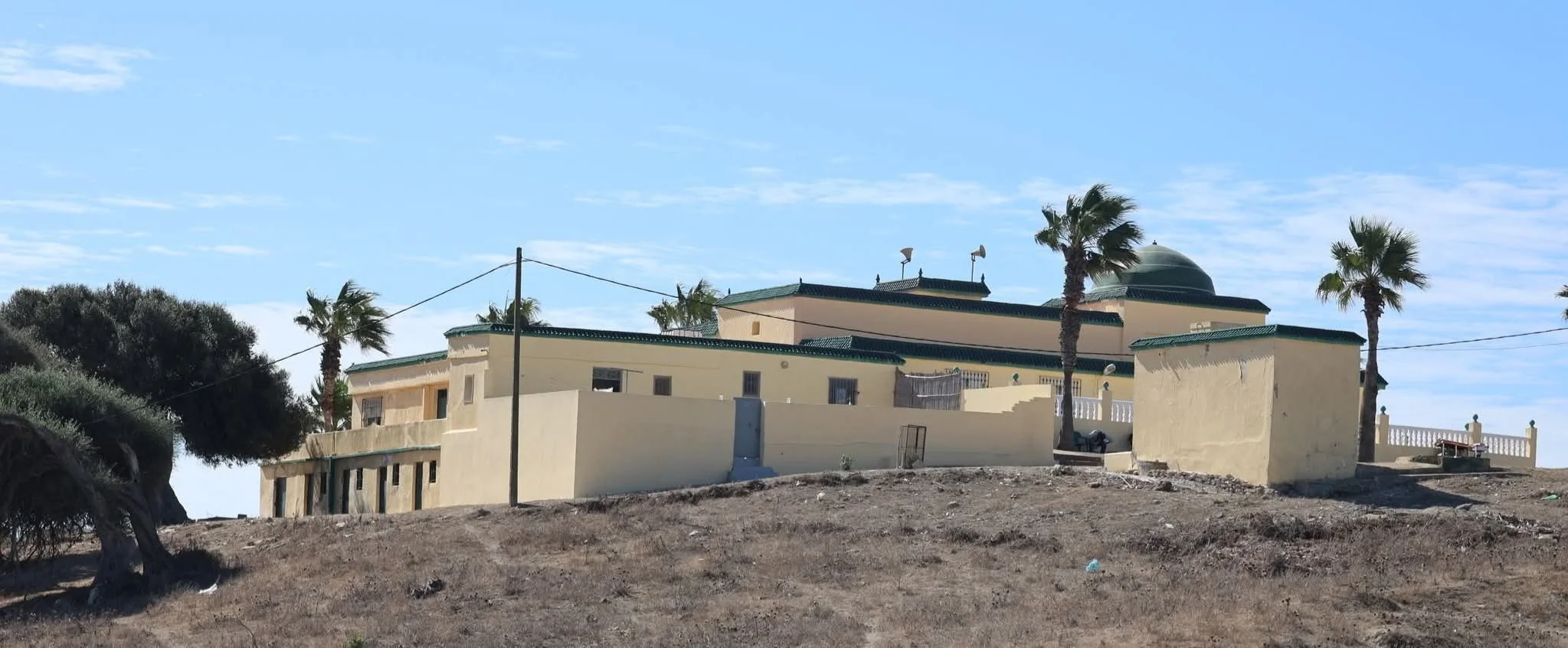
The shrine of al-Qāsim ibn Idrīs stands on a hill overlooking the Atlantic shoreline near Tangier. It is traditionally associated with the Ribāṭ of al-Qāsim ibn Idrīs, regarded as the first ribāṭ (early Sufi devotional center) founded in Morocco, making it a landmark of early Idrissid sacred history and spiritual settlement.
The subsequent decades validated al-Qāsim's insight with grim precision. Those brothers who concentrated power and competed for sovereignty—Muḥammad in Fez, ʿUmar in the Rif—were assassinated in 221/836. Those who dispersed to their assigned regions and governed autonomously survived: ʿĪsā, despite military defeat, outlived his brothers and eventually controlled Fez; Dāwūd remained at the eastern frontier and later entered Fez in 263/877 to renovate al-Qarawiyyīn mosque; the descendants of ʿAbd Allāh in Lamṭa established the Banū Amghār lineage that would found the crucial ribāṭ of ‘Ain al-Fiṭr; the line of al-Qāsim himself at Jawṭa created such commercial prosperity that the term "Jūṭiyya" became synonymous with market abundance, and his descendants later governed Fez after the Marinids.
The pattern was undeniable: concentration created vulnerability, dispersal enabled survival. But mere geographic distribution was insufficient; it required institutional embodiment. Governors who ruled through conventional political means—taxation, military force, administrative control—remained exposed to the same dynamics that had destroyed the centralized state: succession crises, rival claimants, vulnerability to external manipulation. The ribāṭ offered an alternative: an institution that reproduced Idrīsī authority across geography without requiring the apparatus of sovereignty, that could survive dynastic collapse because it operated independently of political power, that transformed the liability of dispersal into the strength of redundancy.
The ribāṭ network that would eventually structure Moroccan Islam for twelve centuries thus emerged not from religious vision or ideological program but from the specific requirements of Idrīsī survival under systematic assassination threat. Kanza's dispersal created the geographic distribution; al-Qāsim's withdrawal created the institutional form; the civil war's catastrophic outcome validated the logic of both. What began as emergency response to political crisis became, over subsequent generations, the foundational structure of Moroccan religious, social, and political life.
This origin explains characteristics of ribāṭs that would otherwise appear anomalous or contradictory. Their rural location was not marginality but strategy: distance from political centers reduced vulnerability to infiltration while maintaining moral authority. Their genealogical foundation was not archaic traditionalism but operational necessity: baraka transmitted through blood could not be seized, bought, or eliminated, making it more durable than any political title. Their comprehensive functionality was not the accretion of additional roles onto a religious core but the requirement of total institutional presence in territories where no other authority existed. Their network structure was not organizational hierarchy but the replication of nodes across geography, ensuring that the destruction of any single ribāṭ could not collapse the system.
The ribāṭ, in short, was the Idrīsī answer to an impossible question: How does a Prophetic lineage survive when concentration invites assassination, fragmentation produces civil war, and political sovereignty generates perpetual conflict? The answer was not political but spatial and genealogical: distribute Prophetic presence across the landscape, embed it in tribal networks through marriage, institutionalize it through teaching and service, and ground it in baraka that operates beyond the reach of political power. When the Idrīsī state finally collapsed—when Fez fell definitively to the Fatimids and their proxies in 309/921 and again in 389/974—the ribāṭ network not only survived but multiplied, proving that Kanza's geometry and al-Qāsim's institutional innovation had indeed solved the problem they were designed to address. The Idrīsids had learned what no other Muslim dynasty would: that authority embedded in landscape and genealogy could outlast any throne.
4. The Founding Generation - Documentary Evidence of Early Ribāṭs
The ribāṭ as institutional form did not remain confined to al-Qāsim's solitary foundation near Tangier. Within a generation of his withdrawal, multiple ribāṭs appeared across Morocco, each responding to specific local conditions but sharing structural features that reveal a common logic. Three foundations from the 3rd/9th century—al-Qāsim's own ribāṭ (c. 221/836), Ribāṭ Nakūr (240/854-855), and the ribāṭ of Moulay Būsalḥām (d. c. 343/954)—provide documentary evidence of the ribāṭ's early character and demonstrate its emergence over a century before the first Mālikī urban institution. Examining these foundations in detail establishes both the chronological priority of ribāṭs over rābiṭas and the functional template that later formations would adapt to their own purposes.
4.1. Ribāṭ Nakūr: The Earliest Documented Formal Institution (240/854-855)
If al-Qāsim's ribāṭ provides the paradigmatic Idrīsī foundation, Ribāṭ Nakūr offers crucial comparative evidence: the earliest clearly documented ribāṭ in Morocco, founded not by Idrīsids themselves but by a lineage that consciously imitated the Idrīsī model while lacking its genealogical foundation. The geographic and historical account preserved by al-Bakri (d. 487/1094) in Kitāb al-masālik wa-l-mamālik provides exceptional detail on Nakūr's origins, structure, and eventual fate, making it the most fully documented early ribāṭ and revealing both the ribāṭ's institutional logic and the limits of non-sharīfian replication.
The foundation narrative begins not in 240/854 but over a century earlier, during the reign of the Umayyad ruler al-Walīd ibn ʿAbd al-Malik (86-96/705-715), when al-ʿAbd Ṣāliḥ ibn Manṣūr al-Ḥimyarī began calling the Sanhāja and Ghumāra peoples of the Rif mountains to Islam. This early daʿwa established a precedent for religious authority in the region but did not yet constitute a formal ribāṭ. The actual institutional foundation came in 240/854-855, when al-ʿAbd Ṣāliḥ's grandson Saʿīd ibn Idrīs founded both the ribāṭ and the city of Nakūr (near modern Hoceima). Al-Bakri's explicit statement is critical for chronological arguments: textual evidence suggests that the ribāṭ was conceived as a formal institution in Morocco as early as the middle of the ninth century.
The architectural and institutional design reveals deliberate planning rather than organic growth. Al-Bakri specifies that the ribāṭ "was built as a rural mosque" with "design and supporting endowments modelled after the initial mosque of Alexandria in Egypt." The Alexandrian model was significant: Alexandria represented the first Arab-Islamic city in Egypt after the conquest (21/642), combining mosque, administrative center, and waqf-supported infrastructure in a single complex. By modeling Nakūr on Alexandria, Saʿīd ibn Idrīs was not improvising but adapting an established Islamic urban template to a rural Moroccan context. The ribāṭ was multi-functional by design—mosque, endowed institution, administrative center—not through later accretion of additional roles.
Within three generations, Nakūr had grown from ribāṭ into city-state. By the time Saʿīd's son ʿAbd al-Raḥmān ash-Shahīd (d. before 305/917) succeeded him, the principality had developed administrative structures, economic networks, and political ambitions that required constant military activity to sustain. But here the Banū Ṣāliḥ faced a structural problem that would ultimately prove fatal: they lacked Prophetic descent. To compensate, they pursued two strategies: martial achievement and sharīfian alliance. ʿAbd al-Raḥmān's career exemplifies the first strategy: despite training as a jurist and completing four pilgrimages to Mecca (an extraordinary demonstration of piety), he spent his reign conducting jihād against various enemies and suppressing Berber uprisings. The second strategy involved intermarriage with the Banū Sulaymān, the Idrīsī sharīfs of Tlemcen (descendants of Sulaymān ibn ʿAbd Allāh, brother of Idrīs I). These marriages created children of mixed genealogy who could claim some connection to Prophetic lineage through their mothers.
Al-Bakri's analysis of this strategy is devastating in its clarity: "To counteract the growing influence of their political rivals, the Idrissid sharifs of Fez and the nearby region of Ghumara, the Banu Salih intermarried with the sharifs of Banu Sulayman clan of Tlemcen. This matrimonial policy helped the Banu Salih maintain a religiously legitimated principality, allied with the Umayyads of Córdoba, that was similar in administrative organisation to the mini-states founded by the Idrissids themselves." The crucial phrase is "similar in administrative organisation"—the Banū Ṣāliḥ consciously copied the Idrīsī model, proving that the ribāṭ-to-principality trajectory was recognized as distinctly Idrīsī and worth replicating.
But similarity in administrative form could not overcome difference in genealogical foundation. Al-Bakri articulates the distinction with precision: "Unlike the Idrissids, whose well-established Muhammadian origins enabled them to enjoy the fruits of an ascribed nobility, the Banu Salih had to depend on a more unstable form of acquired status that demanded continual reaffirmation." This is the key analytical contrast: ascribed nobility (inherited through blood, permanent, inalienable) versus acquired nobility (earned through deeds, temporary, requiring constant renewal). Idrīsī authority simply was; Banū Ṣāliḥ authority required perpetual proof.
4.2. The Ragrāga: Holy Men or Umayyad Agents?
The Ragrāga tradition represents the most significant non-Idrīsī ribāṭ network in Morocco, emerging among Maṣmūda Berber populations in the Atlas foothills and Atlantic hinterland. The principal ribāṭ—known today as Ribāṭ Shākir—is situated in the Aḥmar region of Āsafī Province, in the commune bearing the saint's name (Sīdī Shīkir), on the northern bank of the Tansīft River. This positioning placed the institution at a critical juncture between the coastal plains of Dukkāla and Shiyāẓma to the west, the High Atlas mountains to the south, and the approaches to Marrakech to the east. Unlike the Idrīsī ribāṭs examined throughout this article, the Ragrāga institution originated as a military outpost against Barghawāṭa incursions before transforming into a center for Sufi instruction. Its authority rested not on sharīfian genealogy but on contested claims of Prophetic companionship—a legitimation strategy whose historical foundations raise difficult questions.
The tradition associates the Ragrāga's sacred origins with Shākir ibn ʿAbd Allāh al-Azdī, an Arab of the Azd tribe who entered Morocco with ʿUqba ibn Nāfiʿ in 62-63/681-683. Ibn ʿIdhārī identifies him among a group ʿUqba stationed in Morocco; the author of al-Sayf al-maslūl specifies that "ʿUqba appointed him over the mosques when he departed." Later hagiography frames this as a pedagogical mission—teaching Qurʾān and religious practice—but the historical reality of Umayyad administration in the Maghrib suggests otherwise. The Umayyad state extracted jizya even from Berber Muslims, enslaved their women for transport to Damascus, and administered the region through military garrisons designed for taxation and territorial control. Shākir's post on the northern bank of the Tansīft—facing Barghawāṭa territory—functioned as a military and administrative outpost: a base for tax collection, surveillance, and patrolling the populations who would eventually rise against Umayyad oppression in the great Berber revolt (122-123/740-741) that shattered Umayyad power in the Maghrib. The pious framing as "mosque administration" and "Qurʾānic instruction" represents later reinvention of what was, in its origins, an apparatus of imperial extraction.
The campaign ended when Kusayla al-Awrabī, chief of the Awraba Berbers, killed ʿUqba at Tahūda (63/683) in response to Umayyad brutality. The Awraba—the same tribe that would welcome Mawlāy Idrīs I a century later (172/788)—remembered ʿUqba as an oppressor, not a propagator of Islam. If Shākir was indeed ʿUqba's companion, he participated in this campaign. The question then arises: on what basis do the Ragrāga claim spiritual authority for figures associated with Umayyad conquest? The tradition offers no answer.
Sources attribute the ribāṭ's construction to Yaʿlā ibn Muslīn al-Ragrāgī around the end of the 4th/10th century, built on Shākir's tomb. The institution was "initially founded as a defensive outpost against the Barghawāṭa, who were then making regular incursions in Dukkāla and Ragrāga"—a function explicitly distinguished from the spiritual origins of Tīṭ al-Fiṭr. This military origin meant the Ragrāga initially fulfilled the Qurʾānic imperative rābiṭū in its original martial sense—frontier stationing against an enemy—rather than the transformed ethical sense that characterized Idrīsī foundations. The ribāṭ served Maṣmūda populations facing Barghawāṭa raids until the Almoravid destruction of Barghawāṭa power in 448-449/1056-1057 eliminated the military rationale. The institution then transformed into a spiritual center, developing what sources describe as a "Maṣmūda Sufi tradition" parallel to the Ṣanhāja Sufism of Tīṭ al-Fiṭr.
The tradition centers on seven figures known as Rijāl Ragrāga al-Sabʿa (the Seven Saints of Ragrāga), whose tombs are distributed across the Shiyāẓma and Ragrāga regions: Abū Bakr ibn Shammās at Akermoud on the Shiyāẓma coast, with his son Ṣāliḥ buried alongside him; Rasmīn (or Wasmīn) at Jabal al-Ḥadīd in Shiyāẓma; Abū ʿAbd Allāh Adnās in Bilād al-Tawāʾ; Yaʿlā ibn Wāṭil at al-Maʿmūra near Marrakech; Saʿīd ibn Abī Yabqā al-Sābiq at Tamāzit in Shiyāẓma; and ʿĪsā Abī Khābiya at Tansīft. Hagiographic tradition claims these seven were Berber companions of the Prophet ﷺ who met him at Tabūk and introduced Islam to Morocco before the Arab conquests. A hadith in Muslim (2900) describing wool-clad people from "the direction of the Maghrib" meeting the Prophet ﷺ has been cited in support. Al-Kattānī (d. 1927) preserves a tradition of their Berber dialogue with the Prophet ﷺ.
The tradition contains irreconcilable claims. The Seven Saints supposedly met the Prophet ﷺ at Tabūk (9/630), yet Shākir accompanied ʿUqba's campaign (62-63/681-683), and Yaʿlā was martyred fighting Barghawāṭa—possibly contemporary with events at Tīṭ al-Fiṭr (419/1027-28). These cannot coexist. A companion of the Prophet ﷺ (d. 11/632) could not have accompanied ʿUqba fifty years later. A contemporary of ʿUqba could not have fought Barghawāṭa four centuries afterward. The hadith in Muslim names no individuals and provides no identification beyond "the direction of the Maghrib." No documentation places any of these figures before the Barghawāṭa polity (established 124/741-742).
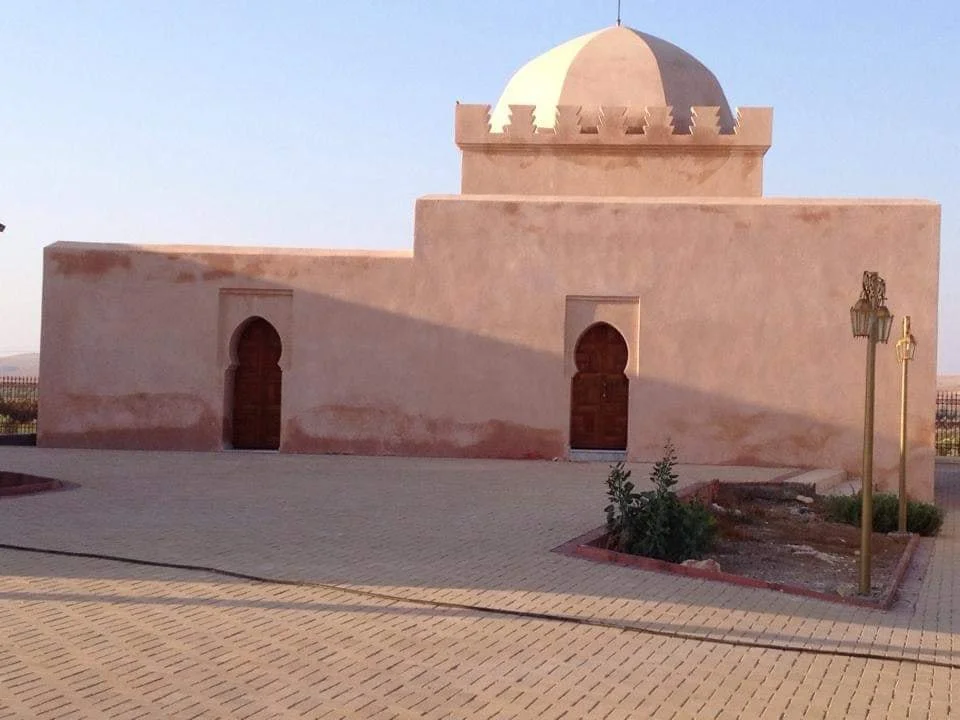
Shrine of Shākir ibn ʿAbd Allāh al-Azdī — A small maqām built in a plain, earthen style, with thick plastered walls, two horseshoe-arched wooden doors, and a dome rising above a crenellated roofline, opening onto a wide paved courtyard in a calm rural setting.
The Prophetic companionship claim served a structural function. Lacking sharīfian genealogy, the Ragrāga could not ground authority in documented descent from the Prophet ﷺ. The Banū Ṣāliḥ at Nakūr addressed this through martial achievement and intermarriage with Idrīsī sharīfs. The Ragrāga pursued a different strategy: claiming direct Prophetic encounter that bypassed genealogy entirely. This strategy had an inherent weakness. Genealogy can be documented and verified through established chains. Prophetic companionship, centuries after the fact, could only be claimed—tradition elaborated without evidentiary constraint.
No record exists of contact between the Idrīsids and the Ragrāga—no alliance, no opposition, no acknowledgment. When Mawlāy Idrīs I arrived (172/788), he was welcomed by the Awraba—the tribe of Kusayla, who had resisted ʿUqba. Subsequent Idrīsī expansion is documented through various tribal alliances. The Ragrāga are absent. Whether this reflects geographic distance, Barghawāṭa control of intervening territory, or the tradition's later coalescence, the Ragrāga developed independently of Idrīsī networks.
The Seven Saints were the focus of an annual pilgrimage known as al-Dawr (the Circuit), lasting forty-four days and conducted by Maṣmūda communities visiting the tomb sites in sequence. This circuit—one of Morocco's oldest organized pilgrimage practices—continued until the ʿAlawid sultan Mawlāy Ismāʿīl (r. 1082-1139/1672-1727) established a competing pilgrimage to the Seven Saints of Marrakech, redirecting popular devotion toward his capital. The Ragrāga Dawr diminished but persists among communities in the region today.
From the 5th/11th century, figures associated with the Ragrāga are documented in al-Tādilī's al-Tashawwuf. Abū ʿAbd Allāh al-Ragrāgī (d. 480/1065) studied under ʿAbd al-ʿAzīz al-Tūnisī and was known for karāmāt. Abū Zakariyyā al-Malīghī served as head of the ribāṭ and held the rank of badīl. ʿAbd al-Khāliq ibn Yāsīn al-Daghūghī (d. 571/1156), titled Imām and Shaykh al-Islām, was a contemporary of Mawlāy ʿAbd Allāh Amghār of Tīṭ al-Fiṭr. Abū Ibrāhīm Ismāʿīl Ū Gmātin (d. 595/1180), imam of Agawz and described as malāmatī and majdhūb, actively resisted Almohad fiscal oppression.
The late Marinid period witnessed a remarkable convergence of these two historically distinct ribāṭ traditions through the introduction of the Shādhiliyya ṭarīqa into Morocco. The pedagogical chain (silsila) linking Muḥammad ibn Sulaymān al-Jazūlī (d. 870/1465)—the figure who would revolutionize Moroccan Sufism—back to Abū al-Ḥasan al-Shādhilī traversed both the Idrīsī and Ragrāga networks in a configuration that illuminates the institutional dynamics of ṭarīqa transmission. Al-Jazūlī's seven-year formation at Ribāṭ ʿAyn al-Fiṭr under Muḥammad Amghār al-Ṣaghīr connected him to an Idrīsī institution whose methods this article has traced across four centuries. Yet Amghār al-Ṣaghīr's own master, Saʿīd al-Hartanānī, had received his initiation from ʿAbd al-Raḥmān al-Ragrāgī—a shaykh of the Maṣmūda tradition examined above. Al-Ragrāgī, in turn, held his authority through an Egyptian transmission descending from al-Shādhilī himself through Muḥammad al-Maghribī, Aḥmad al-Qarāfī, and Aḥmad ʿAnūs al-Badawī. The silsila thus braided together lineages that had operated in isolation for centuries: Idrīsī sharīfian authority grounded in genealogical baraka, Ragrāga indigenous tradition grounded in contested claims of Prophetic proximity, and Egyptian Shādhilī methods representing the institutional ṭarīqa model the Marinid makhzan sought to introduce. That al-Jazūlī—himself an Idrīsī sharīf—received the Shādhilī transmission through a chain requiring passage through the Ragrāga network demonstrates how the ṭarīqa's arrival reconfigured relationships between previously separate institutional formations, subordinating both to a new organizational logic while preserving their distinct contributions to Moroccan religious life.
The Ragrāga demonstrate that the ribāṭ form was not exclusively Idrīsī. Indigenous Berber communities developed their own traditions responding to local conditions without sharīfian authority. Yet the contrast confirms this article's argument: while ribāṭs could exist without Idrīsī descent, the durability and generative capacity that characterized Moroccan ribāṭs derived from the Idrīsī innovation of embedding Prophetic authority in genealogy and landscape. The Ragrāga's resort to unprovable companionship claims, their historical association with ʿUqba's campaign, their absence from Idrīsī networks, and their vulnerability to dynastic displacement reveal what ribāṭs looked like when they lacked the genealogical foundation that made the Idrīsī model resilient. Their eventual integration into Idrīsī-led transmission chains in the Marinid period—with al-Jazūlī, himself an Idrīsī sharīf, receiving through both networks—demonstrates that even successful non-Idrīsī traditions ultimately required connection to sharīfian authority to achieve lasting institutional transformation.
4.3. Mawlāy Būsalḥām: The Idrīsī Prince of the Atlantic Frontier (d. c. 343/954)
The third founding-generation ribāṭ demonstrates the Idrīsī strategy at its most audacious: an Idrīsī prince operating deep inside enemy territory. According to Ḥajjī in ṣulaḥāʾ maghāriba, Mawlāy Būsalḥām was Aḥmad ibn ʿAbd Allāh ibn Sulaymān, a descendant of the Sulaymānid branch of the Idrīsī family. He established his ribāṭ at Marja al-Zarqāʾ (the Blue Lagoon) on Morocco's Atlantic coast—not in safe territory but in what sources describe as a "zone of doctrinal danger": the heartland of Barghawāṭa influence, the heterodox Berber confederation that had rejected both Sunni and Shīʿī orthodoxy in favor of syncretic Islam combined with pre-Islamic Berber practices. His nickname "Abū Silhāma" derives from a miracle recorded in popular tradition: he stopped the sea's advance toward the shore using his mantle (silhām), demonstrating that Idrīsī baraka commanded forces that Barghawāṭa heterodoxy could not match.
The chronological significance cannot be overstated: Būsalḥām died circa 343/954, fourteen years before the establishment of the first documented Mālikī urban institution (Darras ibn Ismail's rābiṭa in Fez, 357/968). This means Idrīsī ribāṭs were already functioning as anti-heresy institutions—with an Idrīsī prince actively combating Barghawāṭa heterodoxy on the most dangerous frontier—over a decade before Mālikī scholars established their first urban center. Moreover, Būsalḥām's success inside Barghawāṭa territory highlights the operational superiority of genealogical baraka over scholarly credentials: when Abū ʿImrān al-Fāsī—trained in Córdoba, Kairouan, and Baghdad—later attempted to teach in Fez, he was expelled by Zanāta rulers and forced to relocate to Kairouan (c. 410-420/1019-1029). An Idrīsī prince could establish a functioning ribāṭ in the Barghawāṭa heartland where a Mālikī scholar could not secure foothold even in the Idrīsī capital, because blood-transmitted baraka exceeded what any amount of learning could replicate.
Būsalḥām's ribāṭ at Marja al-Zarqāʾ exemplified a pattern of sacred appropriation rather than destruction. The Blue Lagoon was a pre-Islamic sacred site, a liminal water-land threshold where local populations had recognized sanctity before Islam's arrival. By establishing his ribāṭ there, Būsalḥām transformed the location's meaning through sustained presence: the landscape remained sacred, but its source shifted from pre-Islamic veneration or Barghawāṭa practice to Idrīsī Prophetic authority. This strategy proved more effective than either iconoclasm (which would alienate populations attached to their sacred geography) or accommodation (which would leave Barghawāṭa structures intact). Populations could maintain their recognition of certain locations as powerful while reorienting their understanding of what made them sacred and who could mediate that sanctity.
The hagiographic tradition surrounding Būsalḥām reveals how the ribāṭ created narrative templates for centuries of Moroccan sainthood. He is described as combining "sharīfian descent, extreme ascetic practice, early signs of sanctity, and a sustained struggle against heterodoxy"—but we now understand "sharīfian descent" with precision: Idrīsī genealogy, connecting him to both the Hasanid branch and eastern networks. His legend links him to al-Khiḍr, the mysterious prophet-saint of Qurʾānic tradition (Surat al-Kahf) associated with esoteric knowledge and the hidden hierarchy of saints, positioning him as one who could guide populations lost in Barghawāṭa syncretism back to Prophetic teaching. This standardization of sainthood narratives—Idrīsī descent, asceticism, miracles, anti-heresy combat, esoteric knowledge—established criteria by which sanctity would be recognized and authenticated in Morocco for the next millennium.
The eventual fate of Būsalḥām's model reveals the limits of baraka against military force and the strategies dynasties employed to appropriate Idrīsī authority. The Almoravids in the 5th-6th/11th-12th centuries butchered Barghawāṭa heterodoxy. Significantly, the Almoravids—themselves founded at an Idrīsī ribāṭ (Aglū, under Waggāg ibn Zallū)—recognized Idrīsī descendants as sharīfs even while suppressing their Zaydī theological identity. Būsalḥām's ribāṭ and others were not destroyed but absorbed: genealogical authority preserved, social functions continued, but doctrinal independence subordinated to Mālikī frameworks. This pattern would characterize all subsequent dynasties' relationships with Idrīsī institutions. The baraka proved too valuable to eliminate.
By Būsalḥām's death in 343/954, the Idrīsī ribāṭ phenomenon had developed distinct functional specializations: al-Qāsim's withdrawal and commercial protection, Nakūr's institutional replication and limits of non-genealogical authority, Būsalḥām's anti-heresy combat and sacred appropriation. Yet all shared fundamental characteristics—rural positioning, genealogical authority, comprehensive services, voluntary economic support—that would define ribāṭs for centuries. When the first Mālikī rābiṭa appeared in Fez fourteen years after Būsalḥām's death, it entered a landscape already structured by over a century of Idrīsī ribāṭ operation. The claim that Mālikī movements created Morocco's Islamic infrastructure is not merely incomplete but inverted: Mālikī institutions adapted to and eventually appropriated a network that Idrīsī princes had built to survive political collapse and contest religious heterodoxy through baraka-sustained presence across the countryside.
4.4. The Bajliyya of Iglī-Māssīna: The Twelver Shīʿī Ribāṭ Network in Sūs
The ribāṭ phenomenon in early Morocco was not monolithic but violently contested. The most significant challenge to the Idrīsī model came from the Bajliyya, a Twelver Shīʿī movement that established a network of ribāṭs extending from the coastal region of Iglī through Māssīna to Taroudant in the interior—not a single institution but a constellation of fortified positions (ḥuṣūn) organized around eschatological expectation. Named after Iglī, the Bajliyya operated for two centuries before Almoravid forces butchered them into extinction, demonstrating that alternatives to Idrīsī authority existed, functioned across generations, and were eliminated not through doctrinal defeat but through military extermination.
The Bajliyya chose Māssīna as their center for reasons that distinguish passive eschatology from Idrīsī operational baraka. A ḥadīth preserved in al-Qurṭubī's Tadhkira declared that the Mahdī would emerge from Māssīna at the end of time. While Idrīsī ribāṭs grounded authority in genealogical baraka transmitted through active sharīfian presence and comprehensive social service, the Bajliyya positioned their network as an eschatological waiting station—ribāṭs organized around anticipation of the Hidden Imam's return rather than around the immediate exercise of Prophetic authority through blood. Their founder Ibn Warsand operated with strategic clarity during the fragmentation following Idrīs II's death, when Sūs fell to Aḥmad ibn Idrīs, a descendant of Yaḥyā ibn Idrīs ibn Idrīs. Ibn Warsand initially declared allegiance to this Idrīsī prince—operating within the existing political framework despite doctrinal differences. Only around the middle of the 3rd/9th century did he openly proclaim Twelver doctrine, and later the Bajliyya pledged loyalty to Idrīs ibn Muḥammad ibn Jaʿfar, another Idrīsī descendant ruling Sūs.
This sequential accommodation reveals tactical sophistication: recognize Idrīsī political authority during their strength, assert doctrinal independence during their fragmentation, maintain ribāṭ networks when no alternative power can challenge them. The Bajliyya's territorial extent—from coastal Iglī through Māssīna to inland Taroudant—indicates they achieved significant geographic presence through multiple ribāṭs functioning as nodes in a network. But where Idrīsī ribāṭs embedded themselves in tribal structures through marriage, provided comprehensive social services that made them indispensable, and distributed baraka through descendants who inherited both genealogy and institutional model, the Bajliyya ribāṭs appear to have functioned primarily as sites of Twelver teaching, pilgrimage to locations associated with the awaited Mahdī's emergence, and fortified positions (ḥuṣūn) from which they could resist external pressure.
The distinction matters for understanding why they survived two centuries but were ultimately eliminable. Idrīsī ribāṭs could not be destroyed without eliminating the sharīfs themselves, and even when sharīfs were killed, their descendants continued operating ribāṭs elsewhere because baraka traveled with blood. The network's redundancy meant that destroying one node left dozens operational. But Twelver ribāṭs organized around eschatological expectation at specific geographic locations faced a different vulnerability: their authority derived from prophetic geography (Māssīna as the site of the Mahdī's emergence) rather than from genealogical baraka that could operate anywhere. Remove the ribāṭs from Māssīna, and you remove the institutional embodiment of the prophecy. Moreover, if the Bajliyya ribāṭs functioned primarily as teaching centers and fortified positions rather than as comprehensive social institutions providing arbitration, healing, commercial protection, and welfare, then destroying them did not create the social vacuum that destroying Idrīsī ribāṭs would have produced.
The Almoravid assault between 448-449/1056-1057 targeted the Bajliyya precisely because their ribāṭ network controlled geography the Almoravids needed. Taroudant and its surroundings constituted the main passage between Almoravid lands in the south and northern Morocco. A network of ribāṭs holding this corridor, openly proclaiming Twelver Shīʿism, and possessing sufficient strength to fight Almoravid forces could not be bypassed or accommodated. The Bajliyya confronted the Almoravids at Taroudant and fought, demonstrating they had organized their ribāṭ network for defense. But when the Almoravids prevailed, the violence was systematic and total: they killed large numbers of the Bajliyya, sparing only those who returned to Sunnism, and seized the property of those they killed, treating it as booty. This language is devastating: "returned to Sunnism" erases Twelver identity as original apostasy rather than alternative Islamic formation; property seizure as booty classifies Bajliyya possessions as legitimate spoils of jihād against heretics.
Compare this violence to Almoravid treatment of Idrīsī ribāṭs. Waggāg ibn Zallū at Aglū—himself an Idrīsī sharif descended from Yaḥyā ibn Idrīs II—trained ʿAbd Allāh ibn Yāsīn, who founded the Almoravid movement. The Almoravids emerged from an Idrīsī ribāṭ, depended on Idrīsī baraka for legitimacy, and could not butcher their own genealogical source. They preserved Idrīsī sharīfian status while suppressing Zaydī theological content, imposing Mālikī legal frameworks on ribāṭs whose social functions and genealogical authority they required. The Bajliyya ribāṭ network received no such accommodation. Twelver doctrine was inseparable from their institutional existence: remove the Hidden Imam, the eschatological waiting, the Māssīna prophecy, and the ribāṭs lose their reason for being. Idrīsī authority could survive doctrinal transformation because it rested on blood performing social services across generations; Bajliyya authority required Twelver theology to justify ribāṭs organized around prophetic geography rather than sharīfian genealogy.
The Bajliyya's initial allegiance to Idrīsī princes reveals early Moroccan Islam's fluidity before Mālikī-Almoravid violence imposed uniformity. Ibn Warsand pledged to Aḥmad ibn Idrīs; later Bajliyya leaders recognized Idrīs ibn Muḥammad ibn Jaʿfar. These were not tactical deceptions but functional arrangements: Idrīsī princes governing Sūs accepted Twelver ribāṭ networks within their territories, and Twelver leaders recognized Idrīsī political oversight while maintaining doctrinal independence. This coexistence proved possible because Idrīsī Zaydī theology—which the Almoravids would later suppress—shared with Twelver Shīʿism the fundamental premise that legitimate authority derives from Prophetic descent through ʿAlī. Both located legitimacy in the Ahl al-Bayt; both understood imamate as divinely-ordained. The doctrinal distance between Zaydī Idrīsids and Twelver Bajliyya was narrower than later Sunnī historiography suggests, making their coexistence under Idrīsī suzerainty comprehensible.
5. The Consolidation Phase – Idrīsī Ribāṭs as Institutional Infrastructure (4th-5th/10th-11th Centuries)
By the late 4th/10th century, the Idrīsī ribāṭ network had evolved from emergency response to political crisis into Morocco's primary Islamic infrastructure. The founding generation—al-Qāsim's withdrawal, Nakūr's formal institution, Būsalḥām's anti-heresy combat—had established the paradigm; the consolidation phase demonstrated its replication, systematization, and institutional maturity. Three ribāṭs from this period reveal the network's geographic distribution, functional specialization, and capacity to survive the definitive collapse of Idrīsī political authority. When the Idrīsī caliphate ended in 389/974 with the loss of Fez, these ribāṭs did not collapse but multiplied, proving that authority grounded in genealogical baraka and comprehensive social service could outlast any political regime.
5.1 Ribāṭ Jabal al-ʿAlam: The Supreme Ribāṭ and Arabization of the Rif
If Tit al-Fiṭr provides documentary evidence of ribāṭ operations, Jabal al-ʿAlam in the Ghomāra highlands of the western Rif demonstrates the ribāṭ's capacity to transform entire regions linguistically, doctrinally, and spiritually. Established by Idrīsī sharīfs in the 5th/11th century or earlier, Jabal al-ʿAlam became what sources describe as Morocco's "supreme ribāṭ"—not through political authority or institutional hierarchy but through the caliber of saints it produced, the reach of its teaching, and the intensity of devotion it inspired. The ribāṭ's location in the Rif mountains, among Ghomāra and Ṣanhāja Berber populations whose Tamazight-speaking communities had resisted linguistic and cultural transformation, made its Arabization function particularly significant.
Arabization flowed from Jabal al-ʿAlam not through conquest or administrative imposition but through Qurʾānic education. Young students came to the mountain to memorize the Qurʾān under sharīfian masters, and memorizing the Qurʾān required learning Arabic. The ribāṭ became the vehicle through which Arabic—not as the language of imperial administration but as the language of the Prophet ﷺ—spread into the Berber highlands. Students who completed their memorization returned to their villages bilingual, capable of leading prayer, teaching children, and maintaining Qurʾānic transmission. This created a dispersed network of Arabic literacy embedded in Tamazight-speaking populations, transforming the linguistic landscape without destroying indigenous languages. The Rif remained Berber-speaking, but its religious life operated increasingly in Arabic, creating the diglossia that would characterize Morocco for centuries.
The ribāṭ's pedagogical significance is best demonstrated through its most famous disciple: Abū al-Ḥasan al-Shādhilī (d. 656/1258), founder of the Shādhiliyya order, one of the most influential Sufi ṭarīqas in Islamic history. Al-Shādhilī studied at Jabal al-ʿAlam under Mawlāy ʿAbd al-Salām ibn Mashīsh (d. 625/1227), an Idrīsī sharīf whose spiritual authority and teaching method shaped al-Shādhilī's own practice. The Shādhiliyya would spread across North Africa, Egypt, the Levant, and beyond, carrying methods and doctrines that originated at an Idrīsī ribāṭ in the Rif mountains. That this occurred without institutional hierarchy—no central authority licensing teachers, no formal curriculum imposed from above, no bureaucratic structure controlling transmission—demonstrates the ribāṭ network's capacity to generate and disseminate knowledge through personal relationships and spiritual genealogies rather than through administrative systems.
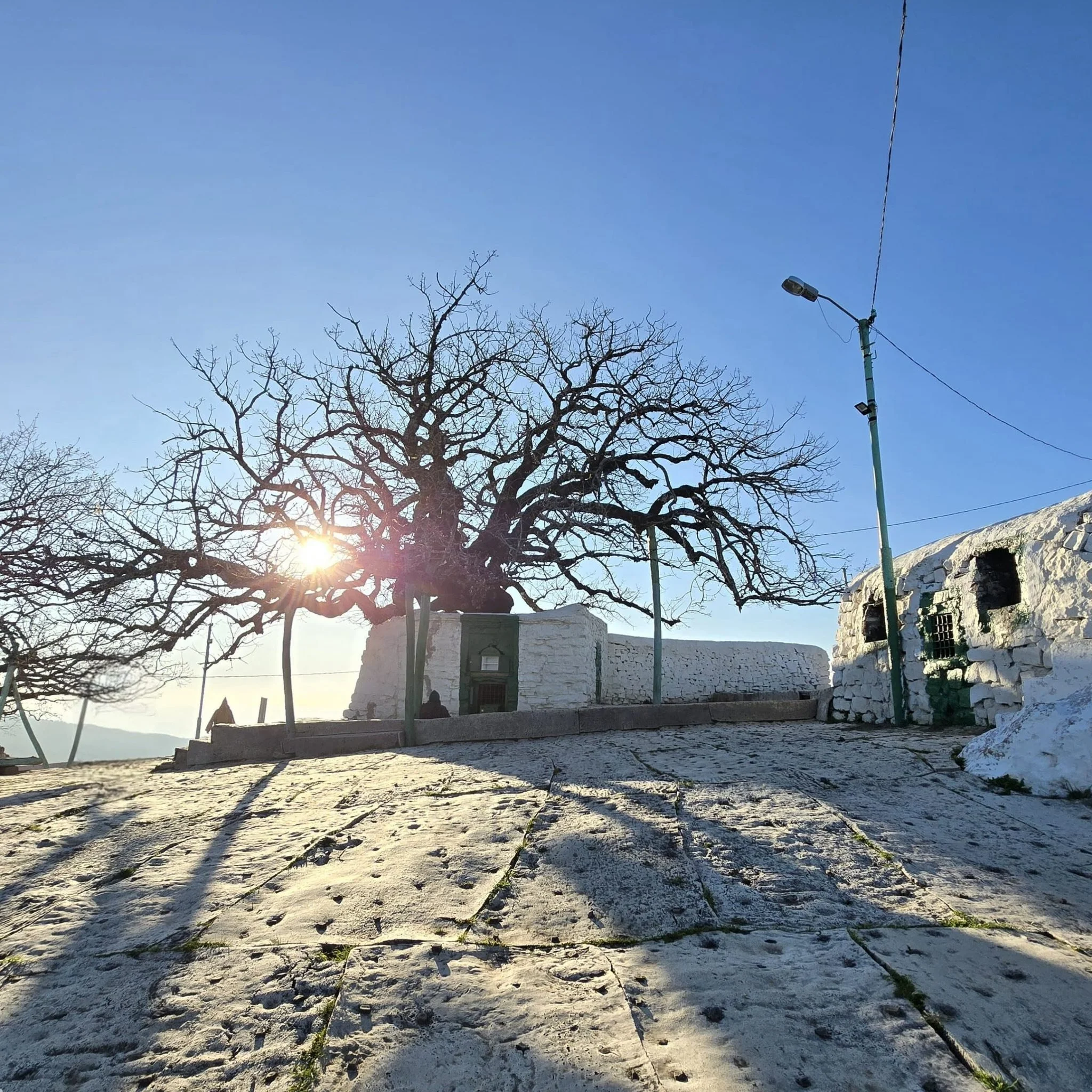
Mawlāy ʿAbd al-Salām ibn Mashīsh, Jabal al-ʿAlam (approx. 1,300 m), Chefchaouen Province, northern Morocco—about 60 km southwest of Tétouan by road.
Ibn Mashīsh's own death reveals the ribāṭ's anti-heresy function and the dangers Idrīsī sharīfs faced even in their own strongholds. He was martyred in 625/1227, killed while opposing a false prophet named Abū al-Ṭawājīn who had emerged in the region claiming divine revelation. This was not the first time an Idrīsī sharīf had confronted heterodoxy through direct engagement—Būsalḥām had done the same against Barghawāṭa—but Ibn Mashīsh's martyrdom demonstrates that such confrontations carried mortal risk. Yet the ribāṭ survived his death and continued operating, proving again that institutional continuity did not depend on individual charisma but on genealogical succession: Ibn Mashīsh's descendants and students carried forward the ribāṭ's functions, maintaining its teaching, arbitration, and spiritual authority.
Jabal al-ʿAlam also became the origin point for Morocco's most important pilgrimage outside the Prophet's ﷺ tomb in Medina: the visitation known as al-ḥajj al-aṣghar (the lesser pilgrimage), which came to function as a substitute for those who could not afford or physically manage the journey to Mecca. The Sabʿat Rijāl (Seven Saints) pilgrimage circuit, which would later be systematized and appropriated by the ʿAlawid sultans, originated from the veneration of saints associated with Jabal al-ʿAlam and the network of ribāṭs connected to it. This pilgrimage infrastructure created economic flows that sustained ribāṭs through gifts, endowments, and the voluntary support of visitors seeking baraka. It also created cultural patterns that reinforced sharīfian authority across generations: families made pilgrimage together, children learned to recognize and venerate Idrīsī descendants, and popular religious practice oriented itself around ribāṭ networks rather than state-controlled mosques.
The ribāṭ's comprehensive functions—Qurʾānic education, Arabic transmission, Sufi training, anti-heresy combat, pilgrimage center, healing through baraka, charity distribution—demonstrate how a single institution could provide the total infrastructure rural populations required. There is no evidence that Jabal al-ʿAlam ever received state support or operated under political oversight; its authority derived from genealogy, its economic base from voluntary gifts, its social functions from recognized need. When dynasties rose and fell—Almoravids replacing Idrīsī princes, Almohads conquering Almoravids, Marinids succeeding Almohads—Jabal al-ʿAlam continued teaching, healing, arbitrating, and transmitting baraka. Its continuity across regime changes proves that ribāṭs had achieved institutional independence from political authority, operating on principles that transcended any particular state formation.
5.2 Ribāṭ Ayn al-Fiṭr: The Documentary Archive of Idrīsī Authority
The ribāṭ Tit al-Fiṭr (ʿAyn al-Fiṭr) in Dukkala provides the most complete documentary evidence of how Idrīsī institutions operated across five centuries and multiple political regimes. Founded in the late 4th/10th century by Ismāʿīl, a descendant of ʿAbd Allāh ibn Idrīs II, the ribāṭ was positioned inside Barghawāṭa territory on Morocco's Atlantic coast near present-day El Jadida. The site took its Berber name Tit-n-Fiṭr, "Spring of Sustenance," from the natural spring that provided water and supported the surrounding ecosystem. The alliance with Sanhāja Berbers of Azammūr came through witnessed miracles: lions surrounding Ismāʿīl during prayer without attacking, the ground opening beneath the tribal chief ʿAbd al-ʿAzīz ibn Baṭṭār's feet when he attempted coercion, rain brought during drought. Ibn Baṭṭār formalized the relationship through intermarriage with Ismāʿīl's family and appointed him imam and chief of Sanhāja Azammūr, creating reciprocal obligation that would sustain the ribāṭ across dynastic cycles.
The Tamīm ibn Zīrī edict of 409/1018 represents the earliest formal documentation of how states and ribāṭs negotiated authority in post-Idrīsī Morocco. Tamīm ibn Zīrī ruled Fez as a Zanāta Maghrāwī sultan during the same period when his regime would expel Abū ʿImrān al-Fāsī, the leading Mālikī reformer, from the city. The edict addressed to Abū Jaʿfar Isḥāq Amghār authorizes the murābiṭ to receive a share of kharāj (produce tax) collected from Sanhāja Azammūr as compensation for his family and followers. The contractual terms specify that this arrangement continues as long as the murābiṭ maintains spiritual rank and does not relocate. This was formalized exchange modeled on the Prophet's Medinan covenant: the sharīf provides arbitration, mediation, teaching, and legitimation of tribal leadership; the state provides material support and official recognition. The edict makes visible what operated informally across Morocco: ribāṭs performed governmental functions in territories where states lacked infrastructure or legitimacy to rule directly.
The arbitration system documented in the Tamīm edict reveals how Idrīsī baraka translated into juridical authority. Disputes were resolved through collective oath scaled to offense severity: theft required two oath-takers, rape four, murder of a woman twenty, murder of a man forty. Cases requiring fewer than ten oath-takers were settled locally within tribes; cases requiring ten or more came to the ribāṭ "with the moral assistance of the murābiṭūn." The ribāṭ handled precisely those disputes where local mechanisms had failed or where stakes demanded legitimacy beyond tribal capacity. Elections for tribal qaids occurred at the ribāṭ rather than within tribal territories because only this neutral space allowed competing factions to accept outcomes without triggering violence. The physical positioning reinforced function: situated on boundaries between tribal territories, the ribāṭ was accessible to all parties while captured by none. Violence within its precincts was absolutely prohibited, creating sanctuary where enemies could negotiate.
Abū Jaʿfar Isḥāq Amghār's intellectual production demonstrates that ribāṭs participated fully in trans-regional Islamic scholarship. In 412/997, he composed an ʿaqīda (doctrinal position paper) responding to questions from a scholar in Sfax, Ifrīqiya. The content parallels Ibn Abī Zayd al-Qayrawānī's Risāla, proving that Dukkala ribāṭs were teaching mainstream Mālikī doctrine over half a century before the first documented Mālikī urban institution appeared in Fez. Abū Jaʿfar also developed the physical complex: a congregational mosque whose cut-stone minaret—resembling Marrakech's Kutubiyya—remains Morocco's oldest privately-built religious structure. When famine forced temporary relocation in 419/1004, he attempted teaching among Masmūda populations at Iyir fortress. The resistance he encountered demonstrates that ribāṭ authority required tribal embedding through kinship and demonstrated service; Idrīsī genealogy alone could not sustain operations without local acceptance.
The ribāṭ's transformation from regional to trans-regional institution occurred under Abū Jaʿfar's son Abū ʿAbd Allāh Amghār and grandson ʿAbd al-Khāliq (d. 614/1199). Together they founded the al-Ṭāʾifa al-Sanhājiyya, recognized by the 8th/14th century jurist Ibn Qunfudh as one of the Maghreb's most noted Sufi institutions. The significance of "Sanhājiyya" requires understanding political context: the Almoravids ruling Morocco and al-Andalus were themselves Sanhāja, making this designation alignment with imperial power rather than tribal restriction. The ṭāʾifa extended across Almoravid territories from Dukkala through the Moroccan Sahara into al-Andalus, transforming a Dukkala ribāṭ into an organizational center operating at imperial scale.
The relationship between ʿAyn al-Fiṭr and the Almoravid dynasty reveals how military powers required sharīfian legitimation. ʿAlī ibn Yūsuf ibn Tāshfīn (r. 453–537/1061–1143) and his vizier Abū al-Walīd ibn Rushd (d. 520/1126)—grandfather of the philosopher and himself a noted Mālikī jurist—solicited Abū ʿAbd Allāh's blessing before constructing Marrakech's defensive walls. The sharīf approved the project and made the first donation toward expenditures that ultimately reached seventy thousand gold dinars. A letter dated 527/1112 provides the earliest official state recognition of the Banū Amghār as descendants of the Prophet ﷺ. The Almoravids treated Abū ʿAbd Allāh as semi-official spokesman for all Sanhāja Berbers of Morocco. When sufi shaykhs and righteous figures across Morocco were summoned to Marrakech to confirm their oath of allegiance to ʿAlī ibn Yūsuf, Abū ʿAbd Allāh refused, citing "extreme lack of care for the world." The Almoravids needed his blessing; he did not need their appointment. His nickname "Abū al-Abdāl" (Father of Substitutes) positioned him within Sufi cosmological hierarchies where ten Banū Amghār leaders held the rank of badīl—candidates for Quṭb al-Zamān (Axis of the Age)—authority operating beyond any sultan's jurisdiction.
Abū ʿAbd Allāh's teaching methods combined Mālikī jurisprudence with ascetic practices demonstrating baraka's operational reality. He taught Saḥnūn's Mudawwana and the example of al-salaf al-ṣāliḥ while maintaining spiritual discipline contemporary sources describe as "having the hereafter between his eyes." He loved al-Ghazzālī's writings so intensely that sources claim he miraculously transported himself to the scholar's funeral. His dietary restrictions were severe: refusing to eat food others produced lest it be contaminated by their sins, he limited himself to tree leaves, wild plants allowable by Islamic law, and fish from the sea. His ten Rules of Companionship—avoiding disputes, pursuing justice, generosity, contentment with divine provision, forbearance, concealing esoteric knowledge from the uninitiated, concealing others' sins, conceding final words in arguments, satisfaction with one's lot, refusing worldly exertion—created discipleship methods informed by Nizāmi futuwwa traditions adapted to Moroccan tribal contexts. These rules trained disciples who would establish ribāṭs across the region, creating pedagogical networks that extended Dukkala methods throughout the Maghrib.
The pedagogical chain from ʿAyn al-Fiṭr demonstrates how ribāṭs generated institutional reproduction through personal transmission.
During Abū ʿAbd Allāh Amghār's leadership, the ribāṭ functioned as a major teaching center attracting students from across Dukkala and beyond, implementing what sources describe as a deliberate educational and spiritual strategy to spread knowledge and virtue during the unstable period of Almoravid-Almohad conflict. Students came from Sakūra, Banū Mājir, Banū Daghūgh, and throughout the region, studying Qurʾānic sciences, Mālikī jurisprudence through Saḥnūn's Mudawwana, and the fundamentals of taṣawwuf. Among his most noted disciples were ʿAbd al-Khāliq ibn Yāsīn al-Daghūghī, Wazjīj ibn Walūwn al-Ṣanhājī, ʿUmar and Yaḥyā al-Dukālī, and Abū Zakariyyā Yaḥyā ibn Ṣāliḥ al-Muṣṭāwī. Even Abū al-ʿAbbās al-Sabtī, who would become one of Marrakesh's most celebrated saints, visited ʿAyn al-Fiṭr while still a young man seeking formation. The ribāṭ's capacity to gather leading poles of knowledge and righteousness during a period of political chaos demonstrates its centrality to Morocco's Islamic intellectual life and its role as a civilizational mission operating independently of dynastic authority.
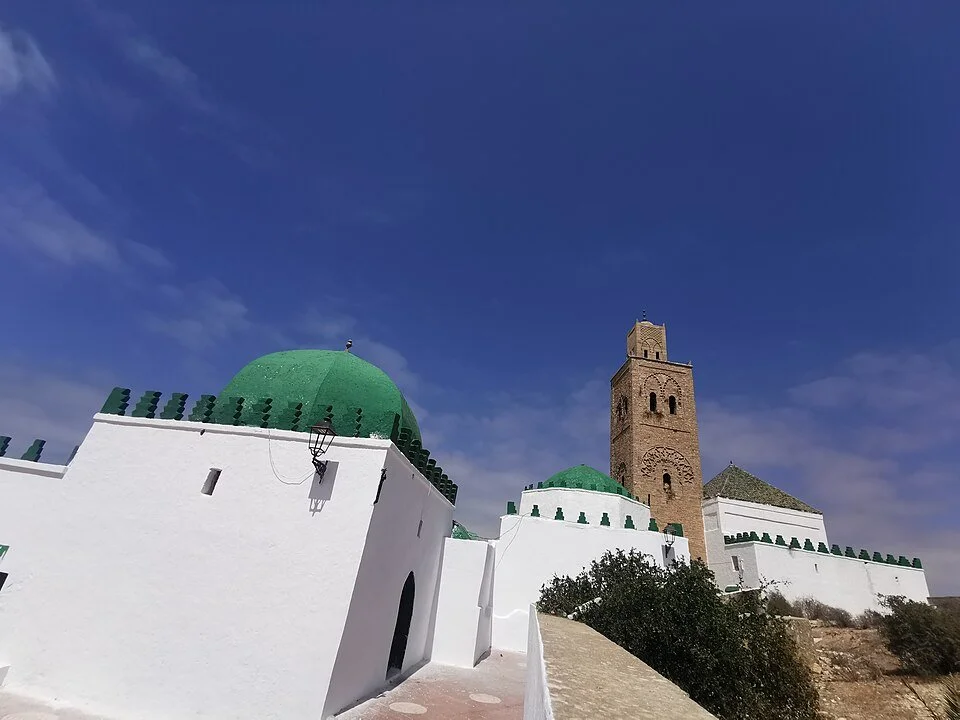
Shrines of the Amghar Ribāṭ (near El Jadida) — A cluster of whitewashed sanctuaries crowned with green domes and edged with green crenellations, set against the Atlantic sky, with a tall stone minaret rising above the complex.
Abū Shuʿayb al-Sāriyā (d. 561/1166) spent his formative years at the ribāṭ absorbing the ten Rules before establishing his own center at Iliskāwīn in Dukkala's interior. Al-Sāriyā—nicknamed "the Pillar"—functioned as structural support representing communities before government officials, using baraka to shield populations from predatory taxation. His training connected multiple Dukkala centers within fifty kilometers: Iliskāwīn, Aghmat, and Tit al-Fiṭr, creating horizontal networks through circulation of teachers and students. Al-Sāriyā's ethical hypersensitivity exemplified the discipline Abū ʿAbd Allāh's Rules demanded. When his cow ate from a neighbor's field, al-Sāriyā pulled food from his own mouth and fasted the cow for three days to expiate the theft. He refused to eat raisins if they came from canals whose water might have passed through unlawfully acquired land upstream, operating according to principles of ritual purity so extreme they exceeded juridical requirements.
His political activism spanned three regimes—Almoravid, Almohad, and the transitional period between them—always maintaining the same function: defending communities from state predation through supernatural threat. Under Almoravids, when tax rebels were condemned to death, al-Sāriyā's plea was initially dismissed by a governor who showed color prejudice. The governor was immediately struck by stomach cramps and learned to release all Sanhāja prisoners before al-Sāriyā's arrival. Under Almohads, he spoke against Sanhāja massacres despite being Sanhāja himself, was arrested by ʿʿAbd al-Muʾmin (r. 524–558/1130–1163), subjected to theological interrogation on tawḥīd questions, and answered with Qurʾānic verses only, refusing Almohad technical terminology. An earthquake shook the caliph's palace during the trial; terrified, ʿAbd al-Muʾmin granted him authority to intercede. Governors and caliphs adjusted behavior to avoid curses that contemporary sources document with remarkable consistency.
From al-Sāriyā's ribāṭ at Iliskāwīn emerged Abū Yaʿazzā Yalannūr (d. 572/1177), who became the crucial bridge connecting rural ribāṭ networks to urban scholarly institutions. After years absorbing the Amghāri methods from al-Sāriyā, Abū Yaʿazzā traveled widely before settling in Fez for several years. His presence attracted numerous scholars including Abū ʿAbd Allāh al-Tāwudī ibn Sūdah (d. 580/1184), ʿAlī Abū-Ghālib (d. 568/1173), and ʿAlī ibn Ḥirzihim (d. 559/1164). Ibn Ḥirzihim's uncle, Abū Ṣāliḥ, had studied under Abū al-Najīb al-Suhrawardī (d. 563/1168) in Baghdad before founding his rābiṭa in Fez, establishing the first urban integration of spiritual teaching with Mālikī juridical training and creating direct institutional connection between Baghdad's centers and Morocco's ribāṭ networks. When Abū Ṣāliḥ died, his nephew ʿAlī ibn Ḥirzihim succeeded him as head of the rābiṭa. After Abū Yaʿazzā returned to his village of Taghiya in the Middle Atlas, Ibn Ḥirzihim continued directing students seeking formation to appropriate masters based on their needs and capacities.
When Abū Madyan Shuʿayb (d. 594/1198), studying at al-Qarawiyyīn in Fez, sought spiritual formation to complete his juridical training, Ibn Ḥirzihim directed him to Jabal Iruggan near Taghiya where Abū Yaʿazzā had settled. Abū Madyan spent forty days with Abū Yaʿazzā in the Atlas, absorbing methods that al-Sāriyā had transmitted from ʿAyn al-Fiṭr through the Amghāri chain. He returned to Fez and established khalwa on Jabal Zalāgh, where the mountain became his primary base for formation. This pattern—urban juridical training at al-Qarawiyyīn requiring completion through rural spiritual formation under masters embodying ribāṭ methods—demonstrates how the network functioned through institutional coordination rather than individual initiative. The Ḥarāzimi rābiṭa in Fez, connected through Abū Ṣāliḥ's Baghdad training to eastern learning and through ʿAlī ibn Ḥirzihim's discipleship with Abū Yaʿazzā to rural Moroccan ribāṭ networks, operated as a node directing students to appropriate formations across the institutional landscape.
Abū Madyan eventually fled Fez to perform pilgrimage in Mecca, then settled in Bijāya on the far western frontiers of Morocco to avoid warfare and instability accompanying the Almohad conquest and continue his development in peace. In Bijāya, Abū Madyan adopted Nizāmī techniques to transpose Shīʿī cosmological and authority concepts into a Sunnī framework, becoming the first Maghribi figure to adopt the title "al-Ghawth" (the Support)—a designation borrowed from ʿAbd al-Qādir al-Jīlānī, the culminating product of the Nizāmiyya's institutional shaykh model, whom Abū Madyan is reported to have met at Mount ʿArafāt during the pilgrimage.
Among his companions was Abū Muḥammad Ṣāliḥ ibn Yasrānan al-Mājirī (d. 631/1234), who had received his foundational education at Ribāṭ Tīṭ under Abū ʿAbd Allāh Amghār, where he studied qirāʾāt and demonstrated such early brilliance that the shaykh publicly endorsed him. Al-Mājirī spent years in Abū Madyan's company in Bijāya before Abū Madyan sent him to Baghdad for a forty-day retreat under ʿAbd al-Qādir al-Jīlānī. This dispatch extended the pattern Abū Ṣāliḥ Ḥarazim had established: Moroccan ribāṭ figures training with Baghdad's institutional centers, absorbing Nizāmī educational methods and the institutional shaykh model that ʿAbd al-Qādir embodied. Al-Mājirī returned to Aṣafī where he founded the Mājiri rābiṭa, securing pilgrimage routes from Morocco through Mecca to Jerusalem and establishing connections to the ḥārat al-Maghāriba in Jerusalem, then under Fatimid control and later developed by Ṣalāḥ al-Dīn after Ḥiṭṭīn.
When ʿAlī ibn Ḥirzihim died, he left his son Muḥammad as a young boy. Al-Mājirī took the child under his care, raising and training him in the methods he had learned from Abū Madyan and the institutional knowledge required to lead the Ḥarāzimi rābiṭa. Muḥammad ibn ʿAlī ibn Ḥirzihim succeeded his father as head of the rābiṭa and is buried at Ḥammāt Khūlān, five kilometers outside Fez. Decades later, when Abū al-Ḥasan al-Shādhilī arrived in Fez after wandering in Egypt seeking a master, he contacted Muḥammad ibn ʿAlī ibn Ḥirzihim at the Ḥarāzimi rābiṭa. Muḥammad—trained by al-Mājirī who had studied in Baghdad, inheriting his father's institutional knowledge connecting eastern learning to rural Moroccan ribāṭ networks—directed al-Shādhilī to Jabal al-ʿAlam to meet ʿAbd al-Salām ibn Mashīsh. This direction demonstrates institutional coordination: the Ḥarāzimi rābiṭa operated as a node identifying where specific types of formation could be obtained acr oss the ribāṭ network's accumulated geographical and pedagogical knowledge.
What the network from ʿAyn al-Fiṭr through al-Sāriyā to Abū Yaʿazzā to the Ḥarāzimi rābiṭa demonstrates is ribāṭs communicating across Morocco's institutional landscape. Al-Sāriyā trained Abū Yaʿazzā in rural Dukkala methods transmitted from ʿAyn al-Fiṭr. Abū Ṣāliḥ Ḥarazim studied in Baghdad and founded an urban rābiṭa in Fez integrating eastern techniques with Mālikī training. ʿAlī ibn Ḥirzihim connected both streams through discipleship with Abū Yaʿazzā and succession to his uncle's rābiṭa. Abū Madyan synthesized these influences on Jabal Zalāgh before introducing Nizāmī institutional models in Bijāya. Al-Mājirī extended connections to Baghdad and created pilgrimage infrastructure linking Morocco to Mecca and Jerusalem. Muḥammad ibn Ḥirzihim inherited this coordinated knowledge and directed al-Shādhilī to the appropriate rural formation at Jabal al-ʿAlam. By the 6th-7th/12th-13th centuries, Moroccan ribāṭs operated as nodes in a trans-regional Islamic network extending from the Atlantic coast through the Atlas to Fez to Baghdad to Jerusalem.
This represented the Maghrib's gradual transition toward adopting Mashriqi institutional methods beyond the Mālikī juridical framework that had dominated since the Almoravid consolidation. The process began with Abū Ṣāliḥ Ḥarazim's Baghdad training, accelerated through Abū Madyan's adoption of Nizāmī techniques and the "Ghawth" model, and continued through al-Mājirī's direct training under ʿAbd al-Qādir al-Jīlānī. Ibn Tūmart's Almohad revolution, with its distinct theological program emphasizing tawḥīd and rejecting Mālikī legal dominance, delayed full integration of these eastern models for over a century. During Almoravid and Almohad periods, ribāṭs continued operating as comprehensive institutions performing juridical, educational, economic, protective, and spiritual functions simultaneously. The formal ṭarīqa system with defined membership, hierarchical structure, and specialized spiritual focus would only enter Morocco at the beginning of the Marinid period through the Idrīsīte Shādhilī systematization, introducing what can be understood as the Nizāmiyya triplex: coordinated integration of fiqh, kalām, and institutionalized taṣawwuf into a unified educational program distinct from the ribāṭ's comprehensive social model.
5.3 Ribāṭ Aglū (Dār al-Murābiṭūn): The Dynasty-Building Ribāṭ
If Tit al-Fiṭr demonstrates juridical and economic functions and Jabal al-ʿAlam exemplifies pedagogical and spiritual authority, Ribāṭ Aglū near Tīznīt in the Sūs region reveals the ribāṭ's capacity to build empires. Founded in the 5th/11th century by Waggāg ibn Zallū al-Lamatī (d. 445/1054), a descendant of Yaḥyā ibn Idrīs II, the ribāṭ was positioned on the pre-Saharan edge where the Atlas mountains meet the Sahara, controlling access to trans-Saharan trade routes and serving pastoral Ṣanhāja populations who moved between desert and mountain according to seasonal patterns. The location was strategic for both economic and spiritual reasons: caravans carrying gold, salt, and slaves northward required protection and rest; nomadic tribes required arbitration and teaching; the frontier between settled and unsettled zones required institutions that could operate across both.
Waggāg had studied under Abū ʿImrān al-Fāsī (d. 430/1039), the Mālikī scholar who had been expelled from Fez by Maghrāwa rulers and relocated to Kairouan. This connection to Mālikī networks would prove crucial for the ribāṭ's later role, but it is essential to understand what the training actually meant: Waggāg learned Mālikī jurisprudence, adding legal expertise to the genealogical authority he already possessed as an Idrīsī sharif. The combination—baraka plus fiqh—made him exceptionally effective, but contemporary sources make clear which element populations actually recognized. When drought struck the Nafis valley and Berbers came to Waggāg asking him to plead their case before God, they treated him as a miracle-worker capable of supernatural intervention, not as a legal scholar. Waggāg attempted to downplay this role, presenting himself as "little more than a teacher of Shariʿa and Prophetic Sunna," but the tribes maintained what the source describes as a "stubborn (and ultimately well-justified) belief in his ability to work miracles." Rain came. The tribes were correct. Baraka operated regardless of the sharīf's protests.
This incident reveals the "marriage of convenience between Maliki reformism and tribal social mores" that characterized ribāṭ operations in this period. Mālikī scholars wanted to systematize Islamic practice through jurisprudence, standardize ritual through legal texts, and replace what they considered folk practices with proper orthodoxy. Tribes wanted healing, protection, arbitration, and intercession—services that required supernatural capacity, not legal expertise. The ribāṭ accommodated both by having sharīfs learn Mālikī fiqh while continuing to operate through baraka. Waggāg taught Mālikī law and led prayers according to Mālikī practice, but when populations needed rain or healing or protection from raiders, they sought his baraka, and his baraka delivered. The compromise involved concessions on both sides: Mālikī scholars had to accept that their legal frameworks operated within structures they had not created and depended on authority they could not replicate; tribes had to accept Mālikī ritual and juridical norms as the framework within which baraka operated.
The ribāṭ's most consequential function was training ʿAbd Allāh ibn Yāsīn al-Jazūlī (d. 451/1059), who would found the Almoravid movement. Ibn Yāsīn came to Aglū seeking religious knowledge and received comprehensive formation in Mālikī jurisprudence, Qurʾānic sciences, and the spiritual discipline that Waggāg's lineage embodied. When he left Aglū to begin his own teaching among Ṣanhāja nomads in the Sahara, he carried both Mālikī legal training and the model of the ribāṭ itself—a fortified position where teaching, spiritual formation, and military organization could coexist. The Almoravid movement that emerged from his teaching took its very name from this institutional form: al-Murābiṭūn, "the people of the ribāṭ," demonstrating that the ribāṭ had become not just a building but an identity, a way of organizing Islamic life that could be replicated across geography.
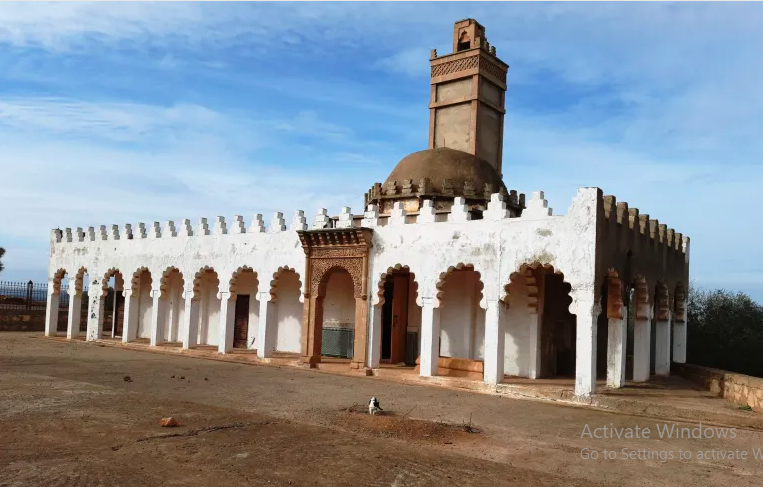
Shrine of ʿAbd Allāh ibn Yāsīn al-Jazūlī (Romani, near Rabat) — A whitewashed shrine with arches, a dome, and a tall minaret, rising quietly over an open rural landscape.
The Almoravid rise from Aglū demonstrates the ribāṭ's capacity to mobilize populations on an imperial scale. Within a generation of Waggāg's death, his students and their followers had conquered Morocco, subjugated the remnants of Barghawāṭa heterodoxy, eliminated the Bajliyya Twelver network, and extended their power across al-Andalus and deep into the Sahara. This was not mere military conquest but the transformation of ribāṭ methods into dynastic apparatus: the Almoravids imposed Mālikī jurisprudence as state law, systematized religious education according to Mālikī texts, and claimed to purify Moroccan Islam from deviation. Yet they could not eliminate Idrīsī ribāṭs because they themselves had emerged from one, had been trained by an Idrīsī sharīf, and depended on sharīfian baraka for legitimacy. When Yūsuf ibn Tāshfīn crossed to al-Andalus in 479/1086, he explicitly invited Abū al-Ḥasan ʿAlī ibn ʿAbd al-Raḥmān, the grandfather of the Dabbaghs, to accompany him bi-qaṣd al-tabarruk bihi (for the purpose of seeking blessing through him). The sultan required an Idrīsī sharīf's presence not for military advice or juridical expertise but for baraka—supernatural capacity that military force and legal training could not replicate. The Almoravid solution—preserve sharīfian status while imposing Mālikī frameworks—became the template for all subsequent dynasties.
After Waggāg's death, the ribāṭ at Aglū maintained continuous contact with Almoravid leadership. His successors—Sulaymān and Abū al-Qāsim ibn ʿAddū, also students trained at the ribāṭ—continued advising Almoravid amirs, demonstrating that the relationship between ribāṭ and dynasty was not one-time training but ongoing consultation. The ribāṭ's authority derived not from political appointment but from genealogical continuity and accumulated wisdom: Almoravid rulers needed sharīfian blessing to govern populations who recognized baraka as superior to military force. This dynamic—dynasties seeking legitimation from ribāṭs they theoretically controlled—would recur across Moroccan history, revealing the limits of political power when confronting genealogical authority.
6. Conclusion: The Ribāṭ as Foundation - Twelve Centuries of Idrīsī Authority
The historical record examined in this study establishes that ribāṭs constituted the earliest form of institutional Islam in Morocco, emerging in the 3rd/9th century as the spatial and social response to Idrīsī political fragmentation. But the ribāṭ was not merely the first institutional form of Moroccan Islam—it was the beginning of a sequence through which Idrīsī authority would structure Moroccan political, religious, and social life for twelve centuries, adapting to each dynastic cycle while maintaining genealogical continuity and institutional influence that transcended any particular regime. Understanding this sequence requires recognizing that the end of the Idrīsī state in 309/921 (or definitively in 374/985 with the assasination of al-Ḥasan ibn al-Qāsim Kannūn) did not mark the end of Idrīsī power but its transformation from centralized political authority into distributed institutional networks that would prove more durable than any dynasty Morocco would produce.
Stage One: The Idrīsī Ribāṭ Age (3rd-5th/9th-11th centuries)
The collapse of centralized Idrīsī authority transformed political vulnerability into institutional innovation. Where the Idrīsī state had concentrated power in Fez—making it vulnerable to assassination, infiltration, and eventual conquest—the ribāṭ network distributed Prophetic presence across Morocco's entire geography. Al-Qāsim's strategic withdrawal, Kanza's dispersal of Idrīs II's sons, and the multiplication of ribāṭ foundations created redundancy: destroying one node left dozens operational, eliminating one sharīf meant his descendants continued elsewhere, conquering Fez did not collapse the rural network. By the 5th/11th century, ribāṭs extended from Atlantic coast to Saharan edge, from Rif highlands to Atlas foothills, operating as comprehensive institutions providing education, arbitration, protection, welfare, and spiritual authority in territories where no other institutions existed.
The six functions identified in this study—transmission of Idrīsī baraka, Arabization through Qurʾānic education, creation of religious literacy, commercial security, legal arbitration, and comprehensive welfare—operated as an integrated system that addressed the total needs of populations beyond state reach. This comprehensiveness made ribāṭs indispensable and impossible to replicate. When political powers arose that could have challenged ribāṭ authority, they discovered instead that they required it.
Stage Two: Indirect Imperial Foundations - Almoravids and Almohads (5th-7th/11th-13th centuries)
The ribāṭ's most spectacular demonstration of institutional power came through its capacity to generate empires without possessing political sovereignty. Both of Morocco's medieval imperial dynasties—the Almoravids and the Almohads—emerged indirectly from Idrīsī ribāṭ networks, proving that genealogical authority grounded in comprehensive social service could mobilize populations on scales that conventional political power could not achieve.
The Almoravid movement originated at Ribāṭ Aglū, where Waggāg ibn Zallū al-Lamatī (d. 445/1054)—an Idrīsī sharīf descended from Yaḥyā ibn Idrīs II—trained ʿAbd Allāh ibn Yāsīn al-Jazūlī (d. 451/1059) in Mālikī jurisprudence, Qurʾānic sciences, and the spiritual discipline the ribāṭ embodied. When Ibn Yāsīn left Aglū to teach among Ṣanhāja nomads in the Sahara, he carried both Mālikī legal training and the ribāṭ model itself—a fortified position where teaching, spiritual formation, and military organization coexisted. The movement that conquered Morocco, subjugated Barghawāṭa heterodoxy, eliminated the Bajliyya Twelver network, and extended across al-Andalus took its very name from this institutional form: al-Murābiṭūn, "the people of the ribāṭ." Yet the Almoravids could not eliminate the Idrīsī ribāṭs from which they had emerged. When Yūsuf ibn Tāshfīn crossed to al-Andalus in 479/1086, he explicitly invited Abū al-Ḥasan ʿAlī ibn ʿAbd al-Raḥmān, the patriarch of the Dabbagh sharifs of Fez, to accompany him bi-qaṣd al-tabarruk bihi (for the purpose of seeking blessing). The dynasty required sharīfian baraka for legitimacy—supernatural capacity that military force and Mālikī jurisprudence could not replicate.
The Almohad case reveals the full theological implications of Idrīsī genealogy and Ahl al-Bayt doctrine. Muḥammad ibn Tūmart (d. 524/1130) was himself an Idrīsī sharīf, his lineage tracing through ʿAbd Allāh ibn Idrīs II. When Ibn Tūmart declared himself al-Mahdī al-Maʿṣūm (the Infallible Guided One), he was radicalizing Idrīsī Zaydī theology into its most extreme messianic form. The Mahdī concept—the awaited descendant of the Prophet ﷺ who would restore justice and establish divine rule before the end of time—operates entirely within Shīʿī cosmology and requires Prophetic genealogy through the Ahl al-Bayt as its foundational prerequisite. Ibn Tūmart's claim transformed Idrīsī baraka from inherited sanctity into eschatological necessity: his ʿiṣma (infallibility) positioned him beyond juridical challenge because the Mahdī, by definition, cannot err. This was the logical extension of Ahl al-Bayt theology that Idrīsī doctrine had always implied—if legitimate authority derives from Prophetic descent and baraka operates through blood, then the perfection of this principle produces not merely pious sharīfs but the messianic figure who completes Islamic history.
Both of Morocco's great medieval empires were thus founded directly by Idrīsī sharīfs who mobilized populations through ribāṭ institutional models and Ahl al-Bayt theological authority. The Almoravids emerged from Waggāg's teaching at Aglū, preserved Idrīsī sharīfian status while imposing Mālikī frameworks, and required continuous sharīfian blessing to mediate. The Almohads emerged from Ibn Tūmart's radical Mahdist interpretation of Ahl al-Bayt theology, elevated Idrīsī descent into messianic infallibility, and maintained the institutional model—comprehensive service, spiritual-military formation, tribal alliance strategies—that ribāṭs had created. When Idrīsī ribāṭs generated two successive empires that together ruled Morocco and al-Andalus for over two centuries (448-668/1056-1269), they proved that genealogical authority grounded in baraka and sustained through comprehensive service could mobilize populations more effectively than any conventional political formation. The institutional form developed in response to 3rd/9th century political crisis had demonstrated capacity not merely to survive dynastic collapse but to build empires that would reshape the entire Islamic West.
Stage Three: The Marinid Alliance and Ṭarīqa Introduction (7th-9th/13th-15th centuries)
The Marinid period (668-869/1269-1465) marked a fundamental shift in the relationship between Idrīsī networks and political power. Unlike the Almoravids, who had emerged from an Idrīsī ribāṭ, or the Almohads, who had challenged Idrīsī authority while depending on ribāṭ infrastructure, the Marinids were Zanāta Berbers lacking both Ṣanhāja genealogical claims and Maṣmūda Mahdist ideology. Their legitimacy crisis required a different solution: alliance with, rather than appropriation of, Idrīsī authority.
The Marinid strategy operated on multiple fronts simultaneously. First, they patronized the two great Idrīsī shrines—Mawlāy Idrīs I in Zarhūn and Mawlāy Idrīs II in Fez—transforming them into pilgrimage centers that reinforced sharīfian sanctity while channeling popular devotion through state-controlled spaces. Second, they encouraged the return of the Idrīsī diaspora to Fez, reversing centuries of geographic dispersal by creating urban positions, granting stipends, and incorporating Idrīsī sharīfs into administrative and scholarly networks. Third, they adopted the Nizāmiyya educational model—the systematic integration of fiqh, kalām, and institutionalized taṣawwuf (spiritual training)—using al-Qarawiyyīn as the institutional base through which this new organizational form would enter Morocco.
The introduction of the ṭarīqa concept through al-Qarawiyyīn scholars represented a profound institutional innovation distinct from the ribāṭ model. Where ribāṭs had operated as comprehensive institutions embedded in tribal contexts, providing juridical, educational, economic, protective, and spiritual functions simultaneously, ṭarīqas specialized in spiritual formation with defined membership, hierarchical structure, and systematized methods. The process began with ʿAbd al-Nūr al-Amrānī (b. 685/1286), an Idrīsī Jūtī sharīf and al-Qarawiyyīn scholar who traveled to Tunis in 745/1345 to collect narratives about Abū al-Ḥasan al-Shādhilī and write the first Moroccan work documenting ṭarīqa organization. His student Ibn ʿAbbād al-Rundī (d. 792/1377), serving as imam of al-Qarawiyyīn, introduced Ibn ʿAṭāʾ Allāh's texts (d. 709/1309) and created scholarly discourse around ṭarīqa methods. But this remained theory confined to urban elite circles; the ṭarīqa had not yet transformed rural practice or challenged ribāṭ dominance.
Stage Four: Wattasid Collapse and Idrīsī Restoration (9th-10th/15th-16th centuries)
The fall of the Marinids and the weak Wattasid interregnum (876-961/1472-1554) created conditions for direct Idrīsī political resurgence. Between 954-959/1547-1552, Muḥammad ibn ʿAbd al-Raḥmān al-Jūtī—an Idrīsī sharīf from the line of al-Qāsim ibn Idrīs II—ruled Fez as sultan for five years, demonstrating that Idrīsī genealogical authority could still translate into political sovereignty when dynastic power collapsed. Though brief, this sultanate proved that six centuries after losing centralized control, Idrīsī descendants retained sufficient legitimacy to claim the throne when circumstances permitted.
But the more consequential Idrīsī restoration occurred not through direct political rule but through the institutional revolution Muḥammad ibn Sulaymān al-Jazūlī (d. 869/1465) initiated. Al-Jazūlī spent seven years (843-850/1428-1435) at Ribāṭ ʿAyn al-Fiṭr studying under Abū ʿAbd Allāh Amghār al-Ṣaghīr, absorbing ribāṭ methods four centuries after the institution's founding. He then combined this formation with the ṭarīqa organizational model, creating what can be understood as the first successful integration of ribāṭ comprehensive service with ṭarīqa hierarchical structure. His Dalāʾil al-Khayrāt became one of Islam's most widely circulated devotional texts, but his greater achievement was mobilizing populations through networks that extended from rural Dukkala to Aghmat, Aṣafī, and Sus.
Al-Jazūlī's theoretical work restored sharīfian imamate as the foundational principle of Islamic authority precisely when Wattasid weakness made alternative legitimations impossible. His jihād against Portuguese incursions demonstrated that sharīfian authority could mobilize military resistance where dynastic power had failed. When he was assassinated in 869/1465—poisoned, like so many Idrīsī ancestors—his students and spiritual descendants continued the work he had begun. The Jazūliyya networks he established in Marrakesh, combining ribāṭ methods with ṭarīqa organization, created the institutional infrastructure that would raise the Saʿdian dynasty to power.
Stage Five: The Saʿdian Sharīfian State (10th-11th/16th-17th centuries)
The Saʿdian rise (956/1549 onward) completed the trajectory this study has traced. The Saʿdians were not Idrīsī but Ḥasanī sharīfs claiming descent through Muḥammad al-Nafs al-Zakiyya (145/76). Yet their path to power operated entirely through networks Idrīsī ribāṭs and Jazūlī organization had created. The Jazūliyya's institutional presence in Marrakesh, its capacity to mobilize tribal populations through comprehensive service combined with ṭarīqa structure, and its ideological emphasis on sharīfian legitimacy as the only valid Islamic authority made Saʿdian sovereignty possible. When the Saʿdians defeated the Wattasids and established Morocco's second explicitly sharīfian dynasty, they were fulfilling a program Idrīsī networks had sustained for seven centuries: that legitimate authority in Morocco derives from Prophetic descent, operates through baraka authenticated by service, and transcends any particular political regime.
The ʿAlawid dynasty that succeeded the Saʿdians in 1069/1659 and rules Morocco today represents the final stage in this sequence. The ʿAlawids, like the Saʿdians, descends from Muḥammad al-Nafs al-Zakiyya rather than Idrīs ibn ʿAbd Allāh, yet their legitimacy rests on foundations Idrīsī ribāṭs established: the principle that Morocco requires sharīfian rule, the institutional networks connecting rural populations to Prophetic genealogy, the pilgrimage circuits venerating saints embedded in landscapes, and the social compact in which baraka obligates service and service sustains baraka. When ʿAlawid sultans patronize Mawlāy Idrīs's shrines in Fez and Zarhūn, sponsor the mawsim (annual festival) cycles, and incorporate Idrīsī descendants into state administration, they acknowledge debts to networks that predate their own sovereignty by eight centuries.
The Ribāṭ as Beginning: Institutional Foundation and Historical Trajectory
What this chronological sequence reveals is that the ribāṭ was not a stage Morocco outgrew but a foundation upon which all subsequent developments were built. The six functions ribāṭs performed in the 3rd-5th/9th-11th centuries—education, Arabization, arbitration, protection, welfare, baraka transmission—created the infrastructure that enabled Almoravid and Almohad mobilization, facilitated Marinid ṭarīqa adoption, sustained al-Jazūlī's institutional revolution, and made Saʿdian and ʿAlawid sharīfian states possible. Each transformation adapted ribāṭ logic to new organizational requirements rather than replacing it: the Almoravids militarized the ribāṭ, the Marinids urbanized it, al-Jazūlī systematized it, the Saʿdians and ʿAlawids nationalized it.
The methodological reversal this study proposes—beginning with ribāṭs rather than with dynasties or with later Mālikī and Sufi institutions—transforms how we understand not just Moroccan Islamic origins but the enduring patterns of authority, sanctity, and political legitimacy that structure Morocco to the present. Ribāṭs were neither marginal nor transitional but foundational, creating institutional forms, social relationships, and legitimation principles that twelve centuries of political change could not eliminate. The Idrīsī state lasted less than two centuries; the Idrīsī ribāṭ network has operated for twelve, adapting to every dynasty while outlasting them all.
Understanding Morocco's Islamic history therefore requires recognizing that political sovereignty and institutional authority have operated on different timescales and through different mechanisms. Dynasties rise and fall across generations; ribāṭ networks reproduce across centuries. States claim territory through conquest; ribāṭs claim authority through baraka sustained by service. Political power requires constant military and administrative effort; genealogical legitimacy operates through inheritance and presence. When we recognize these distinctions, the ribāṭ emerges not as a curious artifact of medieval Morocco but as the institutional form through which Prophetic authority was made continuous, operative, and politically consequential across a millennium of dynastic instability.
The story this article tells—of ribāṭs emerging from Idrīsī dispersal, creating Morocco's first Islamic infrastructure, generating two empires, adapting to Marinid ṭarīqa introduction, enabling al-Jazūlī's restoration of sharīfian imamate, and facilitating Saʿdian and ʿAlawid sovereignty—is only beginning. The subsequent institutional transformations through which ribāṭ logic enters modernity, the twentieth-century appropriations through which nationalist and Islamist movements claim Idrīsī heritage, and the contemporary politics of baraka, genealogy, and authority in postcolonial Morocco all require separate treatment. But none of these later developments can be understood without first recognizing what this study has established: that the ribāṭ created the deep structure of Moroccan Islam, and that structure endures.
