
The Moroccan Sufi Experience and the Making of Islamic Civilization
The study of Moroccan Sufism has long operated within a framework that assumes more than it demonstrates. Prevailing scholarship tends to treat taṣawwuf as a unified Islamic science of interiority, originating in the early ascetic milieus of Basra and Baghdad, systematized by figures such as al-Junayd (d. 298/910) and al-Ghazālī (d. 505/1111), and subsequently transmitted to the Maghrib, where it acquired regional characteristics without altering its essential structure. Moroccan Sufism, in this reading, appears as a local instantiation of a universal model—the Ghazālian synthesis adapted to North African conditions.
This essay challenges that framework by proposing that Morocco represents not a regional variation, but an exception—and that this exception has civilizational consequences that extend far beyond the borders of the kingdom itself.
When Mawlāy Idrīs ibn ʿAbdallāh arrived in Morocco in 172/788, he carried with him more than a claim to political refuge. He carried a conception of sacred authority that would shape the far Islamic West for more than twelve centuries. A great-great-grandson of al-Ḥasan ibn ʿAlī and a survivor of the failed uprising at Fakhkh, he was not fleeing history but relocating it. In the valleys of the Maghrib, beyond the reach of Abbasid surveillance, he established the first ʿAlid state since ʿAlī ibn Abī Ṭālib had ruled from Kufa—and the first anywhere founded by the Ḥasanid line. His son, Mawlāy Idrīs II, would build Fez: not merely a city, but an imperial capital, a declaration that the descendants of the Prophet ﷺ possessed the right and capacity to rule, to build, and to civilize. Before the legal schools had consolidated, before the Sufi orders had formalized, before theological camps had hardened into rival positions, Morocco had already received a foundational principle that would distinguish it from every other Muslim polity: that prophetic descent (sharaf) confers a form of authority no military conquest can grant and no scholarly credential can replace.
It is from this starting point—not from Baghdad, Khurasan, or Cairo—that Moroccan Sufism must be understood.
Sufism itself is not a political invention. It is the science of the soul's journey to God—the discipline by which the heart is purified, the veils of heedlessness lifted, the human being restored to the state of servanthood for which it was created. This science is real. It exists because God exists, because He disclosed Himself to His Prophet ﷺ, and because the Prophet transmitted that disclosure to those capable of receiving it. No institution created it; no settlement can abolish it. The path to God is not a product of history, even if its institutional forms necessarily pass through history.
But pass through history they did. And history is never neutral. The classical narrative of Sufism's formation—its codification in Khurasan, its integration into the Niẓāmiyya madrasa system, its ethical alignment with organized futuwwa, and its theological synthesis in al-Ghazālī's Iḥyāʾ ʿUlūm al-Dīn—was not merely a process of preservation. It was also a process of selection, regulation, and reorientation, designed to render Sufism compatible with Sunni juridical authority and imperial governance. This is not conspiracy; it is how institutions work. Sacred knowledge, entering the domain of law and statecraft, was shaped by the needs of those who administered it.
Central to this process was a reconfiguration of spiritual genealogy. The silsila, universally acknowledged as passing from the Prophet ﷺ through ʿAlī ibn Abī Ṭālib (d. 40/661), originally continued through the Prophet’s household as living bearers of sacred knowledge. In the first centuries of Islam, figures such as Zayn al-ʿĀbidīn (d. 95/713), Muḥammad al-Bāqir (d. 114/732), and Jaʿfar al-Ṣādiq (d. 148/765) functioned not as sectarian symbols, but as widely recognized heirs of prophetic wisdom, teaching jurists, ascetics, and early masters of the interior path. The connection between the Ahl al-Bayt and the science of the heart was not a matter of faction; it was a matter of family—of proximity to the source. The earliest individuals historically designated as “Sufi” emerged from this milieu of prophetic inheritance and familial transmission.
Over time, however, as imperial institutions sought to stabilize religious authority, this genealogical intimacy was attenuated. Prophetic descent was acknowledged symbolically but displaced institutionally, transformed from a living axis of authority into a revered origin point detached from governance. The silsila was preserved, but its intermediate links—the generations between ʿAlī and al-Junayd—were obscured or minimized. The result was a Sufism that honored the Prophet's family at its root while routing its institutional transmission through scholars aligned with caliphal power.
Morocco is decisive for understanding this transformation because it never fully accepted that displacement.
When Eastern Sufi institutions and texts began arriving in the Maghrib under Marinid patronage (668–869/1269–1465), they encountered a society already structured around sharīfian authority. The Idrīsid legacy had embedded in Moroccan political culture the conviction that sanctity and sovereignty could converge in prophetic lineage—not as abstract doctrine, but as lived reality. The ribāṭs that preceded the zawāyā were founded by Idrīsid sharīfs. The saints who emerged in the Almoravid and Almohad periods operated within a framework where descent from the Prophet was not merely honorific but politically consequential. As a result, Sufism in Morocco did not remain confined to lodges or scholarly circles. It became entangled with land, mediation, allegiance, resistance, and rule. The zāwiya emerged not as a marginal spiritual retreat but as a parallel institution of authority—economic, juridical, military, and symbolic.
The thesis of this essay is therefore not that Moroccan Sufism represents a deviation from a universal norm, but that it constitutes a distinct civilizational formation. It arose from the interaction between two inheritances: an indigenous sharīfian principle of authority rooted in the Idrīsid foundation, and an imported, institutionally refined Sufism shaped by Eastern imperial settlements. Their collision—not their harmonious blending—produced a uniquely Moroccan configuration in which sanctity functioned as a public, organizing force rather than a private spiritual discipline.
This configuration explains Morocco's historical trajectory in Africa. Through its Sufi networks, scholarly prestige, and sharīfian legitimacy, Morocco became the principal vehicle for the Islamization of West and Central Africa, transmitting not only Mālikī jurisprudence and Ashʿarī theology, but a model of Islam in which devotion to the Prophet ﷺ, loyalty to his descendants, and social cohesion were structurally intertwined. Egypt, closer to the historical centers of Islamic learning, did not achieve this reach. The Ottomans, masters of a vast empire, did not attempt it. Morocco succeeded because it exported not conquest but civilization—and because its civilization was anchored in a synthesis that other polities could not replicate.
This legacy persists in the modern period. The Moroccan monarchy's claim to the title Amīr al-Muʾminīn is not a ceremonial survival, but the continuation of a political theology in which religious authority, prophetic descent, and state legitimacy remain inseparable. In an African religious landscape contested by Salafi literalism, externally funded extremism, and rival ideological exports, Morocco's Sufi infrastructure—rooted in sharīfian legitimacy and institutional continuity—functions as a stabilizing civilizational force. The Commander of the Faithful presides over a religious establishment in which the ṭarīqas are partners, not subordinates, and in which the centuries-old negotiation between throne and zāwiya continues to structure the nation's religious life.
The methodological orientation of this essay is analytical rather than devotional. It treats Moroccan Sufism as a historical formation shaped by concrete conditions, power relations, and inherited structures—neither reducible to theology alone nor dismissible as ideology. The path to God is real; the institutions that transmit it are human. This essay seeks to render intelligible the Moroccan exception: how Sufism, in this particular land and through this particular lineage, ceased to be merely a spiritual path and became the grammar of a civilization.
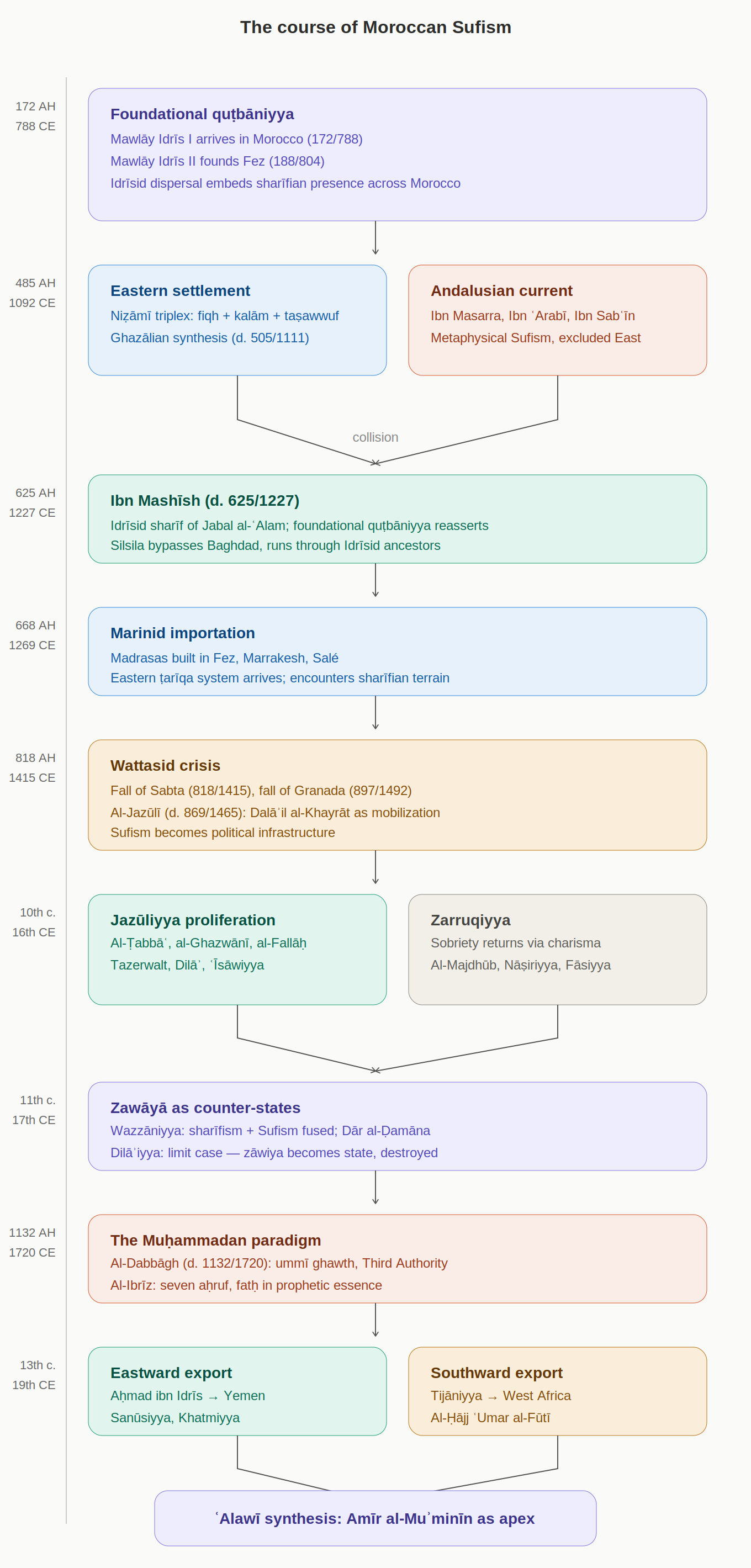
A chronological diagram tracing the development of Moroccan Sufism from the Idrīsid foundation (172/788 CE) to the ʿAlawī synthesis.
1. The Divine Science and Its Transmission
The Prophet ﷺ said: "I am the city of knowledge and ʿAlī is its gate." Fourteen centuries of Sufi tradition have taken this statement seriously. Every major silsila—without exception—passes through ʿAlī ibn Abī Ṭālib before reaching the Prophet ﷺ. Not through Abū Bakr alone. Not through ʿUmar. Not through any other Companion. The Qādiriyya, the Shādhiliyya, the Rifa’iyya, the Khalwatiyya: however they differ in method or geography, they converge on this single point. The convergence is not sentimental. It is structural. If the Prophet ﷺ is the city, ʿAlī is how you enter. There is no other gate.
The question this poses is not devotional but analytical. Why ʿAlī? The Prophet ﷺ had Companions of immense stature—men who migrated, fought, governed, transmitted ḥadīth, founded schools. Yet when the Sufi tradition constructed its chains of spiritual authority, it routed them through ʿAlī with a consistency that demands explanation. The answer cannot be reduced to political allegiance or sectarian affiliation; the silsilas are maintained by Sunni orders with no connection to Shīʿī legal or theological positions. The answer lies elsewhere: in a body of prophetic teaching concerning ʿAlī's unique access to the interior dimension of revelation, and in the doctrine that this access was inheritable—transmissible through his descendants to subsequent generations, forming a chain of light that would extend until the end of time.
The Prophet ﷺ did not merely designate ʿAlī as a knowledgeable Companion. He designated him as the exclusive point of entry to a particular domain of knowledge. He declared that ʿAlī was to him as Hārūn was to Mūsā, excepting only prophethood. He said that he and ʿAlī were created from a single light fourteen thousand years before Adam, that the light was deposited in Adam and passed through the loins of the prophets until it divided between ʿAbd Allāh and Abū Ṭālib, producing Muhammad ﷺ and ʿAlī, and that it reunited in al-Ḥasan and al-Ḥusayn—"two lights from the light of the Lord of the Worlds." At Ghadīr Khumm, before the assembled community, he declared: "Whomsoever I am his master, ʿAlī is his master." These statements constitute not merely praise but investiture. They establish ʿAlī as the bearer of a prophetic function that continues after the seal of prophecy: the function of wilāya, the authority to guide the community in matters of interior knowledge.
This function was not personal to ʿAlī alone. The doctrine of reunited light establishes that al-Ḥasan and al-Ḥusayn carry forward what was divided between the Prophet ﷺ and ʿAlī. The pairing of the Quran with the ʿitra in the ḥadīth al-thaqalayn—"I leave among you that which, if you hold fast to it, you will never go astray: the Book of God and my household"—establishes that the Prophet's ﷺ family constitutes a permanent hermeneutical authority, indispensable for the community's access to the full dimensions of revelation. The Quran is the text; the ʿitra are its living interpreters, bearers of the knowledge required to unlock its interior meanings. This pairing is not rhetorical. It is structural. The Book without the household is incomplete; the chain of transmission that does not pass through the household lacks authority.
The teachings attributed to ʿAlī in the earliest sources confirm his function as the origin of what would later be systematized as Sufi doctrine. His fourfold hermeneutic of the Quran distinguished the exterior (ẓāhir), the interior (bāṭin), the limit (ḥadd), and the point of ascent (maṭlaʿ)—the framework that Sufi exegesis would elaborate for centuries. His dialogue with Kumayl ibn Ziyād (d. 82/701) on the nature of ḥaqīqa (ultimate reality) provides the template for Sufi discourse on metaphysical realization: reality is the unveiling of the splendors of divine majesty without indication; it is the negation of the imagined alongside the affirmation of the known; it is the tearing of the veil through the overwhelming of the secret; it is the attraction of divine oneness toward the attribute of unification; it is a light that flashes from the dawn of eternity and manifests its traces upon the temples of unity. His classification of humanity into the God-centered scholar (ʿālim rabbānī), the learner who is on the path of salvation, and the rabble—aimless followers of every caller, combined with his declaration that the earth is never devoid of one who stands for God with proof—"whether manifest and famous, or fearful and obscured"—establishes the doctrine that later tradition would formalize as the hierarchy of saints: aqṭāb, abdāl, awtād, nuqabāʾ. The terminology would be refined; the structure was already present in ʿAlī's teaching.
The transmission continued through ʿAlī's descendants with a consistency the sources document but the received historiography tends to minimize. Zayn al-ʿĀbidīn, ʿAlī's grandson through al-Ḥusayn, produced the Ṣaḥīfa al-Sajjādiyya, the earliest extant corpus of Islamic devotional literature. His articulation of worship—grounded neither in fear of punishment nor hope of reward, but in the recognition of God’s worthiness to be worshipped—ascribed to Zayn al-ʿĀbidīn—predates by nearly a century the teaching conventionally attributed to Rābiʿa al-ʿAdawiyya (d. 185/801). His son Muḥammad al-Bāqir taught figures foundational to Sufi history, including Ibrāhīm ibn Adham (d. 161/778). Al-Bāqir’s son Jaʿfar al-Ṣādiq presided over a teaching circle in Kufa and Medina numbering, according to classical sources, nine hundred scholars. His students included Abū Ḥanīfa (d. 150/767), Mālik ibn Anas (d. 179/795), Jābir ibn Ḥayyān (d. 197/813), Abū Yazīd al-Bisṭāmī (d. 261/874), and nearly every figure whom the later tradition would credit with founding Sufi doctrine. The knowledge these masters transmitted was not their own invention; it was inheritance from the household of the Prophet ﷺ.
The record of those who held the supreme spiritual station in the early generations confirms this structure—and clarifies a distinction that later Sufi systematization would obscure. The quṭbāniyya that passed through the Prophet's ﷺ household was not the quṭbāniyya that any realized saint might attain through spiritual struggle and divine election. It was the foundational quṭbāniyya (al-quṭbāniyya al-aṣliyya): the axis-hood that inheres in prophetic lineage by divine designation, coextensive with ʿAlid wilāya, inseparable from the seat of prophethood, and constituting the root from which all subsequent forms of saintly authority derive their legitimacy. This quṭbāniyya is not acquired; it is inherited. It does not depend on a master's authorization or a ṭarīqa's chain; it flows through the blood that carried the prophetic light before Adam's creation. Later tradition would recognize quṭbs outside the prophetic lineage—saints whose spiritual realization elevated them to the axis of their age. But theirs is derivative quṭbāniyya, branching from a root they did not plant. The foundational quṭbāniyya remained with the Ahl al-Bayt: from Fāṭima to ʿAlī, from ʿAlī to al-Ḥasan, from al-Ḥasan to al-Ḥusayn, and through their descendants in an unbroken chain. The sources record this chain: Zayn al-ʿĀbidīn, Muḥammad al-Bāqir, Zayd ibn ʿAlī (d. 122/740), ʿAbd Allāh al-Kāmil (d. 145/762), Muḥammad al-Nafs al-Zakiyya (d. 145/762), Jaʿfar al-Ṣādiq, Mūsā al-Kāẓim (d. 183/799), ʿAlī al-Riḍā (d. 203/818)—and, as subsequent sections will demonstrate, Idrīs ibn ʿAbd Allāh and Idrīs ibn Idrīs, founders of the Moroccan state and the city of Fez.
When Idrīs ibn ʿAbd Allāh arrived in Morocco in 172/788, he was not merely a political refugee seeking territory beyond Abbasid reach. He was, by the categories the tradition itself supplies, a bearer of foundational quṭbāniyya—a link in the chain of prophetic light extending from the Prophet ﷺ through ʿAlī, through al-Ḥasan, through ʿAbd Allāh al-Kāmil, to himself. Morocco did not receive the ʿAlid principle through books, through institutions, through scholars trained in Eastern centers. It received the principle in the person of a living quṭb, who established a dynasty, founded cities, and embedded the prophetic light in Moroccan soil. His son Idrīs II (r. 188–213/804–828), who built al-ʿĀliyya as an imperial capital, continued this function. The Moroccan sharīfian tradition is therefore not a regional adaptation of a universal Sufism that originated elsewhere. It is the direct implantation of the foundational quṭbāniyya itself—three centuries before the Marinids imported the Niẓāmī curriculum, four centuries before the ṭarīqa system took institutional form.
The foundational quṭbāniyya did not vanish when the Idrīsid state fragmented. It persisted in the bloodline, carried by descendants dispersed across the mountains and plains of Morocco, preserved in families who maintained their genealogical consciousness even as political power passed to other dynasties. Four centuries after Idrīs II, this quṭbāniyya resurfaced in ʿAbd al-Salām ibn Mashīsh (d. 625/1227), the Idrīsid sharīf of Jabal al-ʿAlam who became the axis of Moroccan Sufism without founding a ṭarīqa, without writing treatises, without traveling to Eastern centers of learning. Ibn Mashīsh's significance lies precisely in what his silsila is not: it does not pass through al-Junayd, through the Baghdadi school, through the Khurasani codifiers. It runs through his Idrīsid ancestors—through Idrīs II, through Idrīs I, through ʿAbd Allāh al-Kāmil, through al-Ḥasan, through ʿAlī—directly to the Prophet ﷺ. When Abū al-Ḥasan al-Shādhilī traveled east and received initiation from al-Wasitī, he was told: "Return to the Maghrib; there you will find your master." He found Ibn Mashīsh. The transmission he received was not derivative quṭbāniyya authorized by an Eastern ṭarīqa; it was the foundational quṭbāniyya of the Ahl al-Bayt, preserved in Moroccan soil, reasserting itself at the moment when institutional Sufism was beginning to arrive from the East. The collision between these two forms—the foundational and the derivative, the inherited and the acquired, the Idrīsid and the Niẓāmī—produced the Moroccan exception.
The geographical origin of Sufi vocabulary reinforces this analysis. Kufa—the city of ʿAlī's caliphate, the center of devotion to his house—was where the term ṣūfī first appeared, applied to figures associated with the ʿAlid circle. Kufa was the birthplace of futuwwa, the ethic of spiritual chivalry that the Abbasid caliph al-Nāṣir would later attempt to capture for caliphal authority. Kufa was where wool was worn as a mark of protest against Umayyad silk, and where the ascetic practices that would later characterize Sufism first took communal form. The concepts of wilāya, quṭb, ghawth, the hierarchy of abdāl and awtād—these emerged among the partisans of ʿAlī before they were systematized in Khurasani manuals or integrated into Baghdadi curricula. The standard narrative's emphasis on Basra as the origin of Sufism is a displacement. It serves to detach the science from its ʿAlid roots. The historiographical operation is not innocent.
The eschatological dimension completes the structure. ʿAlī declared that he opens every knowledge and the Qāʾim seals it. The Mahdī—the awaited descendant of the Prophet ﷺ through Fāṭima who will appear at the end of time—represents the consummation of the prophetic light, the final manifestation of the wilāya that began with ʿAlī. The Sufi hierarchy of saints functions, in the interim, as the spiritual government of the world, preserving the light and transmitting it until the seal appears. The quṭb of each age stands as the link between ʿAlī's opening and the Mahdī's sealing. Morocco, through the Idrīsid implantation of foundational quṭbāniyya, is situated within this arc—not as a peripheral recipient of Eastern developments, but as a direct bearer of the prophetic light awaiting its eschatological fulfillment.
But if the foundational quṭbāniyya passed directly to Morocco through the Idrīsids, what was it that the East developed in the intervening centuries? What happened to Sufism in Baghdad, in Khurasan, in the territories under Abbasid and then Seljuk control, while the prophetic light was embedding itself in Moroccan soil? The answer is not that the East invented Sufism—the science already existed, transmitted through the Ahl al-Bayt to the early masters. The answer is that the East institutionalized it: codified it in manuals, integrated it into madrasa curricula, aligned it with juridical orthodoxy, and subordinated it to caliphal authority. This process—the Eastern settlement—produced the form of Sufism that would eventually arrive in Morocco under Marinid patronage. To understand the Moroccan exception, we must first understand what Morocco did not accept: the settlement itself, and the derivative quṭbāniyya it authorized.
2. The Eastern Settlement
The science that ʿAlī opened did not remain in the hands of those who inherited it by blood. Within two centuries of the Prophet's ﷺ death, a process began that would reshape Sufism from a living transmission rooted in the Ahl al-Bayt into an institutional system compatible with Sunni juridical authority and imperial governance. This process—what this essay terms the Eastern settlement—was not a corruption of Sufism. The path to God remained real; the knowledge transmitted through the early masters remained valid; the transformations of the heart that the science effected did not cease. But the form in which the science was preserved, transmitted, and authorized underwent a fundamental change. The settlement produced a Sufism that could be taught in madrasas, supervised by jurists, and deployed in the service of caliphal legitimacy. It produced a quṭbāniyya that could be attained through spiritual realization and authorized through initiatic chains, independent of prophetic lineage. It produced, in short, the Sufism that the Marinids would later import to Morocco—and that would collide there with the foundational quṭbāniyya the Idrīsids had already implanted.
The settlement unfolded in stages, each responding to specific political pressures. The first stage was geographical: the displacement of Kufa by Basra and Baghdad as the recognized centers of Sufi teaching. Kufa, as the previous section established, was the birthplace of Sufi vocabulary and practice—the city of ʿAlī's caliphate, the home of his partisans, the site where wool was first worn as a mark of devotion and dissent. But Kufa was also dangerous. It was the center of ʿAlid loyalty, the staging ground for revolts against Umayyad and then Abbasid rule, the city most associated with the claim that the Prophet's ﷺ family possessed rights that the caliphate had usurped. The Abbasids, having ridden ʿAlid sympathy to power only to deny the ʿAlids the authority they had been promised, had every reason to diminish Kufa's religious prestige. The elevation of Basra—home of al-Ḥasan al-Baṣrī ī (d. 110/728), a figure with no ʿAlid political associations—as the origin point of Islamic asceticism served this purpose. The narrative that Sufism began with the Basran zuhhād, rather than with the Kufan partisans of ʿAlī, detached the science from its politically dangerous roots. It was the first act of historiographical displacement.
The second stage was genealogical: the reconstruction of the silsila to minimize the Ahl al-Bayt's teaching role. The chain that connects every Sufi order to the Prophet ﷺ passes through ʿAlī—this the settlement could not erase without destroying the tradition's own self-understanding. But the links between ʿAlī and al-Junayd, the figure who would be positioned as the "master of the masters" and the pivot of Sunni Sufism, could be reorganized. The silsila that became standard routes transmission from ʿAlī to al-Ḥasan al-Baṣrī, bypassing the descendants of ʿAlī entirely. Al-Ḥasan al-Baṣrī becomes the crucial node: a figure of unimpeachable Sunni credentials, a scholar who never claimed ʿAlid authority, a man who could serve as a bridge between the Prophet's ﷺ household and the later masters without carrying the political charge that figures like Zayn al-ʿĀbidīn, al-Bāqir, or al-Ṣādiq inevitably bore. The historical record—that these descendants of the Prophet ﷺ taught the very masters credited with founding Sufi doctrine—was not denied; it was simply minimized, relegated to footnotes, overwhelmed by the emphasis on chains that passed through safer figures.
The third stage was textual: the codification of Sufi teaching in manuals that could be studied, transmitted, and supervised independent of living masters from the prophetic household. This process began in Khurasan in the fourth/tenth century and produced the canonical literature of Sunni Sufism: al-Sarrāj's Kitāb al-Lumaʿ, al-Kalābādhī's al-Taʿarruf, al-Qushayrī's al-Risāla, al-Hujwīrī's Kashf al-Maḥjūb. These texts served multiple functions. They systematized Sufi vocabulary, providing definitions of maqāmāt and aḥwāl that could be taught as a curriculum. They defended Sufism against charges of heresy by demonstrating its compatibility with Sunni jurisprudence and Ashʿarī theology. They established a canon of recognized masters—a list of authorities whose teachings could be safely cited—while marginalizing figures whose ʿAlid associations or ecstatic utterances made them problematic. Al-Ḥallāj, executed in 309/922 for pronouncements that threatened the distinction between Creator and creature, became the paradigm of Sufism's dangerous edge; al-Junayd, master of "sobriety" (ṣaḥw) and critic of ḥallājian excess, became the paradigm of its safe center. The textualization of Sufism made it portable, teachable, and—crucially—controllable by institutions other than the Ahl al-Bayt.
The fourth stage was institutional: the integration of Sufism into the Niẓāmiyya madrasa system established under Seljuk patronage. Niẓām al-Mulk (d. 485/1092), vizier to the Seljuk sultans Alp Arslan and Malik-Shāh, created a network of madrasas designed to produce scholars loyal to a specific synthesis: Shāfiʿī jurisprudence, Ashʿarī theology, and disciplined Sufism. This "triplex" was not an organic development; it was a strategic response to the Fatimid challenge. The Fatimid caliphate, established in North Africa and extended to Egypt, represented an alternative Islamic civilization grounded in Ismāʿīlī doctrine—a civilization that claimed access to esoteric knowledge through the Imam, offered a comprehensive religious formation to its adherents, and threatened to absorb the loyalties of Muslims dissatisfied with Abbasid rule. The Niẓāmiyya system was designed to counter this threat by offering everything the Fatimid daʿwa offered—legal guidance, theological coherence, spiritual depth—without requiring allegiance to an ʿAlid Imam. Sufism, integrated into this system, became a tool of Sunni state-building: a means of providing access to the interior dimensions of religion under the supervision of jurists and the patronage of sultans.
The fifth stage was theological: the synthesis achieved by Abū Ḥāmid al-Ghazālī (d. 505/1111) in his Iḥyāʾ ʿUlūm al-Dīn. Al-Ghazālī, a product of the Niẓāmiyya system and its most influential graduate, accomplished what no previous figure had: a comprehensive integration of Sufi interiority with Sunni legal and theological orthodoxy. The Iḥyāʾ demonstrated, in encyclopedic detail, that the science of the heart was not a deviation from normative Islam but its completion—that fiqh without taṣawwuf was a body without a soul, but that taṣawwuf without fiqh was a soul without a body. This synthesis was not merely intellectual; it was institutional. It provided the theoretical foundation for a Sufism that could be taught in madrasas, supervised by jurists, and practiced by scholars whose primary allegiance was to the juridical establishment. The ṭarīqa system that emerged in subsequent centuries—organized orders with standardized litanies, hierarchical structures, and institutionalized chains of authorization—was built on the Ghazālian foundation. The Sufi shaykh became a figure analogous to the jurist: an authority whose legitimacy derived from his place in a chain of transmission, certified by his predecessors, integrated into a system of training and authorization that paralleled the juridical ijāza.
The sixth stage was political: the capture of futuwwa under caliphal authority. The Abbasid caliph al-Nāṣir li-Dīn Allāh (r. 575–622/1180–1225), in 604/1207, issued a decree (manshūr) institutionalizing futuwwa—the ethic of spiritual chivalry—with the caliph himself as its supreme head. The decree was explicit: futuwwa originated with ʿAlī ibn Abī Ṭālib, who received it from the Prophet ﷺ. Al-Nāṣir was not denying ʿAlī's foundational role; he was appropriating it. By positioning the caliph as the head of a spiritual tradition that acknowledged ʿAlī as its origin, al-Nāṣir accomplished a remarkable inversion: ʿAlid charisma was captured for Abbasid legitimacy. The Sufi orders that aligned with this system—and most did—became instruments of caliphal religious policy. The quṭb was no longer necessarily a descendant of the Prophet ﷺ; he was whoever held the highest spiritual station in the Sufi hierarchy, authorized by chains that passed through al-Junayd and the Baghdadi masters, integrated into a system that ultimately acknowledged caliphal supremacy.
The paradigmatic figure of the settlement's final form was ʿAbd al-Qādir al-Jīlānī (d. 561/1166). A scholar of Ḥanbalī jurisprudence, a preacher of immense popular appeal, and a master whose spiritual authority was recognized across the Sunni world, al-Jīlānī embodied the synthesis the settlement had produced. He was a quṭb—but his quṭbāniyya was not foundational. It was not inherited through prophetic blood; it was attained through spiritual realization and authorized through initiatic chains. His order, the Qādiriyya, became the model for subsequent ṭarīqa organization: centralized authority, standardized practice, institutional structure capable of spanning vast distances and persisting across generations. The Qādiriyya spread from Baghdad across the Islamic world—including, eventually, to Morocco. It represented the settlement's success: a Sufism that honored ʿAlī at its root while routing authority through figures aligned with Sunni juridical and political institutions.
The settlement was not a conspiracy. It was a complex historical process involving scholars of genuine piety, masters of authentic realization, and institutions that transmitted real knowledge of God. The path remained real; the transformations it effected in human hearts remained valid; the saints it produced were saints. But the settlement had consequences. It separated quṭbāniyya from prophetic lineage, making it a station attainable by any realized master regardless of descent. It integrated Sufism into structures of Sunni state power, making the ṭarīqa a partner—often a subordinate partner—of the sultanate. It produced a form of religious authority that could be institutionalized, regulated, and deployed in the service of political legitimacy. And it obscured, without entirely erasing, the ʿAlid genealogy of the science—the fact that the masters credited with founding Sufi doctrine had learned it from the descendants of the Prophet ﷺ.
But the settlement was also an act of exclusion. The Niẓāmī triplex integrated a disciplined, juridically supervised Sufism; it did not integrate the philosophical Sufism that had developed in parallel—the current rooted in Neoplatonic emanationism, shaped by engagement with Greek metaphysics, and dangerously proximate to Ismāʿīlī cosmology. This Sufism spoke of fayḍ, of the Prophet ﷺ as the first emanation of divine light, of creation as a cascade of being flowing from the One through the Universal Intellect to the material world. It shared conceptual vocabulary with the Fatimid daʿwa the settlement was designed to counter. The Niẓāmī architects could not incorporate it without undermining the very boundaries they had constructed between Sunni orthodoxy and Ismāʿīlī esotericism. Al-Ghazālī himself attacked the philosophers; his synthesis made room for the heart's knowledge but not for emanationist metaphysics. The current that would later produce Ibn ʿArabī (d. 638/1240), Ibn Sabʿīn (d. 669/1270), al-Shushtarī (d. 668/1269) was not refused by accident. It was refused by design.
This refusal had geographical consequences. The philosophical Sufism that the East excluded did not disappear. It migrated—or rather, it flourished where it had already taken root: in the Andalusian-Maghribī space, within the territories of Almoravid and Almohad rule, among scholars who operated at the margins of state religious policy or in direct tension with it. Ibn Masarra in Córdoba (d. 319/931), Ibn al-ʿArīf in Almería (d. 536/1141), Ibn Barrajān in Seville (d. 536/1141), and later Ibn ʿArabī in Murcia—these figures developed a Sufism that the Eastern settlement could not absorb. When Ibn ʿArabī traveled east, he was read but not institutionalized; his school took root in the Mamluk lands and Ottoman domains only partially, and always controversially. Ibn Sabʿīn died in Mecca, rejected by the scholars of the Ḥijāz. al-Shushtarī wandered from court to court. The East produced the settlement; the Andalusian-Maghribī space produced what the settlement refused.
This is the second current that Morocco would inherit—not through state policy, not through institutional adoption, but through individual scholars, persecuted masters, and liturgical absorption. The Almoravids burned al-Ghazālī's Iḥyāʾ and imprisoned Ibn Barrajān. The Almohads had their own theological program and did not institutionalize Andalusian Sufism. Yet the cosmology survived, transmitted through circles of disciples, embedded in devotional texts, waiting to be absorbed into the Moroccan synthesis through channels the state did not control. How this occurred—and how Morocco took the depth of Andalusian metaphysics while refusing its philosophical apparatus—is the subject of the next section.
3. The Andalusian Current
The Sufism that the Eastern settlement excluded did not develop in opposition to Islam. It developed in engagement with the full inheritance of late antiquity—the Neoplatonic tradition that had passed into Arabic through the translation movement of the second/eighth and third/ninth centuries, carrying with it a metaphysics of emanation, a cosmology of descending light, and a conception of the soul's return to its origin that resonated profoundly with Quranic themes of divine self-disclosure and human vicegerency. This engagement was not unique to Andalusia; it occurred wherever Muslim intellectuals encountered Greek philosophy. But in Andalusia, at the far western edge of the Islamic world, this engagement produced a distinctive Sufi current—one that the Eastern settlement could not integrate and would eventually refuse.
The foundational figure was Muḥammad ibn Masarra of Córdoba (d. 319/931). A generation before al-Sarrāj began codifying Sufism in Khurasan, Ibn Masarra had already articulated a system that combined ascetic discipline with emanationist cosmology. His sources included the pseudo-Empedoclean texts circulating in Arabic, the Neoplatonic Theology of Aristotle (in fact a paraphrase of Plotinus), and the esoteric currents that had entered Islam through early Shīʿī and Ismāʿīlī channels. Ibn Masarra taught that creation proceeds from God through successive emanations—a divine light that descends through the Universal Intellect, the Universal Soul, and the celestial spheres to the material world, and that the human soul, by purification and ascent, could return through these stages to its origin. This was not the Sufism of the Basran zuhhād or the Baghdadi masters of sobriety. It was a Sufism shaped by philosophical cosmology, offering a map of the soul's journey grounded in metaphysical structure.
Ibn Masarra's teaching was controversial from the beginning. He was accused of heresy, left Córdoba for the East, and returned only to establish a circle of disciples in the mountains outside the city, away from the scrutiny of the jurists. After his death, his followers were persecuted; his books were burned; his grave was desecrated. Yet his influence persisted, transmitted through networks of disciples who preserved his teachings in secret or embedded them in less controversial forms. The Masarran current did not disappear. It went underground, resurfacing in subsequent generations in figures who carried forward the emanationist cosmology while adapting it to new circumstances.
Two centuries later, this current reemerged in the work of Ibn al-ʿArīf of Almería and Ibn Barrajān of Seville. Both operated under Almoravid rule—a dynasty of Mālikī literalists hostile to speculative theology and suspicious of Sufism. The Almoravids had conquered Andalusia to defend it against the Christian advance and to purify it of what they perceived as religious laxity; they were not patrons of philosophical mysticism. Ibn al-ʿArīf's Maḥāsin al-Majālis, a manual of spiritual instruction, presented Sufi teaching in terms acceptable to juridical sensibilities while preserving the Masarran emphasis on the soul's ascent through stages of purification. Ibn Barrajān's Quranic commentaries employed a symbolic hermeneutic that read the sacred text as a map of cosmic and spiritual realities—an approach that implied the emanationist framework without stating it explicitly. Both men attracted the suspicion of the Almoravid authorities. Ibn Barrajān was summoned to Marrakesh and imprisoned; he died in captivity. Ibn al-ʿArīf was also summoned to Marrakesh and died there shortly after arrival, under circumstances that suggest he was poisoned. The Almoravid state did not execute them publicly as the Abbasids had executed al-Ḥallāj. It removed them quietly, eliminating scholars whose teachings threatened the juridical monopoly on religious authority.
The persecution did not end the current. It dispersed it. The disciples of Ibn al-ʿArīf and Ibn Barrajān scattered across the Andalusian-Maghribī space, carrying their masters' teachings into new environments. Among them was a young man from Murcia who would become the most influential Sufi thinker in Islamic history: Muḥyī al-Dīn ibn ʿArabī. Ibn ʿArabī's work represents the full flowering of the Andalusian current—the emanationist cosmology brought to systematic completion, the Masarran themes elaborated into a comprehensive metaphysics of waḥdat al-wujūd (the unity of being), the symbolic hermeneutic extended to encompass the entirety of existence as divine self-disclosure. His al-Futūḥāt al-Makkiyya and Fuṣūṣ al-Ḥikam would shape Sufi thought for centuries, generating schools of commentary, provoking fierce controversy, and establishing a vocabulary of metaphysical Sufism that remains current to this day.
Yet Ibn ʿArabī did not remain in Andalusia. He left the Almohad domains in 598/1202 and never returned. His journey took him east—to Mecca, to Anatolia, to Damascus, where he died and was buried. The East received him, read him, debated him; but it did not institutionalize him the way it had institutionalized al-Ghazālī. The Niẓāmī triplex had no place for waḥdat al-wujūd. The juridical establishment that had integrated disciplined Sufism could not integrate a metaphysics that seemed to dissolve the distinction between Creator and creature. Ibn ʿArabī's school took root in certain circles—among Ottoman court scholars, in Indian Sufi lineages, in the commentarial traditions of Egypt and Syria—but always controversially, always at the margins of juridical respectability, never as part of the normative synthesis. The East produced al-Ghazālī and al-Jīlānī; it received Ibn ʿArabī as a problem to be debated, not a master to be institutionalized.
Ibn Sabʿīn of Murcia and al-Shushtarī of Guadix represent the final generation of the Andalusian current in its original environment. By their time, the Almohad empire was collapsing; the Christian reconquest was accelerating; the Andalusian-Maghribī space that had nurtured this Sufism was disintegrating. Ibn Sabʿīn developed a radical monism that went beyond even Ibn ʿArabī's formulations, asserting the absolute unity of existence in terms that scandalized jurists and philosophers alike. He wandered from Morocco to Sabta to Tunisia to Egypt to Mecca, finding patronage nowhere permanent, rejected by the scholars of every city he entered. He died in Mecca, his legacy contested, his teachings preserved only by those few disciples willing to defend what the juridical establishment refused. Al-Shushtarī, his disciple, took a different path: he became a wandering poet, composing verses in colloquial Arabic, singing in marketplaces and Sufi gatherings, transmitting the Andalusian cosmology not through treatises but through song. He died in Egypt, leaving behind a body of poetry that would enter the liturgical repertoire of Moroccan Sufism—the path by which Andalusian metaphysics would survive.
The Andalusian current thus presents a paradox. It produced the most sophisticated metaphysical Sufism in Islamic history—a tradition of thought that continues to shape Sufi discourse worldwide. Yet it was institutionally homeless. The Eastern settlement refused it; the Almoravids persecuted it; the Almohads did not adopt it; the reconquest destroyed the environment in which it had flourished. Its masters died in exile, in prison. Its texts were read but not taught in madrasas; its cosmology was debated but not integrated into the triplex. By the end of the seventh/thirteenth century, the Andalusian space that had produced this Sufism was gone—absorbed into Christian kingdoms that had no interest in preserving its intellectual legacy.
Yet the current did not disappear. It survived in Morocco—not through institutional adoption, not through state patronage, but through liturgical absorption. The cosmology of prophetic light, the metaphysics of divine self-disclosure, the conception of the Prophet ﷺ as the axis of existence—these entered Moroccan Sufism through devotional texts that presupposed the Andalusian framework without requiring mastery of its philosophical vocabulary. The Ṣalāt al-Mashīshiyya, attributed to ʿAbd al-Salām ibn Mashīsh, expresses a vision of the Prophet ﷺ as the primal light from which creation unfolds—language that echoes Ibn Masarra and anticipates Ibn ʿArabī, embedded in a prayer that could be recited by the unlettered. The Dalāʾil al-Khayrāt of al-Jazūlī, the most widely disseminated devotional text in the Islamic world after the Quran, presupposes the Prophet's ﷺ cosmic centrality without elaborating it in philosophical terms. Morocco took the depth and refused the apparatus. It absorbed the Andalusian vision through practice rather than theory, through liturgy rather than treatise, through the voice of al-Shushtarī singing in the marketplace rather than the pen of Ibn ʿArabī composing in solitude.
This absorption was possible because Morocco was not external to Andalusia. The Almoravids ruled from Marrakesh to Zaragoza; the Almohads held the same empire; scholars and saints moved freely across the Strait. When Ibn al-ʿArīf was summoned to Marrakesh, he was not crossing into a foreign land; he was traveling within a single polity. When al-Shushtarī wandered through the Maghrib, he was moving through territories that had been connected to Andalusia for two centuries. The Andalusian current was not an import that Morocco received from outside. It was a dimension of the Moroccan-Andalusian intellectual space—a dimension that the ruling dynasties suppressed but could not eradicate, that survived the fall of Andalusia by embedding itself in Moroccan devotional life.
The significance of this absorption for the argument of this essay is twofold. First, it means that Morocco possessed, by the time the Marinids began importing the Eastern settlement, not only the foundational quṭbāniyya of the Idrīsids but also the cosmological depth of the Andalusian current—a depth the Eastern triplex had deliberately excluded. Second, it means that Morocco absorbed this depth in a distinctive way: through liturgy rather than philosophy, through practice rather than speculation, through texts that could be recited by the illiterate rather than studied by scholars. The Moroccan synthesis that emerged from the collision of Idrīsid inheritance, Eastern importation, and Andalusian cosmology would bear the marks of all three—but it would transmit the Andalusian dimension in forms that the jurists could not easily attack and the state could not easily control. How this synthesis occurred—in the figure of Ibn Mashīsh, in the formation of the Shādhiliyya, in the Jazūlī transformation—is the subject of the next section.
4. What Morocco Already Possessed
When the Marinids began importing Eastern Sufi institutions in the seventh/thirteenth century, they did not find a blank slate. They found a society already shaped by four centuries of sharīfian presence—a society in which the descendants of the Prophet ﷺ had founded cities, established dynasties, organized religious life, and embedded themselves so deeply in the social fabric that no subsequent ruler could govern without them. The Idrīsids were not merely the first Muslim dynasty in Morocco. They were the founding act of Moroccan Islamic civilization itself. To understand what the Marinid importation encountered—and why it was transformed rather than simply adopted—we must understand what the Idrīsids had built and what their descendants had become in the centuries between the fall of the Idrīsid state and the rise of the Marinids.
The arrival of Mawlāy Idrīs ibn ʿAbd Allāh in 172/788 was not simply the arrival of a political figure. It was the arrival of the House of the Prophet ﷺ on Moroccan soil—a living reminder of prophethood, a physical link to the man through whom God had addressed humanity for the final time. The Berber tribes who received Idrīs and pledged allegiance to him were not merely acknowledging a political claimant. They were recognizing in his person the continuation of prophetic presence. The Prophet ﷺ had died a century and a half earlier in Medina; now his great-great-great-grandson stood among them, bearing the same blood, carrying the same light, representing the same household that God had purified and elevated above all other households. This was not abstract theology. It was embodied reality. The sharīf was not a symbol of the Prophet ﷺ; he was the Prophet's ﷺ family, present, visible, accessible. Morocco's Islam did not begin with the arrival of jurists or the establishment of madrasas. It began with the arrival of the Prophet's ﷺ house.
The Idrīsid political theology was Zaydī in orientation—not in the sense of adherence to a formal Zaydī legal school, which did not yet exist in systematic form, but in the sense of the political principles associated with Zayd ibn ʿAlī and his descendants. Zaydī imamate held that any descendant of ʿAlī and Fāṭima who possessed the requisite knowledge, piety, and courage had not merely the right but the duty to rise against unjust rule and establish legitimate government. This was not quietism. It was activist sharīfism: the conviction that the Prophet's ﷺ family bore responsibility for the community's guidance and that qualified members of the household were obligated to lead when circumstances permitted. Idrīs ibn ʿAbd Allāh had participated in the uprising at Fakhkh precisely because Zaydī principles demanded action against Abbasid tyranny. His flight to Morocco was not an abandonment of that mission; it was its relocation to terrain where it could succeed. The state he founded was the realization of Zaydī political theology: an ʿAlid imam, descended from the Prophet ﷺ through al-Ḥasan, ruling by right of lineage and obligation of justice.
Mawlāy Idrīs II transformed this political foundation into a civilizational project. The construction of Fez—or more precisely, of al-ʿĀliyya, the original city on the western bank of the river—was not merely the founding of a capital. It was the creation of a center: a place where the Prophet's ﷺ household would anchor a new Islamic civilization at the western edge of the world. Fez became what Kufa had briefly been under ʿAlī and what Medina had been under the Prophet ﷺ: a city organized around the presence of the household, drawing scholars, merchants, and craftsmen into the orbit of sharīfian authority. The Qarawiyyīn mosque, founded during the Idrīsid period, would become one of the great centers of Islamic learning. But more significant than any single institution was the template the Idrīsids established: that Moroccan urban life, Moroccan religious life, Moroccan political life would be organized around the presence and authority of the Prophet's ﷺ descendants. The Idrīsids did not merely rule Morocco. They founded the pattern by which Morocco would be ruled.
The fragmentation of the Idrīsid state in the fourth/tenth century did not end sharīfian influence. It dispersed it. As the unified Idrīsid polity broke into competing principalities and eventually succumbed to external pressures—Fatimid intervention, Umayyad incursions from al-Andalus, the rise of Berber confederations—the Idrīsid lineages did not disappear. They multiplied. They intermarried with Berber families. They settled in the mountains and the plains, in the cities and the countryside. They established themselves as local notables, as mediators, as repositories of baraka. By the time the Almoravids arrived in the fifth/eleventh century, Idrīsid sharīfs were present throughout Morocco—not as rulers, but as a dispersed sacred aristocracy whose blessing conferred legitimacy and whose opposition could destabilize any regime. Morocco had been seeded with prophetic lineage. The Idrīsid project had become cellular, distributed, resilient.
This dispersal produced a distinctive social institution: the sharīfian family as a unit of religious and social authority independent of state structures. Idrīsid lineages maintained their genealogical consciousness across generations, preserving records of descent, intermarrying strategically, and transmitting to their children the awareness that they belonged to the household of the Prophet ﷺ. This consciousness carried obligations. The sharīf was expected to embody prophetic character: generosity, justice, learning, piety. He was expected to serve his community: mediating disputes, providing refuge, distributing charity. Sharīfian families became nodes of social organization, points of reference around which tribes and towns oriented themselves. The authority they exercised was not delegated by any state; it derived from their blood, from their connection to the Prophet ﷺ, from the recognition that in their presence something of prophethood remained accessible.
The institutional form that expressed this sharīfian presence before the arrival of the ṭarīqa system was the ribāṭ. The ribāṭ was originally a frontier fortification—a garrison for warriors defending the borders of Islam. But in Morocco, under Idrīsid influence, the ribāṭ evolved into something more complex: a combined military-spiritual institution where martial discipline and devotional practice interpenetrated. The earliest ribāṭs in Morocco were founded by Idrīsid sharīfs along the Atlantic coast—at Tanja, at Aṣīla, at Basra, at locations now forgotten. These were not lodges for contemplative withdrawal. They were centers of power: training warriors, organizing defense, projecting sharīfian authority into frontier territory. The men who gathered in the ribāṭs were simultaneously soldiers and devotees, their military service inseparable from their spiritual practice. The ribāṭ represented a form of organized sanctity that preceded the zāwiya and differed from the Eastern Sufi lodge. It was rooted in sharīfian leadership, oriented toward action in the world, and embedded in structures of territorial authority.
The Almoravid movement itself emerged from a ribāṭ —the island retreat in the al-Sāqiya al-Ḥamrāʾ region where ʿAbd Allāh ibn Yāsīn trained the warriors who would conquer Morocco and al-Andalus. The Almoravids were not Idrīsids; they were Ṣanhāja Berbers whose legitimacy derived from their role as reformers and defenders of Mālikī orthodoxy. But the institutional form they employed—the ribāṭ as a center of military-spiritual formation—was the form that Idrīsid sharīfs had established in Morocco centuries earlier. The Almoravids did not invent the ribāṭ; they appropriated it. And even as they built their empire, the Idrīsid sharīfs remained embedded in Moroccan society, their authority undiminished by the fact that they no longer ruled. The Almoravids needed sharīfian endorsement; they could not simply ignore the descendants of the Prophet ﷺ whose presence gave Morocco its Islamic character.
The saints who emerged in Morocco during the Almoravid and Almohad periods operated within this framework—but the framework itself was more complex than a simple complementarity between sharīfs and saints. Some figures combined both: Idrīsid descent and evident holiness, prophetic lineage and spiritual authority, the inherited baraka of blood and the manifest baraka of miracles. Mawlāy ʿAbd al-Salām ibn Mashīsh, ancestor of the Banī ʿArūs sharīfs of the Ghomara region, was an Idrīsid who was also a saint—a man whose sanctity was recognized not despite his lineage but as its flowering. The Banu Amghars in Dukkala often combined three forms of authority in a single person: they were tribal chiefs exercising political leadership, Idrīsid sharīfs carrying prophetic descent, and saints whose baraka attracted disciples and pilgrims. This combination was distinctively Moroccan. It did not separate the sharīf from the saint and ask them to complement each other; it fused them in single figures whose authority was simultaneously genealogical, political, and spiritual. Abū Yaʿzā (d. 572/1177), the illiterate Berber saint of the Middle Atlas Mountains, represented a different pattern—sanctity without sharīfian lineage, holiness recognized within a social framework shaped by sharīfian presence but not itself derived from prophetic blood.
The sharīfian policy established by the Idrīsids became the template for all subsequent Moroccan political history. The Almoravids, lacking sharīfian lineage, sought to compensate through religious rigor and military success—but they could not ignore the sharīfs. The Almohads, grounding their legitimacy in Ibn Tūmart's Mahdism, represented a different model—but even they found that sharīfian families retained an authority that Mahdist claims could not simply override. The Marinids, as we shall see, attempted to borrow sharīfian baraka through patronage of sharīfian shrines and saints. The Saʿdians and ʿAlawīs would resolve the problem by being sharīfs themselves: dynasties of prophetic descent whose legitimacy combined political power with inherited sanctity. The pattern was set by the Idrīsids: whoever rules Morocco must either be a sharīf or must negotiate with the sharīfs. There was no other path to stable legitimacy.
The Idrīsid descendants who populated Morocco by the Marinid period were thus not relics of a vanished dynasty. They were a living presence: families who maintained their genealogical identity, who carried obligations of social and religious leadership, who represented in their persons the ongoing connection between Morocco and the household of the Prophet ﷺ. Some had become saints, their tombs sites of pilgrimage. Some had become scholars, teaching in the mosques and madrasas of Fez. Some had become rural notables, mediating disputes among tribes and providing sanctuary to those in need. Some had married into Berber lineages, producing families that combined sharīfian descent with indigenous rootedness. Together, they constituted a dispersed infrastructure of prophetic presence—an infrastructure that the Marinids would have to engage, that the Eastern Sufi imports would have to reckon with, and that would shape the distinctive character of Moroccan Sufism.
This is what Morocco already possessed when the Marinid importation began: not merely the foundational quṭbāniyya established in Section I, but a civilization founded by the Prophet's ﷺ household, a template of sharīfian authority embedded in political culture, a dispersed network of Idrīsid lineages carrying prophetic memory into every region of the country, an institutional precedent in the ribāṭ, and a model of sanctity that integrated saints with sharīfs rather than subordinating one to the other. The Marinids would import the Niẓāmī synthesis—the triplex of Mālikī fiqh, Ashʿarī theology, and Ghazālian Sufism. They would build madrasas and patronize Sufi masters trained in Eastern methods. But what they imported would encounter what was already present—and would be transformed by the encounter.
The Idrīsid project, moreover, was not closed. The founding of Morocco by the Prophet's ﷺ household was not merely a historical event to be commemorated. It was an ongoing reality with eschatological implications. The sources indicate that the Mahdī—the awaited descendant of the Prophet ﷺ who will appear at the end of time to fill the earth with justice—will emerge from the Maghrib. Some traditions specify that he will be of Ḥasanid descent; some specify that he will come from Morocco; some identify him as Idrīsid. The Idrīsid foundation thus points forward as well as backward. It is not merely the origin of Moroccan Islamic civilization; it is the preparation for its eschatological fulfillment. Morocco is not simply a place where the Prophet's ﷺ household once ruled. It is the place where his household established itself and multiplied, awaiting the moment when one of their number will emerge to complete the mission that began when Mawlāy Idrīs crossed into the Maghrib in 172/788. The collision between Idrīsid inheritance and Marinid importation, the subject of the next section, must be understood in this light: as a chapter in a story whose ending has not yet been written.
5. The Collision and the Synthesis
The Marinid sultans prepared the ground but did not live to see what would grow from it. Abū al-Ḥasan ʿAlī and Abū ʿInān Fāris built madrasas in Fez, Marrakesh, and Salé; they endowed chairs, salaried scholars, and consciously imported the Niẓāmī triplex—Mālikī fiqh, Ashʿarī theology, regulated taṣawwuf—as a technology of legitimation. The ṭarīqa was welcomed; the infrastructure was constructed; the Eastern model was transplanted. Yet Morocco was not Baghdad, and the system landed on terrain it could not fully comprehend: a society already structured by prophetic lineage, by Idrīsid memory, by rural allegiances that no madrasa curriculum could redirect. The Marinids built the apparatus. The apparatus did not govern the sacred. When the Marinid dynasty collapsed into factional violence and the Wattasids emerged to inherit its wreckage, the infrastructure remained—but the crisis that would activate it had only begun.
The Wattasid period is conventionally narrated as decline: a dynasty of regents who could not hold what the Marinids had built, who watched the kingdom contract while stronger powers encircled it. This reading is not wrong, but it misses what the pressure produced. The fall of Sabta to the Portuguese in 818/1415 signaled that the Atlantic coast was no longer secure. The fall of Granada in 897/1492 was received not as distant tragedy but as civilizational amputation—the western flank of Islam severed, al-Andalus erased from the map, refugees flooding into Fez and the northern ports carrying the memory of a world that had vanished. Castilian and Portuguese expansion intensified; the Wattasid sultans found themselves governing without imperial depth, admitting Ottoman troops into Fez not as allies but as testimony to their own inadequacy. Muḥammad al-Shaykh al-Wattāsī (r. 910–932/1505–1526), Aḥmad al-Wattāsī (r. 932–954/1526–1549), and ʿAlī Abū Ḥassūn (r. 954–956/1549–1554): these were not builders of empire but managers of contraction, rulers who spent their reigns negotiating with forces they could not command. It is precisely in this climate—borders bleeding, courts unstable, the old order visibly failing—that Moroccan Sufism ceased to be a spiritual supplement and became a political infrastructure.
The figure who crystallized this transformation was Muḥammad ibn Sulaymān al-Jazūlī. He appeared not in Fez, not in the urban centers where the Marinid madrasas had been built, but in Afughal, near Asafi, on the Atlantic plain—territory exposed to Portuguese pressure, far from the court's effective reach. Al-Jazūlī was not a quietist saint seeking withdrawal from the world. He was a man who sought power, possibly the throne itself, building a movement grounded in prophetic devotion but oriented toward political ends. The Dalāʾil al-Khayrāt, his collection of prayers upon the Prophet ﷺ, was not merely a devotional text; it was a technology of mobilization. Through its recitation, dispersed communities were synchronized into a single rhythm; loyalty was anchored in the Prophet ﷺ rather than in princes who could not protect their subjects; spiritual authority became socially reproducible without requiring state certification or scholarly credential. Al-Jazūlī died in 869/1465—perhaps assassinated, perhaps by Wattasid agents who recognized the threat he posed—but his death did not end the movement. It multiplied it. The Jazūliyya proliferated across Morocco with a speed and density that no previous Sufi current had achieved: in Fez, in Marrakesh, in the Atlas, in Zarhūn, in Meknes, in the Sūs. Urban and rural, literate and illiterate, the movement spread through litany rather than treatise, through rhythm rather than argument, through the portable power of ṣalawāt that required no madrasa to transmit.
The Jazūlī heirs who carried this proliferation forward were not contemplatives but organizers. ʿAbd al-ʿAzīz al-Ṭabbā (d. 914/1508)ʿ in Marrakesh, ʿAbdallāh al-Ghazwānī (d. 935/1529) and ʿAbd al-Karīm al-Fallāḥ (d. 933/1527) in the same city—these figures built zāwiya-complexes that could feed, teach, host, shame elites, and mobilize bodies. They reformatted urban allegiance through residence, ritual calendars, and the management of followers. In Meknes, al-Hādī ibn ʿĪsā (d. 933/1518) became a public constraint on princely behavior, his presence a challenge that rulers could not simply ignore. The majdhūb—the intoxicated saint, abrasive, poetic, scandalous—emerged as a central social actor, terrifying elites and consoling the street, forcing sanctity into public space through curse and laughter, miracle and darija speech. Authority no longer flowed primarily from decree or fatwā; it flowed from presence, from the capacity to embody the sacred in a way society recognized as immediate and undeniable. The Moroccan landscape filled with figures whose power derived not from state appointment but from baraka manifest in action—and the Wattasid court found itself governing a kingdom where the most potent authorities owed it nothing.
Aḥmad Zarrūq al-Fāsī (d. 899/1484) represented the alternative: the scholar-Sufi whose orientation was toward the Niẓāmī synthesis, the Egyptian Shādhiliyya, the Ayyubid model of disciplined taṣawwuf integrated with juridical authority. His formation passed through Fez and then through Egypt; his project was to provide Moroccan Sufism with a normative skeleton, a way to discipline sanctity without killing it. Yet Zarrūq could not hold in the crisis. When Marinid authority collapsed and Fez erupted into factional violence—Qarawiyyīn scholars enthroning an Idrīsid claimant, collective punishment inflicted on Jewish communities accused of collaboration—Zarrūq refused the fatwās that sanctified vengeance. He refused assassination logic. He refused to let jurisprudence become the instrument of mob theology. This refusal rendered him untenable. He departed Morocco, not as a mystic fleeing the world but as a jurist expelled by a society that, in that instant, was rejecting restraint. Zarrūq died in Miṣrāta, far from the land he had tried to discipline. His books remained; his model had failed to take root in Moroccan soil.
But the Moroccan paradox is that Zarrūq's sobriety returned—through channels he would never have endorsed. His works circulated as manuscripts, but their carriers were not jurist-shaykhs; they were men seized by charisma. The transmission passed through Zarhūn to ‘Abd Allah ibn Ibrāhīm Afḥam (d. 939/1524), then to ʿAlī al-Dawwār (d. 950/1535), and culminated in ʿAbd al-Raḥmān al-Majdhūb (d. 976/1561),—the figure who re-educated Moroccan society through darija aphorism and biting wisdom, a language no scholarly class could monopolize. Through the majdhūb, Zarrūqī ethics entered the popular bloodstream without requiring the apparatus Zarrūq had envisioned. This is Moroccan method: discipline enters only after charisma has torn open the social membrane. The Zarruqiyya and the Jazūliyya, ostensibly rival currents, interpenetrated through figures who drew on both—and the sharīfian houses that emerged in subsequent generations, most notably the Wazzānīs, would synthesize Zarruqī affiliation with the legacy of Ibn Mashīsh and al-Jazūlī, claiming all three inheritances as their own.
The political consequence of this ferment was the rise of sharīfian power from outside the Wattasid system entirely. In the Sūs, in Taroudant, a sharīfian family—the Saʿdīs—allied with Jazūlī networks and began to mobilize resistance against the Portuguese presence on the coast. They were not Wattasid clients; they were an alternative center of legitimacy, drawing on prophetic descent and zāwiya support to build a power base the Wattasids could not match. By the mid-tenth/sixteenth century, the Saʿdīs had displaced the Wattasids entirely, and a sharīfian dynasty ruled Morocco for the first time since the Idrīsids. The zāwiya had produced the dynasty. The liturgical engine al-Jazūlī had built, the networks his heirs had proliferated, the sanctity that the Wattasids could not control—these had generated a political transformation that no Marinid madrasa had anticipated. Morocco had forged, under the pressure of civilizational crisis, a mechanism the East had never produced: Sufism as political infrastructure, the zāwiya as counter-state, sanctity as the operational form of power.
The synthesis that emerged from this collision was neither the Eastern settlement nor the Idrīsid inheritance in pure form. It was something new—a Moroccan configuration in which prophetic devotion, sharīfian legitimacy, and organized sanctity fused into a single complex capable of outlasting dynasties. The Jazūliyya provided the liturgical engine: ṣalawāt as technology, devotion as synchronization, love of the Prophet ﷺ as the bond that held communities together when states failed. The Zarruqiyya provided the juridical conscience: the insistence that sanctity must not dissolve the law, that discipline must frame charisma, that Sufism must remain answerable to the normative structure of Islam. The majdhūbs provided the shock: the rupture that forced sanctity into public space and demonstrated that authority could flow from presence alone, without credential or appointment. And the sharīfian principle—the Idrīsid inheritance that Morocco had carried since the second/eighth century—provided the axis around which the synthesis organized itself. The zāwiya that emerged from this collision was not a lodge for private devotion; it was an institution of territorial sanctity, capable of holding people, routes, grain, vows, militias, and legitimacy when thrones trembled. It was, in short, a counter-state—and its proliferation across Morocco in the centuries that followed would make Sufism not merely a path to God but the grammar of Moroccan civilization.
6. Zawāyā as Counter-States
The mechanism forged under Wattasid pressure did not remain contained. It proliferated. By the tenth/sixteenth century, Morocco was covered with zawāyā, each claiming a share of the Muḥammadan inheritance, each exercising authority that the throne could not grant and could not revoke. The zāwiya was not a lodge for private devotion; it was an institution of territorial sanctity—a provider of security, a distributor of food and learning, a mediator of conflicts, a mobilizer of collective action. Where the state could not reach, the zāwiya governed. Where the state could not protect, the zāwiya sheltered. Where the state could not adjudicate, the zāwiya arbitrated. The Marinids had imported the ṭarīqa; the Wattasid crisis had activated it; now the zawāyā multiplied until they constituted a parallel grid of authority extending from Tanja to the river of Zanāga (Senegal), from Tlemcen to Adrār, from Chinguetti to Timbuktū. Morocco had become a civilization of saints.
The proliferation was also a proliferation of claims. Al-Ghazwānī had theorized the jaras—the Bell saint whose "pealing" of the Muḥammadan Reality rang out to the world, whose authority was confirmed by infallibility, whose station exceeded that of the ordinary quṭb. But after his death in 935/1528–1529, multiple figures claimed the inheritance. At al-Ṭabbāʿ's tomb, when the shaykhs of the Jazūliyya gathered to determine succession, each announced his portion of the prophetic legacy: Saʿīd al-Ḥāḥī (d. 953/1546) recounted his paranormal states; Raḥḥāl al-Kūsh (d. after 945/1530), declared himself "the vehicle of bridegrooms" and "the Nurturer on land and sea"; ʿAlī al-Būzīdī (d. 956/1549) claimed mastery of outward and inward states; al-Fallāḥ (d. 933/1526) announced himself their provision. Al-Ghazwānī's reply settled the matter: "I am your Sultan and the ruler of your silence; with me alone you are minted. He who stamps his own dirham or dinar will succeed; if not, he will not." He grasped the empty air, balled his fingers into a fist, and declared: "God is directing this." The others submitted—except Raḥḥāl, who departed with his disciples to found his own intoxicated-rūḥaniyya sphere. This was the Moroccan method: the quṭbāniyya was contested, negotiated, multiplied. There was no central authority to certify the quṭb; there was only the claim, the following, the baraka manifest in action. And so the claims proliferated. Every major zāwiya produced its own axis, its own inheritor of the Muḥammadan light.
The Jazūliyya itself fragmented into branches that became autonomous powers. In Tazerwalt, Aḥmad ibn Mūsā al-Simlālī (d. 971/1563–1564) became the southern pole, his zāwiya controlling trade routes and commanding the loyalty of the Berber tribes of the Anti-Atlas. In Dilāʾ, in the Middle Atlas, Abū Bakr ibn Muḥammad al-Majjāṭī al-Dilāʾī (d. 1021/1612) established what would become the most powerful zāwiya in Morocco—a quasi-state that would, for a generation, rival and nearly supplant the throne itself. In Marrakesh, the Jazūlī heirs continued to shape urban life through ritual calendars, residential authority, and the management of followers. In Meknes, the ʿĪsāwiyya of al-Hādī ibn ʿĪsā (d. 933/1526) developed into a ṭarīqa whose ecstatic practices and public rituals would mark Moroccan religious culture for centuries. The point is not the catalogue; the point is the pattern. Morocco generated sanctity that mapped itself onto roads, valleys, plains, and market-nodes until the country was covered by a parallel grid of authority—one the throne had not created and could not simply command.
The Zarruqiyya, despite Zarrūq's failure to implant his sober model during his lifetime, proliferated through channels that transformed his juridical program into something he might not have recognized. The transmission passed through ʿAbd al-Raḥmān al-Majdhūb (d. 976/1568)—the figure who carried Moroccan Sufi ethics into the popular bloodstream through darija aphorism and biting wisdom, a language no scholarly class could monopolize. From the majdhūb, the Zarruqī brand passed to Abū al-Maḥāsin Yūsuf al-Fāsī (d. 1013/1604–1605), who transformed the Zarruqiyya from manuscript ethic into urban authority. This is the Moroccan method: Zarrūq's sobriety entered Moroccan consciousness through the very channels of charismatic rupture he had opposed. Al-Fāsī's circle attracted scholars, notables, and sharīfs, making the zāwiya a competitor to purely academic authority. The Fāsī line continued through ʿAbd al-Raḥmān al-Fāsī (d. 1027/1618) and ʿAbd al-Qādir al-Fāsī (d. 1091/1680), demonstrating how Moroccan sanctity could build dynastic-scale continuity without being dynastic.
Another transmission passed through the Idrīsid disciple Aḥmad ibn Yūsuf al-Milyānī (d. 929/1514), whose students established webs across Figuig, Sijilmāsa, the Drāʿa valley, and Fez. In Tamgrūt, at the edge of the Sahara, Muḥammad ibn Nāṣir (d. 1085/1674) founded the Nāṣiriyya, a zāwiya that became the intellectual and commercial hub of the Drāʿa valley, training scholars, hosting caravans, and extending its influence into sub-Saharan Africa. In Fez, the transmission passed through Aḥmad ibn Yaḥyā al-Lamṭī (d. 985/1570), then ʿAlī ibn Muḥammad al-Sūsī (d. 1004/1589), and crystallized in Muḥammad ibn ʿAṭiyya (d. 1052/1637), whose circle attracted scholars and notables, making the zāwiya a competitor to purely academic authority. From Ibn ʿAṭiyya emerged al-Ḥasan ibn Masʿūd al-Yūsī (d. 1102/1687), the great scholar-saint who would become one of the most important intellectual figures of ʿAlawī Morocco. In Figuig, ʿAbd al-Qādir al-Simāḥī (d. 1025/1616) and his successors extended the Zarruqī web into the Moroccan Eastern Sahara—al-Bayyiḍ, al-Aghwāṭ, Adrār—demonstrating how the zāwiya could project Moroccan religious authority deep into territories no sultan's army could hold.
The most consequential synthesis emerged in Wazzān, where ʿAbd Allah al-Sharīf (d. 1089/1678) fused what had been separate streams into a single torrent. He was an Idrīsid sharīf, descended from Yamlaḥ, the brother ʿAbd al-Salām ibn Mashīsh. He was a Jazūlī-Ghazwānī Sufi, initiated through a chain that passed from ʿAlī ibn Aḥmad al-Sarsārī (d. 1027/1618) back to al-Ghazwānī. And he was the founder of a zāwiya that would become, at its height, the most powerful religious institution in Morocco—claiming upwards of hundreds of thousands of followers across the Rif mountains as far as Touat. ʿAbd Allah al-Sharīf established Wazzān as Dār al-Ḍamāna, "the House of Guarantee": whoever entered was promised salvation; whoever was buried there was assured of paradise. The very ground became sacred. This was not metaphor; it was operative theology. Pilgrims flooded to Wazzān; offerings accumulated; land grants multiplied; the Wazzānī sharīfs became wealthy beyond any calculation, their zāwiya a rival to the throne in everything but name.
The Wazzānī phenomenon demonstrated the counter-state logic in its sharpest political form, because it coupled territory, initiation, and sharīfian charisma into a reproducible sovereignty. ʿAbd Allah al-Sharīf's grandsons, al-Tuhāmī (d. 1127/1715) and al-Ṭayyib (d. 1181/1767–1768), expanded the order throughout the Maghreb and into sub-Saharan Africa—the Tuhāmiyya in one direction, the Ṭayyibiyya in another. Successive shaykhs—ʿAlī ibn Aḥmad (d. 1226/1811), al-ʿArabī (d. 1266/1850), ʿAbd al-Salām (d. 1310/1892–1893)—maintained the zāwiya's position as indispensable to Moroccan governance. The Wazzānīs mediated between the sultans and the unruly northern and far eastern Saharan tribes; they served as ambassadors to European governments; they administered distant territories on behalf of the throne. They could boast to the sultans: "We shall never rule Morocco, but without us you would not rule." The symbiosis was ritualized: a Wazzānī sharīf held the stirrup of the sultan as part of his installation into office. The gesture acknowledged what everyone knew—that the throne rested on supports it had not built and could not remove.
But the symbiosis was also a tension. The ʿAlawī dynasty, which emerged in the mid-eleventh/seventeenth century to reunify Morocco after the Saʿdian collapse, was itself sharīfian—descendants of the Prophet ﷺ through a line traced to ʿAlī ibn Abī Ṭālib. They were also products of Sufi activism, their rise facilitated by networks of sanctity they had cultivated in the Tafilalt. Yet precisely because they claimed the Muḥammadan inheritance for themselves, they could not tolerate rivals who claimed the same. The Wazzānīs posed a permanent challenge: sharīfian authority outside the throne, quṭbāniyya that the sultan did not control, a guarantee of salvation that did not flow through the Commander of the Faithful. Mawlāy Ismāʿīl (r. 1082–1139/1672–1727), the great consolidator of ʿAlawī power, moved against al-Tuhāmī al-Wazzānī —only to be stopped, according to hagiography, by the miraculous intervention of a dead saint. Mawlāy Sulaymān (r. 1206–1238/1792–1822) attempted to control succession within the order, appointing his own choice as shaykh; al-ʿArabī al-Wazzānī responded by supporting rebels against the sultan. The Wazzānīs actively intervened in succession disputes, backing Mawlāy Maslama against Mawlāy Sulaymān, serving as the power behind a pretender's throne. The tension was never resolved; it was managed—through grants, through co-optation, through the tacit acknowledgment that the zawāyā possessed an authority the throne needed but could not absorb.
The Dilāʾiyya represented the limit case: the zāwiya that actually became a state and therefore had to be destroyed. Founded by Abū Bakr al-Majjāṭī in the early eleventh/seventeenth century, the Dilāʾ zāwiya grew into a power that controlled much of central Morocco, maintained its own army, collected its own taxes, and—during the interregnum following the Saʿdian collapse—effectively governed the country. The Dilāʾiyya were not sharīfs; their authority derived purely from sanctity, from scholarly reputation, from the networks of discipleship they had built. For a generation, they demonstrated what the zāwiya could become when it no longer merely paralleled the state but replaced it. Mawlāy al-Rashīd (r. 1076–1082/1666–1672), the founder of ʿAlawī rule, understood the threat. In 1079/1668, he destroyed the Dilāʾiyya zāwiya, exiled its leaders to Tlemcen, and erased its physical infrastructure. He also destroyed the zāwiya of Aḥmad ibn Mūsā in Tazerwalt in 1081/1670—the southern pole that had functioned as a quasi-state in its own sphere. The message was clear: the zāwiya could exist, could flourish, could exercise enormous influence—but it could not become the state. That position was reserved for the sharīfian throne.
The ʿAlawī resolution was not the elimination of the zawāyā but their subordination within a framework that acknowledged their indispensability while asserting the supremacy of the Commander of the Faithful. The sultans cultivated relationships with the major orders; they patronized saints and shrines; they sought the endorsement of powerful shaykhs. But they also insisted that all legitimate authority flowed through the throne—that the Amīr al-Muʾminīn was the supreme inheritor of the Muḥammadan function, the axis around which Moroccan Islam organized itself. The zawāyā became partners rather than rivals, their authority recognized but contained, their quṭbāniyya acknowledged but subordinated to the sharīfian quṭbāniyya of the ruling house. This arrangement produced a distinctive Moroccan configuration: a state that was itself rooted in Sufi networks and sharīfian legitimacy, governing a society saturated with zawāyā that the state could not eliminate and did not wish to. The throne and the zāwiya, the sultan and the saint, the political and the spiritual: these were not separate spheres in Morocco but interpenetrating dimensions of a single civilizational order.
This is what "Sufism becomes civilization" means. It means that by the twelfth/eighteenth century, Morocco was a society in which the zāwiya was not a marginal institution for the pious few but a fundamental structure of social life—organizing education, arbitrating disputes, protecting travelers, feeding the poor, mobilizing resistance, conferring legitimacy. It means that the categories the Eastern settlement had tried to separate—sanctity and sovereignty, spiritual authority and political power—had fused in Morocco into combinations the Niẓāmī triplex had never anticipated. It means that the quṭbāniyya al-Ghazwānī had theorized and the Wazzānīs had institutionalized had become the operative grammar of Moroccan authority, reproduced in hundreds of zawāyā across the empire, each claiming its portion of the prophetic light. The mechanism forged under Wattasid pressure had proliferated until it saturated Moroccan society—and the ʿAlawī state that emerged to govern this society did so not by abolishing the mechanism but by positioning itself at its apex, as the supreme zāwiya, the ultimate inheritor of the Muḥammadan function, the sharīfian axis around which all other axes turned.
7. The Muḥammadan Paradigm and Its Export
The zāwiya system that saturated Morocco by the twelfth/eighteenth century was not static. It generated—and the generation was doctrinal as well as institutional. The collision between Idrīsid inheritance, Eastern importation, and Andalusian cosmology had produced not merely a network of counter-states but a distinctive articulation of what sainthood meant, how it functioned, and what its relationship to prophethood entailed. This articulation reached its crystalline expression in the teachings of ʿAbd al-ʿAzīz al-Dabbāgh (d. 1132/1720), preserved by his disciple Aḥmad ibn al-Mubārak al-Lamaṭī in al-Ibrīz min Kalām Sayyidī ʿAbd al-ʿAzīz al-Dabbāgh. From al-Dabbāgh, the Moroccan Muḥammadan paradigm would travel—eastward to Yemen, Libya, and Sudan, southward to the Sahel and the Niger bend—producing movements that reshaped the religious landscape of Africa and the Arabian Peninsula. The export was not incidental. It was the consequence of a model that had matured in Moroccan soil and now sought wider terrain.
Al-Dabbāgh was the ummī ghawth—the unlettered axis, the saint who had received without scholarly training, without ṭarīqa affiliation, without the initiatic chains that the Eastern settlement had made normative. He could not read or write. He had no shaykh in the conventional sense. His authority derived from fatḥ: direct divine opening, unmediated by human instruction, confirmed by his capacity to speak truths that the learned could not refute. This was not the quṭbāniyya of the institutional shaykh, certified through silsila and authorized through ijāza. It was foundational quṭbāniyya reasserting itself outside the apparatus—the Third Authority that relativized both sultan and scholar, operating in a register neither could control. Al-Dabbāgh lived in Fez, taught in Fez, and died in Fez; yet his teaching belonged to no school, his authority to no institution. He was the demonstration that the Muḥammadan inheritance could flow through channels the Niẓāmī settlement had never anticipated.
Al-Ibrīz is not a systematic treatise. It is a record of conversations—questions posed by Ibn al-Mubārak, answers given by al-Dabbāgh, arranged thematically but preserving the texture of lived exchange. Yet from these conversations emerges a coherent vision, and at its center stands the Muḥammadan Reality as the axis of all spiritual motion. Al-Dabbāgh's teaching on the seven aḥruf of the Quran exemplifies the method. The Quran, he taught, was revealed in seven letters—not as philological variants for the convenience of Arab tribes, but as seven modes of prophetic light. Each ḥarf condenses one radiance of the Prophet's ﷺ essence: a light of prophethood, a light of messengership, a light of human clay, a light of pure spirit, a light of knowledge, a light of contraction (qabḍ), and a light of expansion (basṭ). The Quran is a web of these seven lights woven into articulate sound; every elongation, pause, and emphatic consonant becomes an act of tajallī—a disclosure of which mode of Muḥammadan light is passing through the reciter's chest at that instant. To recite the Quran is not merely to read a text; it is to participate, however partially, in the sevenfold spectrum of prophetic reality.
This cosmology of Muḥammadan light structures every dimension of al-Dabbāgh's teaching. The Prophet ﷺ is the first of created essences, the moment where divine knowledge, power, and mercy were poured without veil. Everything that comes after—angelic, celestial, terrestrial—is a diluted residue of that first radiance. The ghawth, for all his cosmic responsibility, can receive only 366 of the Prophet's ﷺ 124,000 spiritual essences; to receive more would unmake him. If the full weight of the Prophet's ﷺ light were placed on the Throne, it would dissolve; if placed on the seventy veils above the Throne, they would shatter; if placed on all of creation at once, everything would collapse into nothing. The Muḥammadan light belongs to another category of existence altogether—not greater by degree but different in kind. Every saint who performs an act beyond his capacity does so while wearing a robe temporarily given to him by the Prophet ﷺ; the light is not his own, the power is not his own, and when the moment passes, the robe is returned and he descends to his natural measure.
The famous debate between the Ṣiddīqī and Ḥusaynī parties, which al-Dabbāgh reports and adjudicates, reveals the political theology implicit in this cosmology. The Ṣiddīqī party held that spiritual inheritance flows through companionship: those who walked with the Prophet ﷺ, who witnessed his conduct, received a transmission that cannot be replicated, and the measure of sainthood is distance from that original presence. The Ḥusaynī party held differently: the Prophet's ﷺ light can only settle fully in natures fashioned to receive it, and such natures exist primarily among his descendants. This is not genealogy as social privilege but genealogy as ontological resonance—the children of the Prophet ﷺ inherit because their created constitution was formed from the same primordial substance as his. Al-Dabbāgh, though trained in the Ṣiddīqī lineage, declares his allegiance to the Ḥusaynī interpretation. His own unveilings showed him that the Prophet's ﷺ station is so singular that only those whose nature mirrors his can fully inherit from him. The Moroccan path, grounded in Idrīsid sharīfism, here receives its doctrinal vindication: proximity to the Prophet ﷺ is not merely historical or devotional but constitutional, embedded in blood and being.
The opening (fatḥ) that al-Dabbāgh describes is not mystical absorption into undifferentiated unity. It is opening in the essence of the Prophet ﷺ—the first and necessary step toward fatḥ rabbānī, opening in God. The Prophet ﷺ is both veil and unveiling: veil insofar as his luminosity shelters the seeker from overwhelming divine confrontation, unveiling insofar as his light is the medium through which the divine is made visible. One cannot reach God except through the Prophet ﷺ, nor remain with God except through the Prophet ﷺ. The more one witnesses Muḥammad ﷺ, the more one is prepared to witness the Real. This is the Moroccan Muḥammadan paradigm in its most concentrated form: not the annihilation of the Andalusian metaphysicians, not the sobriety of the Baghdadi masters, but a path of inherited luminosity in which the Prophet ﷺ functions as the operational axis of all spiritual transformation.
Al-Dabbāgh's legacy did not remain in Fez. He had no ṭarīqa in the conventional sense, but he had a parental son—Muḥammad ibn ʿAbd al-Wahhāb al-Tāzī—who carried his teaching forward. Through al-Tāzī, the Dabbāghī doctrine reached Aḥmad ibn Idrīs al-Fāsī (d. 1253/1837), the figure who would become the primary vector for the export of the Moroccan Muḥammadan paradigm to the East. Aḥmad ibn Idrīs was a Wazzānī sharīf, descended from Ibn Mashīsh through the Banū ʿArūs. He had encountered both Aḥmad al-Tijānī and Mawlāy al-ʿArabī al-Darqāwī—the two most prominent Sufi masters of his generation—but he preferred al-Tāzī's doctrine. The Tijānī path, with its claims to exclusivity and its prohibition on visiting other saints, did not satisfy him. The Darqāwī path, for all its Shādhilī credentials, did not offer what al-Tāzī transmitted: the Dabbāghī vision of direct opening in the Muḥammadan essence, the cosmology of sevenfold light, the Third Authority that required no institutional validation.
Aḥmad ibn Idrīs left Morocco, traveled to Egypt, taught in Mecca, and eventually settled in Yemen, where he died. He never founded a ṭarīqa in the formal sense, but his students did—and the movements they founded would reshape the religious landscape of northeastern Africa and the Arabian Peninsula. Muḥammad ibn ʿAlī al-Sanūsī (d. 1276/1859), an Algerian who studied with Aḥmad ibn Idrīs in Mecca, founded the Sanūsiyya in Libya—a movement that combined Sufi discipline with tribal organization, establishing a network of zawāyā across Cyrenaica that functioned as an alternative state. The Sanūsī order would resist Italian colonialism for decades; its leaders would become kings of Libya in the twentieth century. Muḥammad ʿUthmān al-Mīrghanī (d. 1268/1852), another student of Aḥmad ibn Idrīs, founded the Khatmiyya (also called Mīrghaniyya) in Sudan—a movement that became one of the two great religious-political poles of Sudanese society, shaping the country's politics into the present day. These were not peripheral developments. They were state-forming movements, and their doctrinal core was the Moroccan Muḥammadan paradigm transmitted through al-Dabbāgh, al-Tāzī, and Aḥmad ibn Idrīs.
The eastward export carried the Muḥammadan paradigm with sharīfian credentials intact but without the sharīfian infrastructure that had sustained it in Morocco. Al-Sanūsī was an Idrīsid sharīf; al-Mīrghanī was Ḥusaynī. They carried prophetic lineage in their persons, but they did not operate in a society already saturated with prophetic lineages, where Idrīsid families had embedded themselves in every region over four centuries, where the tomb of Mawlāy Idrīs anchored the religious geography, where the negotiation between throne and zāwiya had produced a distinctive political theology. They took the doctrinal content—the centrality of the Prophet ﷺ, the emphasis on direct connection, the vision of the saint as a channel for Muḥammadan light—and transplanted it into environments where the relationship between sanctity and sovereignty would develop differently. Their sharīfian descent conferred personal authority, but they had to build the infrastructure from scratch. The Sanūsiyya became a quasi-state in the Libyan desert, its network of zawāyā organizing tribal society across Cyrenaica; the Khatmiyya became one of the great religious-political poles of Sudanese society. The Moroccan synthesis had generated a model portable enough to travel and potent enough to produce new formations wherever it landed—but the formations differed because the soil differed.
The Tijāniyya represented a different trajectory—and a different set of problems. Aḥmad al-Tijānī (d. 1230/1815) was born in ʿAyn Māḍī, in the Moroccan Eastern Sahara (modern Algeria), and spent his formative years traveling in search of spiritual realization. He studied in Fez; he traveled to Egypt, where he encountered the Khalwatiyya and received instruction from Maḥmūd al-Kurdī, a student of al-Ḥifnāwī, who was himself a student of Muḥammad al-Bikrī—the author of Ṣalāt al-Fātiḥ. Al-Tijānī would adopt this prayer as the centerpiece of his liturgy, claiming that it had been revealed to him directly by the Prophet ﷺ, though its authorship by al-Bikrī is well documented. In 1196/1782, in the oasis of Abū Samghūn, he received what he claimed was a definitive vision: the Prophet ﷺ appeared to him in waking state, authorized him to instruct others, and declared him the Quṭb al-Maktūm, the Concealed Pole, and the Khātim al-Awliyāʾ, the Seal of Saints.
The claim was extraordinary. The concept of the Seal of Saints (khātim al-awliyāʾ) had circulated in Sufi discourse since al-Ḥakīm al-Tirmidhī (d. 320/932), who had posed the question but left it unanswered: if Muḥammad ﷺ is the Seal of Prophets, who is the Seal of Saints? Ibn ʿArabī had claimed the station for himself, though with qualifications that later commentators debated endlessly. Al-Tijānī's claim was more direct and more absolute: he was the seal, the final and greatest of the saints, the figure through whom all previous saintly authority culminated and after whom no comparable station would appear. His path, he declared, was not one ṭarīqa among many but the source from which all paths flowed—the Muḥammadan origin that had been hidden until his appearance and that would remain supreme until the Day of Judgment.
The Tijānī claims, preserved in Jawāhir al-Maʿānī by ʿAlī Ḥarāzim Barrāda and in other hagiographical sources, are staggering in their scope. Al-Tijānī declared that his foot was on the neck of every saint from Adam until the trumpet is blown; that the relationship of the poles to him was like the relationship of the common folk to the poles; that all saints would be incorporated into his circle and take his wird; that even the Mahdī, when he appears, would receive the Tijānī path and become his disciple. He claimed that the Prophet ﷺ had given him the Greatest Name reserved for ʿAlī ibn Abī Ṭālib, that 70,000 angels accompanied each of his disciples, that his companions would enter paradise without reckoning regardless of their sins, that whoever received his wird was emancipated from the Fire of Hell. The claims multiplied until al-Tijānī himself acknowledged that if he expressed what God had bestowed upon him and his companions, "the great gnostics would be unanimous in having me killed."
Yet the Tijāniyya failed in Morocco. Al-Tijānī settled in Fez in 1213/1798, residing in a house provided by Sultan Mawlāy Sulaymān, and established his zāwiya in Bulayda, a separate quarter. He taught there until his death in 1230/1815. But the order never achieved the dominance in Morocco that it would later achieve in West Africa. The reasons are structural. Al-Tijānī was not Shādhilī; he could not claim the lineage that connected Ibn Mashīsh, al-Shādhilī, and al-Jazūlī—the golden chain that most Moroccan Sufism honored. His zāwiya was urban, located within Fez itself; but the most powerful zawāyā in Morocco had always been rural, strategically positioned at the intersection of tribes and trade routes, independent of the makhzan's immediate reach. Al-Tijānī tied himself to Mawlāy Sulaymān's patronage, accepting the sultan's house and the sultan's protection; this made him a dependent rather than a counter-power. Most fatally, he forbade his disciples from visiting the shrines of saints, including Mawlāy Idrīs I and II, and Mawlāy ʿAbd al-Salām ibn Mashīsh—even one's own grandparents. In a society where the visitation of saints was the connective tissue of religious life, where the Idrīsid shrines were the symbolic center of Moroccan Islam, this prohibition rendered the Tijāniyya socially impossible. The Tijānīs could not participate in the networks of baraka that held Moroccan society together.
There were also questions about al-Tijānī himself. His sharīfian lineage—he claimed descent from the Prophet ﷺ through al-Ḥasan—was uncertified. Moroccan sharīfian families maintained meticulous genealogical records, validated by the naqīb al-ashrāf and acknowledged by the sultan; al-Tijānī's family records did not exist. He claimed that his grandfather had migrated from Dukkala to ʿAyn Māḍī, yet in seventeen years of residence in Fez he never traveled to Dukkala, never produced evidence of the migration. The sultan's letters to al-Tijānī never addressed him with the title al-sharīf—a notable omission in a society where sharīfian status was publicly acknowledged whenever it was genuine. The orphan from the Eastern Sahara who claimed to stand above all saints may have been claiming a lineage he could not prove.
The contradiction deepens when one examines the sources. Jawāhir al-Maʿānī, the foundational text of the Tijāniyya written by ʿAlī Ḥarāzim Barrāda, contains passages that undermine the very claims the order would later emphasize. The text acknowledges that al-Tijānī relied on intermediaries—Muḥammad al-Damrāwī al-Tāzī and Ḥarāzim himself—to answer his questions to the Prophet ﷺ; al-Tijānī wanted his encounters (mashāhid) with the Prophet ﷺ to be pure visions, without dialogues or arguments. Al-Damrāwī taught him Jawharat al-Kamāl and Durr al-Anwār; Ḥarāzim wrote the book that al-Tijānī later burned because he was dissatisfied with it. The framework of Jawāhir al-Maʿānī borrowed heavily from the structure of al-Qādirī's biography of Aḥmad ibn ʿAbd Allāh Maʿn al-Andalusī—a text al-Tijānī knew and his scribe followed. And most remarkably, the text itself contains statements that al-Tijānī was not khātim—that the khātimiyya claim emerged only after Ḥarāzim's mysterious death in Medina.
The Tijāniyya succeeded not in Morocco but in the "Moroccan Sudan"—the vast territories of West Africa where Moroccan religious influence had extended through trade, scholarship, and the networks of the zawāyā. Al-Ḥājj ʿUmar al-Fūtī (d. 1279/1864), a Fulani scholar who received the Tijānī path in Mecca, carried it back to Senegal and launched a jihad that established a state stretching from Futa Toro to Timbuktu. The Tijāniyya became the dominant ṭarīqa in Senegal, Mali, and across the Sahel—not because Morocco had accepted it, but because the Moroccan religious infrastructure in West Africa provided the channels through which it could flow. The irony is precise: the path that Morocco rejected became the principal vehicle of Moroccan religious influence in Africa, succeeding in territories where the Moroccan sharīfian synthesis had already prepared the ground.
Muḥammad ibn ʿAbd al-Kabīr al-Kattānī (d. 1327/1909) represented the final iteration of the khātimiyya claim in Morocco—and its fatal conclusion. Al-Kattānī was an Idrīsid sharīf, but from a branch that had been obscure until the nineteenth century. Unlike the Jūṭīs or the Dabbāghs—Idrīsid families whose prominence extended back centuries—the Kattānīs had emerged recently, their scholarly and spiritual credentials still being established. Al-Kattānī sought to replicate al-Tijānī's claims while avoiding his predecessor's errors. He was a sharīf with documented lineage; he maintained the Shādhilī affiliation that al-Tijānī had abandoned; he cultivated relationships with the ʿulamāʾ of Fez. But he also adopted the khātimiyya discourse, claiming stations that implied supremacy over all previous saints, and he positioned himself as a challenge to ʿAlawī authority in a manner that recalled the Wazzānīs at their most provocative.
Al-Kattānī challenged the Tijānīs directly, demanding that they answer the questions al-Ḥakīm al-Tirmidhī had posed centuries earlier—questions that any claimant to khātimiyya must be able to address. Who is the Seal of Saints? What are his signs? How is his station verified? No Tijānī ever answered. The challenge exposed the weakness of claims grounded in private vision rather than demonstrable knowledge. But al-Kattānī's own claims were no less vulnerable, and his political activities brought him into direct conflict with the makhzan. When Sultan ʿAbd al-Ḥafīẓ consolidated power in 1325/1907, al-Kattānī became a threat that had to be eliminated. In 1327/1909, he was arrested, subjected to public flogging, and died from his injuries—some sources say he was beaten to death in the sultan's presence. The makhzan had tolerated Wazzānī provocations for two centuries; it had accommodated al-Tijānī under Mawlāy Sulaymān's protection; but al-Kattānī had crossed a line. The Third Authority could exist—but it could not openly challenge the throne's monopoly on legitimate force.
The Qādiriyya revival under Māʾ al-ʿAynayn (d. 1328/1910) represented a different response to the same crisis. Māʾ al-ʿAynayn was a scholar of the Saharan-Atlantic sphere, based in Smara in the Moroccan Western Sahara (Saguia el-Hamra), operating at the margins of the Moroccan state rather than in its urban centers. He combined Qādirī Sufism with sharīfian legitimacy—he claimed descent from the Prophet ﷺ through the Idrīsids—and mobilized resistance against French and Spanish colonial penetration. His movement was the last attempt at zāwiya-based political action on a large scale, and its failure marked the end of an era. The colonial powers that partitioned Morocco in 1912 would encounter a religious landscape shaped by four centuries of zāwiya proliferation—but the zawāyā would not be able to resist partition as they had once resisted the Wattasids or the Portuguese.
What remained after the colonial interlude was the synthesis itself: the ʿAlawī throne as the apex of a system that integrated sharīfian legitimacy, Sufi networks, and juridical authority into a single complex. The Amīr al-Muʾminīn—the Commander of the Faithful—presides over a religious establishment in which the ṭarīqas are partners rather than subordinates, in which the centuries-old negotiation between throne and zāwiya continues to structure the nation's religious life. Morocco's religious diplomacy in Africa, its export of imams and scholars to Sahelian countries, its projection of a "moderate Islam" grounded in Mālikī fiqh, Ashʿarī theology, and Sufi practice—all of this flows from the synthesis forged in the collision between Idrīsid inheritance, Eastern importation, and Andalusian cosmology. The model that al-Dabbāgh articulated, that Aḥmad ibn Idrīs exported, that al-Tijānī claimed and the makhzan managed, remains operative. Morocco continues to function as the western anchor of Sunni Islam, and its religious infrastructure continues to shape the Muslim communities of West and North Africa.
Yet the Idrīsid project is not complete. The Mahdī—the awaited descendant of the Prophet ﷺ who will appear at the end of time to fill the earth with justice—has not yet appeared. The sources indicate that he will emerge from the Maghrib; some specify that he will be of Ḥasanid descent; some specify that he will come from Morocco; some identify him as Idrīsid. The foundational quṭbāniyya that Mawlāy Idrīs carried to Morocco in 172/788 points forward as well as backward. It is not merely the origin of Moroccan Islamic civilization; it is the preparation for its eschatological fulfillment. The zawāyā that proliferated across the kingdom, the sharīfian families that carried prophetic memory into every region, the synthesis that fused sanctity with sovereignty—all of this is, in the horizon of traditional expectation, preparation. The throne that governs Morocco, the saints who intercede for its people, the scholars who preserve its learning: they hold the space until the one who will complete the mission arrives. Morocco is not simply a place where the Prophet's ﷺ household once ruled. It is the place where his household established itself and multiplied, awaiting the moment when one of their number will emerge to seal what Mawlāy Idrīs opened. The collision between inheritance and importation, the synthesis that emerged from it, the export that carried it beyond Morocco's borders—all of this is a chapter in a story whose ending has not yet been written.
8. Conclusion: Between Memory and Anticipation
The argument of this essay can now be stated in its complete form. Moroccan Sufism is not a regional variation of a universal model. It is a distinct civilizational formation, produced by the collision between an indigenous sharīfian principle—implanted by the Idrīsids in the second/eighth century—and an imported, institutionally refined Sufism shaped by the Eastern settlement. The collision was not harmonious blending; it was transformation. Morocco took what the East offered—the ṭarīqa structure, the Ghazālian synthesis, the triplex of fiqh, kalām, and taṣawwuf—and remade it according to a logic the East had never anticipated: sanctity as sovereignty, the zāwiya as counter-state, prophetic descent as the axis around which all authority organized itself.
The distinctiveness of the Moroccan configuration lies in what it refused to separate. The Eastern settlement had distinguished between foundational and derivative quṭbāniyya, routing spiritual authority through initiatic chains independent of prophetic lineage. Morocco refused this separation. The Idrīsid implantation had already established that the Prophet's ﷺ household could rule, could build, could anchor a civilization—and the saints who emerged in subsequent centuries operated within a framework where sharīfian descent and spiritual realization were not alternatives but complements, often fused in single figures whose authority was simultaneously genealogical, political, and mystical. The zāwiya that proliferated across Morocco from the tenth/sixteenth century onward was not a lodge for private devotion; it was an institution of territorial sanctity, capable of feeding, teaching, sheltering, arbitrating, and mobilizing—capable, in short, of governing where the state could not or would not.
The Andalusian current added cosmological depth without philosophical apparatus. The metaphysics of prophetic light, the vision of the Prophet ﷺ as the axis of existence, the doctrine that creation unfolds from the Muḥammadan Reality—these entered Moroccan Sufism through liturgy rather than treatise, through the Ṣalāt al-Mashīshiyya and the Dalāʾil al-Khayrāt rather than through the Futūḥāt or the Fuṣūṣ. Morocco absorbed the Andalusian vision in forms the jurists could not easily attack and the state could not easily control. The synthesis that emerged—Jazūlī devotion, Zarruqī discipline, majdhūb rupture, sharīfian legitimacy—was uniquely Moroccan, and it produced a society in which Sufism was not marginal but constitutive, not supplementary but structural.
The export of this synthesis reshaped the religious landscape of Africa and the Arabian Peninsula. The Muḥammadan paradigm that al-Dabbāgh articulated in Fez traveled through Aḥmad ibn Idrīs to Yemen, through al-Sanūsī to Libya, through al-Mīrghanī to Sudan—producing state-forming movements whose doctrinal core was Moroccan even when their political circumstances differed. The Tijāniyya, rejected by Morocco for its violation of sharīfian protocol, succeeded in the territories where Moroccan religious infrastructure had already prepared the ground—becoming the dominant ṭarīqa of West Africa through channels Morocco had built but the Tijānīs had not created. The ʿAlawī synthesis—sharīfian throne, Sufi networks, juridical establishment—remains operative, and Morocco continues to function as the western anchor of Sunni Islam, projecting religious influence into Africa through institutions rooted in the collision this essay has traced.
The Present Condition
Yet to speak of Moroccan Sufism today is to speak of a tradition that lives partly on the memory of what it once was. The zawāyā that once functioned as counter-states—independent of the makhzan, capable of challenging sultans, generating their own legitimacy—have largely lost their autonomy. The modern Moroccan state, through the Ministry of Awqāf and Islamic Affairs, has absorbed the ṭarīqas into a managed religious sphere where independence is discouraged and political alignment is rewarded. The great orders of the twentieth and twenty-first centuries—the Būdshīshiyya most prominently—have flourished not as challengers to state authority but as its partners, their expansion facilitated by official tolerance, their leadership careful never to cross the lines the makhzan has drawn. The Būdshīshiyya, with its mass following and international reach, represents Moroccan Sufism's capacity to attract adherents in the modern age; but it also represents the domestication of the zāwiya, its transformation from counter-state to state auxiliary. The Third Authority that al-Dabbāgh embodied—the ghawth who owed nothing to sultan or scholar—finds no institutional expression in contemporary Morocco.
The Karkāriyya, which emerged in the early twenty-first century under Shaykh Muḥammad Fawzī al-Karkārī, represents a different phenomenon: an attempt to recover the charismatic rupture that the majdhūbs once provided, outside the circuits of state-managed Sufism. Its emphasis on direct spiritual experience, its visual distinctiveness, its appeal to seekers dissatisfied with institutional forms—these recall the energy of the Jazūlī proliferation, when sanctity spread through presence rather than credential. Yet the Karkāriyya also demonstrates the limits of contemporary revival: it operates in a landscape where the zāwiya can no longer function as territorial sovereignty, where the relationship between saint and society has been fundamentally altered by the modern state's monopoly on legitimate authority. Whether the Karkāriyya represents a genuine renewal or a symptom of exhaustion—the return of majdhūb energy in an age that cannot sustain it—remains to be seen.
The broader condition of Moroccan Sufism is one of diminished vitality. The literary production that once accompanied the ṭarīqas—the poetry, the hagiography, the doctrinal elaboration—has declined precipitously. The great poets are dead; their successors produce little that will endure. The zawāyā that once generated scholarship now often trade in simpler goods: healing, protection, intercession with the unseen, services that shade into folk magic and the management of jinn. The line between Sufism and popular religion, always porous in Morocco, has blurred further as the doctrinal sophistication of the masters has faded. Many zawāyā have become financial institutions as much as spiritual ones, collecting offerings, managing properties, distributing patronage—functions that were always part of the zāwiya's role, but that now often predominate over the transmission of ʿilm and the cultivation of souls. The charisma that once flowed from realized masters now often flows from inherited position, from family name, from institutional momentum rather than from evident sanctity.
The politicization of the ṭarīqas compounds this condition. Orders that once maintained studied distance from the throne now compete for royal favor, aligning their discourse with state priorities, participating in official religious festivals, lending their prestige to governmental initiatives. This is not conspiracy; it is adaptation to a political environment where independence carries costs and alignment carries rewards. But the adaptation has consequences. A Sufism that functions as an instrument of state religious policy—however benevolent that policy may be—is not the Sufism that once generated counter-states, challenged dynasties, and provided sanctuary from the makhzan's reach. The synthesis that made Morocco exceptional depended on tension between throne and zāwiya, on the negotiation between powers that could not absorb each other. When the zāwiya becomes the throne's auxiliary, the tension dissolves—and with it, something essential to the Moroccan configuration.
The Civilizational Function
And yet. Moroccan Sufism, even in its diminished contemporary form, continues to perform a civilizational function that no other force in the Islamic world can replicate. In an age when Wahhabi literalism has spread through petrodollars and satellite channels, when Salafi movements have captured the religious imagination of millions by offering certainty without depth, Morocco's Sufi infrastructure stands as a living alternative. The veneration of saints, the visitation of shrines, the recitation of ṣalawāt, the cultivation of love for the Prophet ﷺ and his household—these practices, maintained across Morocco despite the critiques of reformists, constitute a bulwark against the flattening of Islam into legal minimalism and theological austerity. The Moroccan model—Mālikī fiqh, Ashʿarī theology, Sufi practice, sharīfian legitimacy—is not merely a heritage to be preserved in museums. It is a living proposition, an argument that Islam can be rigorous without being harsh, orthodox without being narrow, traditional without being closed to the movements of the heart.
The Moroccan state understands this. The ʿAlawī monarchy's projection of religious soft power into Africa—training imams, building mosques, exporting the Moroccan model to Mali, Senegal, Nigeria, and beyond—is not merely diplomatic strategy. It is the continuation of a civilizational mission that began when al-Jazūlī's ṣalawāt spread across the Sahara, when Moroccan scholars carried the Dalāʾil to Timbuktu, when the Tijāniyya (despite its Moroccan rejection) became the vehicle of Moroccan religious influence in territories Morocco had never ruled. The export continues because the model remains coherent: a vision of Islam in which devotion to the Prophet ﷺ, loyalty to his descendants, respect for saints and scholars, and participation in the networks of baraka hold society together against the centrifugal forces of modernity and extremism alike.
Moroccan Sufism, then, remains a builder of hope. Its contemporary condition is diminished; its independence is compromised; its literary and charismatic vitality has faded. But the infrastructure persists. The zawāyā still stand. The festivals still draw millions. The prayers upon the Prophet ﷺ still rise from Moroccan throats in the cadences al-Jazūlī established five centuries ago. The synthesis that this essay has traced—the collision between Idrīsid inheritance, Eastern importation, and Andalusian cosmology—produced a civilization, and civilizations do not die easily. They contract; they lose vigor; they forget what they once knew. But they also remember. They revive. They find, in moments of crisis, the resources to regenerate what seemed lost.
The Eschatological Horizon
The Idrīsid project is not complete. The Mahdī has not appeared. The sources that shaped Moroccan eschatological expectation—the traditions that locate the awaited one in the Maghrib, among the Ḥasanids, among the Idrīsids—remain in force. The foundational quṭbāniyya that Mawlāy Idrīs carried to Morocco in 172/788 was not merely a political achievement; it was the beginning of a preparation. The zawāyā that multiplied across the kingdom, the sharīfian families that embedded themselves in every region, the synthesis that fused sanctity with sovereignty: all of this is, in the horizon of traditional expectation, anticipation. The throne holds the space. The saints intercede. The scholars preserve. And somewhere in the prophetic lineage that Morocco has sheltered for twelve centuries, the one who will seal what ʿAlī opened awaits his moment.
The Moroccan exception is not merely a historical formation. It is a chapter in a story whose ending has not yet been written—and whose completion, when it comes, will vindicate everything Morocco has carried since the day the Prophet's ﷺ great-great-great-grandson crossed into the Maghrib and declared that the household of Muḥammad ﷺ had come to stay.
