Every Street in Fez Is a Theological Argument — If You Know How to Read Al-Ibrīz
Most books of Sufi metaphysics are placeless. The shaykh speaks and the disciple records, and the conversation floats in a devotional space without coordinates — a zāwiya unnamed, a gathering without address, a teaching delivered somewhere in the general direction of the sacred. The reader receives the knowledge and loses the world that produced it.
Al-Ibrīz refuses this. From its opening pages to its final transmission, it insists on location. When Mawlāy ʿAbd al-ʿAzīz al-Dabbāgh speaks — of the Muhammadan light, of the hierarchy of saints, of the divine names and their operations in creation — he speaks from somewhere specific. A lane with a name. A market with a craft. A rooftop room above a particular neighborhood. A gate that opens onto a particular landscape. A bridge over a river the city has carried in its name since its founding. The knowledge does not descend into a generic sacred space. It emerges from a specific intersection, between two men who walked there together or sat there together or happened to meet because one of them was on an errand and the other was waiting.
This is what gives al-Ibrīz its singular texture among the books of Moroccan Sufism. It moves. It has the quality of a city in motion — a chase through named markets that ends at a great chandelier, a fish that sends a man on an errand and opens him at a gate, a dying man smiling in a rooftop room because he can see what the living man downstairs already knows he is seeing, a bridge crossed in conversation whose architecture becomes a cosmology. Fez is not the setting of these events. It is their substance. The saying emerges from the place. The place makes the saying possible.
Al-Dabbāgh was born into this city, formed by it, opened at its northern gate, and buried just outside it. He named its streets when he narrated his biography. And what those names reveal — read carefully, the way he read the composite stone outside the walls, attending to what each element is made of — is that the sacred geography of al-Ibrīz is not decoration. It is the medium through which a divine address reached one man in one city, and through him, through Ibn al-Mubārak who wrote it down, reached everyone who has read it since.
This article walks those streets.
The City He Inhabited
Fez in al-Dabbāgh's era was not a city in the ordinary sense. It was a civilizational argument — one that had been made in stone, water, scholarship, and prophetic genealogy since Mawlāy Idrīs II built al-ʿĀliyya on the western bank of Wādī al-Jawāhir in 192/808 and declared in his inaugural khuṭba that the true imamate was attainable only through the Prophet's ﷺ descendants. Fez was the city the Prophet's ﷺ family built. That founding act was never forgotten — it soaked into the soil, the water, the very names of the streets. When al-Dabbāgh walked through Fez, he walked through nine centuries of accumulated Prophetic baraka made urban.
By the time he was born in 1095/1684, the city had received several more layers. The Marinids had built its great madrasas — al-ʿAṭṭārīn, al-Bū ʿInāniyya — and expanded al-Qarawiyyīn into the oldest university in the world, making Fez the seat of the Ghazālian Sunni synthesis, the Mecca of Islamic Sudan, the city to which scholars from Timbuktu, Kano, and Agadez traveled to receive certification in Mālikī law. The ʿAlawī sultan Mawlāy Ismāʿīl — ruling from Meknes, thirty kilometers away — had secured Morocco's borders, expelled European occupiers from its coastal cities, and brought the wealth of an empire stretching to the borders of Mali and Senegal into circulation between Meknes and Fez. The city was full of water — its famous hydraulic system feeding hundreds of fountains and mills — and full of saints, whose flags were raised at the annual bayʿa ceremony as the state's official acknowledgment that Morocco's sovereignty was ultimately spiritual.
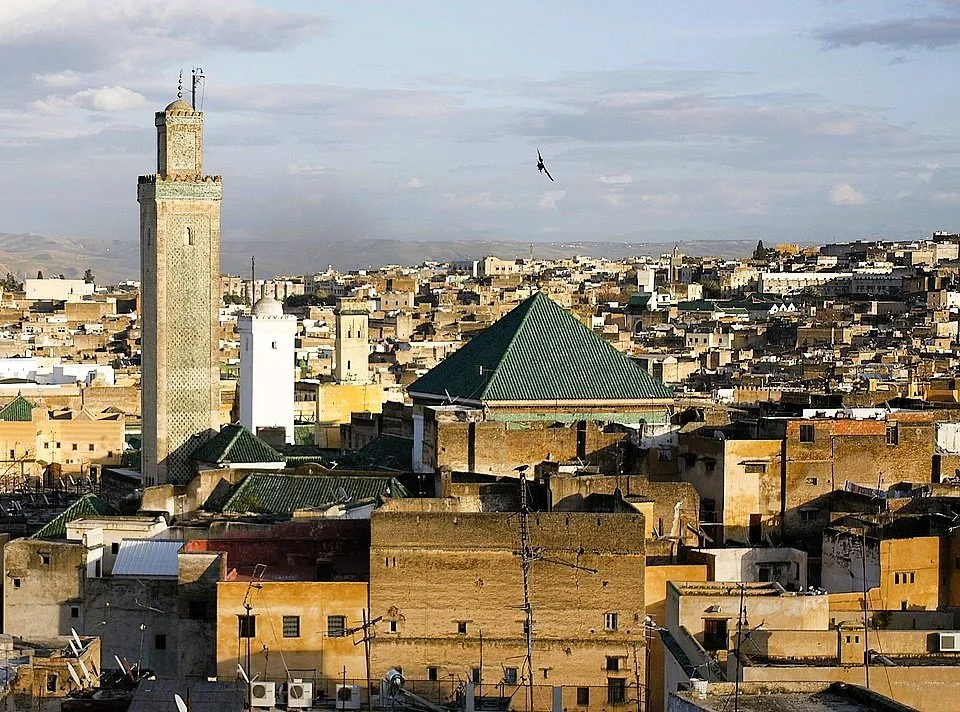
Figure 1. Aerial view of Fez al-Bālī, Morocco, showing the dense medieval medina with its golden-ochre rooftops filling the valley. At center, the green-roofed sanctuary of Mawlāy Idrīs II and the minaret of al-Qarawiyyīn rise above the unbroken urban fabric. A yellow arrow marks the area of Bāb al-Futūḥ to the north, outside which al-Dabbāgh's dome stands beyond the city walls.
It was a city where the clothing a man wore encoded political memory: Moroccans had worn black balgha to mourn the fall of Sabta and Tangier to European powers, until Mawlāy Ismāʿīl, in a gesture of civilizational confidence, replaced black with yellow — announcing that Morocco had turned from mourning to victory. The yellow balgha is still worn. The city remembered through its material culture what its scholars recorded in their books.
And its scholars were writing copiously. Al-Dabbāgh was born into a Fez in the midst of an extraordinary outpouring of hagiographical literature — dozens of works recording the lives and chains of transmission of its saints. ʿAbd al-Raḥmān al-Fāsī, Ibn ʿAyshūn, al-Mahdī al-Fāsī, al-Ifrānī — one after another, compiling the city's spiritual biography, preserving what the accumulated baraka of nine centuries had produced. The Ṣalāt al-Mashīshiyya of Mawlāy ʿAbd al-Salām ibn Mashīsh was recited in the zāwiyas and gatherings of the city as a living devotional practice, not a historical artifact. The city was writing its saints down because it could feel the weight of what it had accumulated.
Yet the greatest saint Fez would produce in that century did not appear in any of these catalogues. Al-Ṣaghīr al-Ifrānī compiled his Ṣafwa — a comprehensive survey of the saints of the eleventh/seventeenth century — and omitted al-Dabbāgh entirely. The most complete product of Fāsī civilization was invisible to Fāsī documentation. He had practiced khumūl — deliberate hiddenness — with such completeness that the scholars could not find him. It would take Ibn al-Mubārak, and then al-Ibrīz itself, to make him visible. And when al-Ibrīz made him visible, it did so through the streets.
The Shrine of Sīdī ʿAlī ibn Ḥirzihim and the Lote Tree: Where al-Khiḍr Was Waiting
Before the opening at Bāb al-Futūḥ, before al-Birnāwī arrived, before the great fatḥ descended — there was a practice. Every Thursday night, al-Dabbāgh made his way to the shrine of Sīdī ʿAlī ibn Ḥirzihim outside the city walls and spent the night there. He and those who gathered recited al-Burda — the Prophetic praise poem of al-Būṣīrī — until they completed it before dawn. He did this not once, not occasionally, but every single Thursday night across years of his twelve-year search. The shrine of ʿAlī ibn Ḥirzihim was the one fixed point in the wandering — the place he returned to when every shaykh he had tried had disappointed him, when every wird had tightened his chest rather than opened it.
The shrine carried its own weight in Fāsī sacred geography. ʿAlī ibn Ḥirzihim (d. 559/1163) was among the foundational saints of Morocco — an Umayyad ancestor, a figure whose baraka had been embedded in that site for five and a half centuries. Al-Dabbāgh's own family were the shrine's custodians: his father Sīdī Masʿūd had been appointed administrator of its endowments by Mawlāy al-Rashīd (r. 1075–1082/1664–1672), the second ‘Alawi sultan, and Sīdī Masʿūd had been buried there alongside the sultan who appointed him. The shrine was not a place al-Dabbāgh visited — it was a place he had inherited.
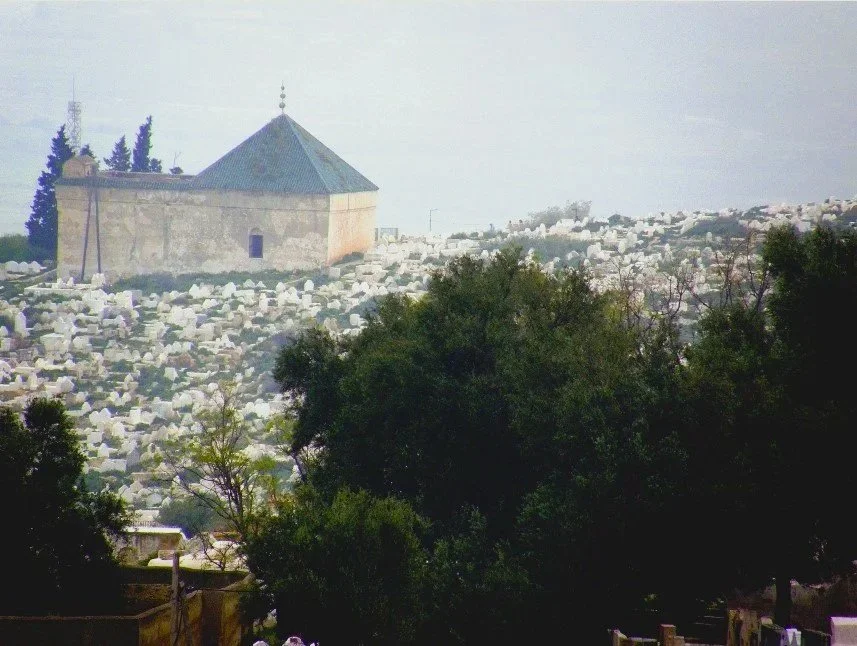
Figure 2. The shrine of Sīdī ʿAlī ibn Ḥirzihim, located outside Bāb al-Futūḥ, Fez, showing the whitewashed cubic mausoleum with its ornate horseshoe arch entrance and decorative frieze above the doorway. Gravestones visible in the foreground. This is the shrine where al-Dabbāgh spent every Thursday night reciting al-Burda, and where al-Khiḍr sat beneath the consecrated lote tree and gave him his wird. The road leading to this shrine was also the road on which al-Dabbāgh's fatḥ descended.
One Friday night, after the completion of al-Burda, he came out of the rawḍah — the sacred interior — and found a man sitting beneath al-Sidra al-Muḥarrara: the consecrated lote tree near the shrine's door. The tree had a legal designation — muḥarrara, liberated, set apart, belonging to God — and a physical presence just at the threshold between the interior of the shrine and the night outside. The man began speaking to him, unveiling things about his interior state with a precision that told al-Dabbāgh immediately: this was one of the knowers.
He asked for the wird. The man delayed, probing for the sincerity of his intention — he wanted to extract from him a true resolve, not a will that would abandon what it received as it had abandoned every previous shaykh. They remained together through the night, al-Dabbāgh pressing, the man resisting, until the dawn appeared and the dust showed in the minaret. Then the man said: "I will not give you the wird until you give me the covenant of God that you will not abandon it." Al-Dabbāgh gave it.
The wird was seven thousand repetitions daily:
“O God, O my Lord, by the rank of our master Muḥammad ibn ʿAbd Allāh ﷺ, join me and our master Muḥammad ibn ʿAbd Allāh ﷺ in this world before the next.”
It was only at the death of Sīdī ʿUmar al-Hawwārī — the shrine's caretaker, who had been present that night and whom the stranger had commended al-Dabbāgh to — that the identity of the man beneath the lote tree was revealed. ʿUmar asked: "Do you know who the man was who transmitted the dhikr to you at the consecrated lote tree?" Al-Dabbāgh said no. ʿUmar said: "He was our master al-Khiḍr, peace be upon him."
The geometry of this revelation is precise. Al-Khiḍr waited at the threshold — not inside the shrine, not in the open countryside, but at al-Sidra al-Muḥarrara, the consecrated tree that marked the boundary between the sacred interior and the world outside. The tree itself was a threshold — liberated from ordinary use, set apart, existing in a different legal and spiritual category from the ground around it. Al-Khiḍr sat at the place where categories meet. Al-Dabbāgh came out from completing al-Burda — the Prophetic praise that had organized his Thursday nights for years — and found waiting for him the figure who stood outside every institutional chain of transmission, who appeared to those chosen for knowledge that bypassed books and masters and all the apparatus of formal learning. The shrine of his family. The tree at its door. The dawn in the minaret. And a wird that would be recited for four years until the opening came.
Bāb al-Futūḥ: The Gate That Named the Opening
Everything in al-Dabbāgh's sacred geography converges at Bāb al-Futūḥ — the Gate of Openings. But the journey to the gate began, as it began for Moses in Sūrat al-Kahf, with a fish.
On Thursday the 8th of Rajab 1125/July 1713, three days after the death of Sīdī ʿUmar al-Hawwārī — the caretaker of the Ḥirzihimī shrine who had been his companion for years — al-Dabbāgh came out of his house. God provided him, through one of His charitable servants, four mawzūnāt. He bought fish, brought it home. His wife said: "Go to Sīdī ʿAlī ibn Ḥirzihim and bring us oil to fry this fish."
The instruction is unremarkable on its surface. A wife, a household, a practical errand. But the shrine of Sīdī ʿAlī ibn Ḥirzihim was the place where al-Khiḍr had sat beneath the consecrated lote tree and given al-Dabbāgh his wird. It was the place he had spent every Thursday night for years reciting al-Burda. It was, in every sense, his sacred center — the site of his first celestial encounter, the anchor of his twelve-year search. And the fish was sending him back there.
In Sūrat al-Kahf, Moses travels with his servant to the confluence of the two seas, carrying a fish as their provision. When Moses asks his servant for the fish at the rock where they stopped, the servant says: "Did you see — when we rested at the rock, I forgot the fish. Nothing made me forget to mention it except the Shayṭān. And it took its way into the sea in a wondrous manner." They had passed the meeting point without realizing it. The fish's escape was the sign they had missed the threshold. Moses turns back: "That is what we were seeking." They retrace their steps and find al-Khiḍr.
Al-Dabbāgh's fish does not escape. It waits to be fried. But it accomplishes the same thing: it sends him back toward the place of his encounter with al-Khiḍr, and on the road between his house and that shrine, the fatḥ descends.
He passed through Bāb al-Futūḥ. The gate is not incidental — its name is the event. Bāb al-Futūḥ: the Gate of Openings, of Victories, of Divine Disclosures. It was the northern gate of Fez al-Bālī, the threshold where the city's contained civilization met the open landscape beyond the walls — the olive trees, the old cemeteries, the shrines of saints. And the moment he reached it:
A shiver entered him. Then intense trembling. Then his flesh began to tingle. He kept walking, the state increasing. His chest began to heave violently until his collarbone was striking his beard. He thought: "This is death, without doubt."
Then something emerged from his inner being like the steam rising from a couscous pot — that most domestic of Moroccan images, the steam of a family meal, the breath of a household — and his inner being began to elongate until it became taller than anything tall. The seven lands spread before him. The seven skies. Every village, every city, every hamlet. A Christian woman nursing her child in her lap. All the seas. Every creature in every earth. He saw the sky as if he were above it, looking into it.
Then a great light like branching lightning came from every direction — from above, below, right, left, before, behind — and struck him with intense cold until he thought he had died. He prostrated face-down to avoid seeing the light, and found that his entire being had become eyes: his eye saw, his head saw, his foot saw, every limb saw. The clothing on his body did not veil that sight. He understood that lying face-down and standing upright were the same.
He could not continue to the shrine of Ibn Ḥirzihim. He turned back toward the city, frightened for himself, weeping. The state returned — an hour on, an hour off — until it settled into his being permanently, present without interruption.
The fish had done its work. It had sent him to the gate. The gate had done what its name promised. And the road to the shrine of al-Khiḍr's lote tree, the road he had walked every Thursday night for years, became the road on which the twelve-year search ended — three days after the death of the man who had been present the night al-Khiḍr gave him the wird, on an errand his wife sent him on, with four mawzūnāt of charity in his pocket.
On his path he passed the tomb of Sīdī Yaḥyā ibn ʿAllāl — the saint of the washermen, buried in the road to Ibn Ḥirzihim. The state intensified at the tomb. The dead saint participated in what was happening to the living saint walking above him. This was the grammar of the roads of Fez: every path led past a resting place, and the buried righteous were not absent from the formation of those who walked over them.
He did not reach the shrine that day. He returned to the city with the oil forgotten, the fish still waiting, the opening permanent.
Simāṭ al-ʿUdūl, the Mausoleum of Mawlāy Idrīs, and the House Near al-Ṣaffārīn
The morning after the fatḥ, al-Dabbāgh went to visit Mawlāy Idrīs.
This was his first movement after the fatḥ became permanent — not toward a scholar, not toward a shaykh, but toward his ancestor. Mawlāy Idrīs II had built Fez in 192/808 on the western bank of Wādī al-Jawāhir, the city that would accumulate nine centuries of prophetic baraka before producing, in one of his own descendants, a saint of this order. The visit was not piety in the conventional sense. It was a return to the source — the illiterate weaver of Ḥūmat al-ʿUyūn, opened at the northern gate of the city his ancestor had founded, walking the morning after toward the shrine that held that ancestor's body.
He did not arrive. In Simāṭ al-ʿUdūl — the lane of the notaries, running at the upper end of al-Ṭāliʿa al-Kubrā where it meets al-Qarawiyyīn — he encountered Sīdī al-Ḥājj Aḥmad al-Jīrūndī. The encounter was not arranged. It happened in the street.
Al-Jīrūndī was not an ordinary figure in Fāsī religious geography. He was the imam of the mausoleum of Mawlāy Idrīs — the keeper of the very shrine al-Dabbāgh was walking toward. His family had come from Girona in Catalonia, carried westward by the long displacement of Andalusian Islam into Morocco, and had embedded themselves into Fez's scholarly and spiritual elite across generations. He had studied under ʿAbd al-Qādir al-Fāsī and taken spiritual companionship with Aḥmad ibn ʿAbd Allāh Maʿn al-Andalusī. Al-Ḥuḍaykī called him "the scholar of his time and imam of his age." He was the official guardian of the city's founding sacred center — and he was standing in a lane near al-Qarawiyyīn when the man who had just been opened walked past him.
Al-Dabbāgh told him what had happened.
Al-Jīrūndī took him away from the lane — away from Simāṭ al-ʿUdūl with its official associations, its notaries and witnesses, its proximity to the mosque — and brought him to the house near the siqāya beside the washermen of al-Ṣaffārīn. The coppersmiths' square: the beating of metal on metal, the sound of the craft that had given the district its name for centuries, the fountain beside it, the washermen working the cloth. Into this domestic interior, tucked into the commercial heart of Fez, al-Jīrūndī sat on the bench and said: tell me again.
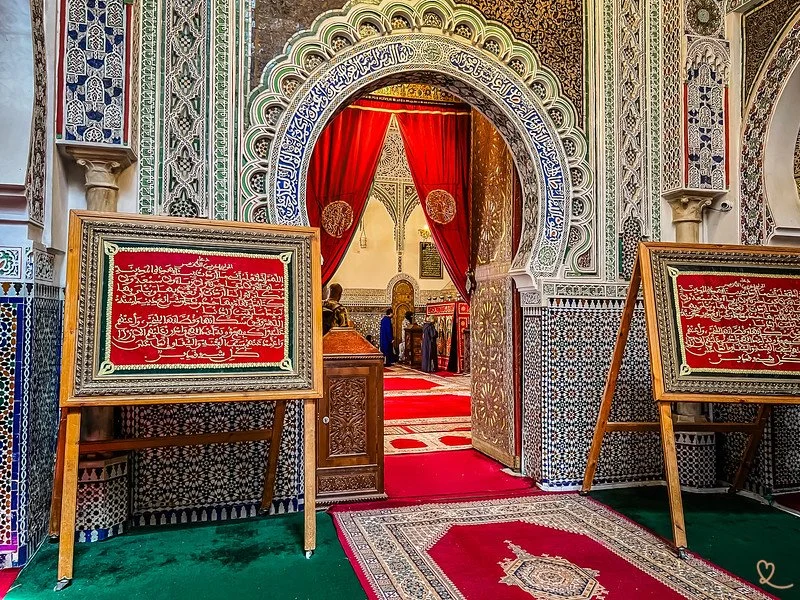
Figure 3. Interior of the mausoleum of Mawlāy Idrīs II, Fez, showing the elaborately decorated entrance arch leading to the burial chamber. Intricate zellij tilework in geometric patterns covers the lower walls, with painted stucco arabesque rising above. A red velvet curtain frames the inner doorway beyond which visitors stand in the presence of the tomb. Two framed panels bearing Arabic calligraphy in gold on green flank the entrance on either side. This is the shrine al-Dabbāgh was walking toward on the morning after his fatḥ, when he encountered al-Jīrūndī in Simāṭ al-ʿUdūl and never arrived.
Al-Dabbāgh repeated what he had seen. The shiver that entered him at Bāb al-Futūḥ. The trembling that built until his collarbone was striking his beard. The thing that emerged from his inner being like the steam of a couscous pot. The elongation of the self beyond all measure. The seven earths spread before him with everything in them — every village, every city, every creature. The Christian woman nursing her infant in her lap, seen from a distance that was no distance. All the seas. The sky visible as if from above it. Then the light like branching lightning from every direction simultaneously — from above and below, right and left, before and behind — striking him with a cold so intense he believed he had died. His prostration face-down to escape the light, and the discovery that prostration and standing were identical — that every limb of his body had become an eye, that the clothing on his back did not veil the sight that now ran through his entire being.
Al-Jīrūndī wept. Then he said: “Lā ilāha illā Allāh — four hundred years, and we have not heard anyone describe anything like this.“
Four hundred years. The statement is a periodization, not an exclamation. Al-Jīrūndī was the imam of the city's founding shrine, the keeper of its deepest institutional memory, and he was counting. From Ibn Mashīsh — the great master of Jabal al-ʿAlam, whose Ṣalāt al-Mashīshiyya was still recited in Fāsī zāwiyas as a living devotion in al-Dabbāgh's time, who had died around 625/1228 — to this morning in the house beside the fountain at al-Ṣaffārīn: four centuries. Between those two openings, Fez had built al-ʿAṭṭārīn and al-Bū ʿInāniyya, had produced generation after generation of Mālikī jurists and Ashʿarī theologians and Sufi masters, had accumulated the hagiographical literature of the Saʿdī and ʿAlawī centuries. All of that production, and no fatḥ of this order. The imam of the founding shrine was the first to name the silence — and the first to name its end.
He gave al-Dabbāgh five mithqāls of silver and a direction: go to Sīdī Abū ʿAbd Allāh al-Tāwudī outside Bāb al-Jīsa. The direction traced a network that ran beneath the surface of official Fāsī religious life. Al-Tāwudī ibn Sūda had been a companion of Abū Yaʿazzā and a disciple of Ibn Ḥirzihim himself — the same Ibn Ḥirzihim whose shrine had been al-Dabbāgh's weekly anchor for years, beneath whose lote tree al-Khiḍr had given him his wird. The network was a single living tissue: Ibn Ḥirzihim → al-Tāwudī → al-Jīrūndī → al-Dabbāgh. The imam of Mawlāy Idrīs's mausoleum was sending the newly opened saint toward the disciple of the saint whose shrine had produced him — closing a circle that had been open for five centuries.
Al-Jīrūndī died that same day. The illness of death came upon him when al-Dabbāgh left. He was buried inside Bāb al-Futūḥ, beside Sīdī ʿAlī ibn Abī Ghālib, with a dome over his grave. The gate that had opened al-Dabbāgh received his first witness within hours. The city kept them both at the same threshold — the saint and the scholar who wept when he heard what the saint had seen, and named the four centuries that had passed since anyone had seen it.
Bāb al-Jīsa: Where the African Scholar Appeared
The morning after the opening at Bāb al-Futūḥ, al-Dabbāgh set out again — directed this time by al-Jīrūndī toward the tomb of Abū ʿAbd Allāh al-Tāwudī ibn Sūda outside Bāb al-Jīsa. He never reached the tomb. At this southern gate of Fez, he encountered Sīdī ʿAbd Allāh al-Barnāwī — the scholar from Bornu, Sub-Saharan West Africa, who had traveled across the Sahara to Fez for this specific encounter.
Al-Barnāwī stayed for six months — through Rajab, Shaʿbān, Ramaḍān, Shawwāl, Dhū al-Qaʿda, and the first ten days of Dhū al-Ḥijja — stabilizing the saint's inner state, erasing fear from his heart in what he witnessed. On the third day of ʿĪd al-Aḍḥā, al-Dabbāgh saw the Prophet ﷺ. Al-Barnāwī said: "Before today I feared for you. Today, since God has joined you to His mercy — the Master of Existence — my heart is at peace. I commend you to God." And he departed for his homeland.
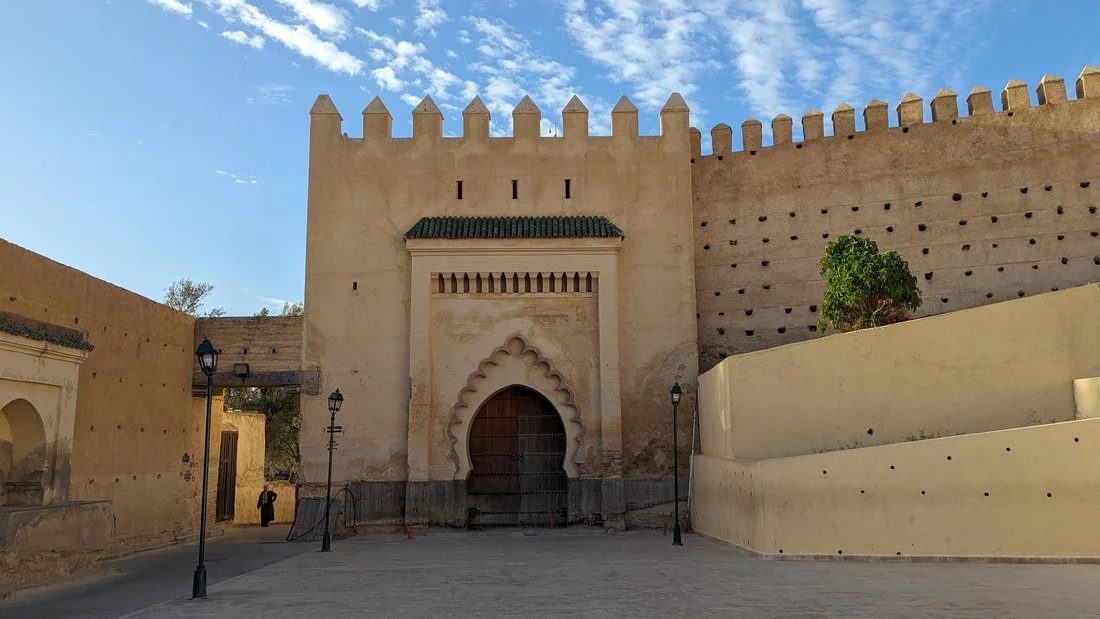
Figure 4. Bāb al-Jīsa, the southern gate of Fez al-Bālī, showing the triple horseshoe arches set into the crenellated city wall. It was outside this gate that al-Dabbāgh, following al-Jīrūndī's dying instruction to seek Sīdī Abū ʿAbd Allāh al-Tāwudī, encountered instead a Black man standing at the large rock near where the muḥaddij sits — staring at him. The man took his hand, drew him into the mosque of Bāb al-Jīsa, and described al-Dabbāgh's own opening back to him as if it had happened to himself. His name was Sīdī ʿAbd Allāh al-Barnāwī. He had crossed the Sahara from Bornu specifically for this meeting. Al-Dabbāgh never reached al-Tāwudī's tomb that day. The gate had something else waiting.
But the departure was not a separation. Al-Dabbāgh would speak of al-Barnāwī as if he were present, would report conversations with him as if they had just occurred. Ibn al-Mubārak, confused, would ask: "But did Sīdī ʿAbd Allāh not go to his homeland?" Al-Dabbāgh's answer was one of the great statements in al-Ibrīz:
“Between the righteous there is no distance, even when their homelands are far apart. A saint in the Maghrib who wants to speak with one in Sudan or Basra — you see him speaking to him as if speaking to someone beside him. And if a third wants to join the conversation, he joins. And a fourth likewise. Until you see a group of the righteous, each in a different region of the world, conversing as if gathered in a single place.”
Bāb al-Jīsa is the gate that opens toward the south — toward the burial grounds, toward the countryside, and in al-Dabbāgh's sacred geography, toward Africa itself. The scholar who came from Bornu entered Fez through the south. He left toward the south. And the teaching his departure generated was about the abolition of distance among the righteous — that the geography of saints is not organized by the cartography of the world but by the topology of baraka, where proximity is spiritual rather than physical, and where a saint in Fez and a saint in the Sudan are beside each other in a way that no map can show.
Al-Raṣīf, al-Sharāṭīn, al-Shammāʿīn, al-Ṣaffārīn: The Chase Through the City
No passage in al-Ibrīz maps Fez more precisely — or more dramatically — than the account of al-Barnāwī's test. ʿAbd Allāh al-Barnāwī had come from the Bornu region of Sub-Saharan West Africa — drawn across the Sahara to Fez specifically to stabilize al-Dabbāgh after his great opening. He had spent months with him, guiding him through the turbulence of the fatḥ. And one day he decided to test him.
Al-Dabbāgh tells it himself. He was in the quarter of Ibn ʿĀmir when a woman appeared — veiled, perfumed, beautiful — and said: "I want to be alone with you and speak with you." He fled. The account becomes a pursuit through the city's most populated streets:
He fled to al-Raṣīf — the paved riverside walkway along Wādī al-Jawāhir, where the flow of people and commerce made anonymity possible. She was there.
He fled to al-Sharāṭīn — the street of the rope-makers, the industrial district where craftsmen worked in the open. She was there.
He fled to al-Shammāʿīn — the chandlers' market, the district of wax and light. She was there.
He fled to the eastern side of al-Qarawiyyīn — the edge of the sacred precinct, the oldest university in the world. He thought he had escaped. She was there.
He fled to al-Ṣaffārīn — the coppersmiths' square, the beating heart of Fāsī craft culture, where the sound of hammers on metal filled the air. She was there.
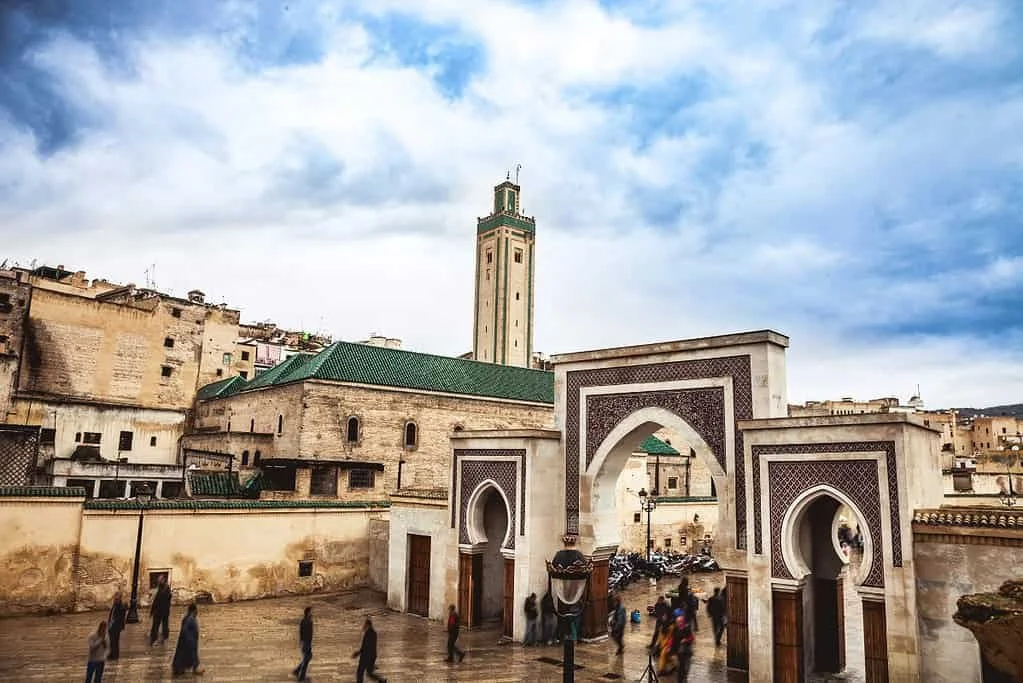
He fled back to al-Shammāʿīn and then inside al-Qarawiyyīn itself — entering the mosque, reaching al-Thuriyyā al-Kubrā, the great chandelier at the mosque's center. The holiest interior space in the city. She was there.

The geography of the chase
Historical map of Fez al-Bālī showing the two original settlements — al-ʿĀliyya on the western bank and Fās on the eastern bank — divided by Wādī al-Jawāhir. The map makes the geography of al-Barnāwī's chase legible: beginning in Jazāʾ Ibn ʿĀmir in the southwestern quarter of al-ʿĀliyya.
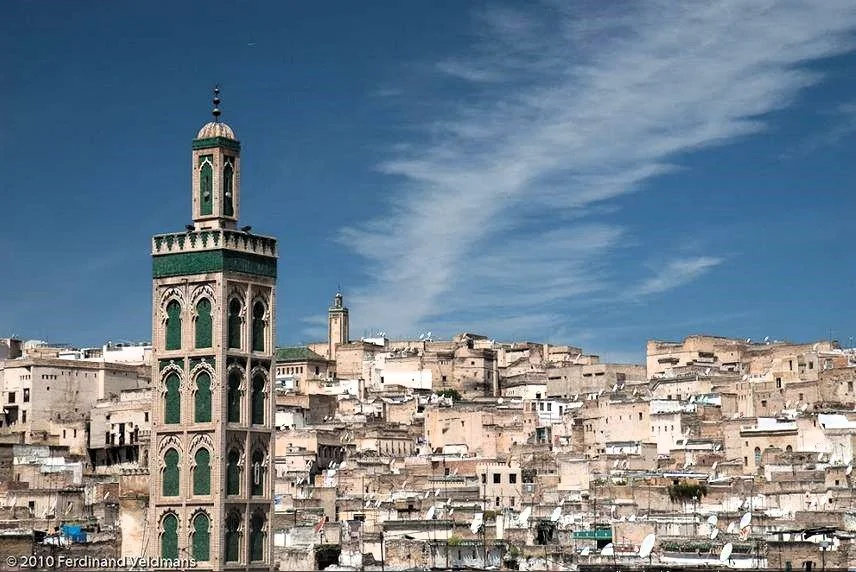
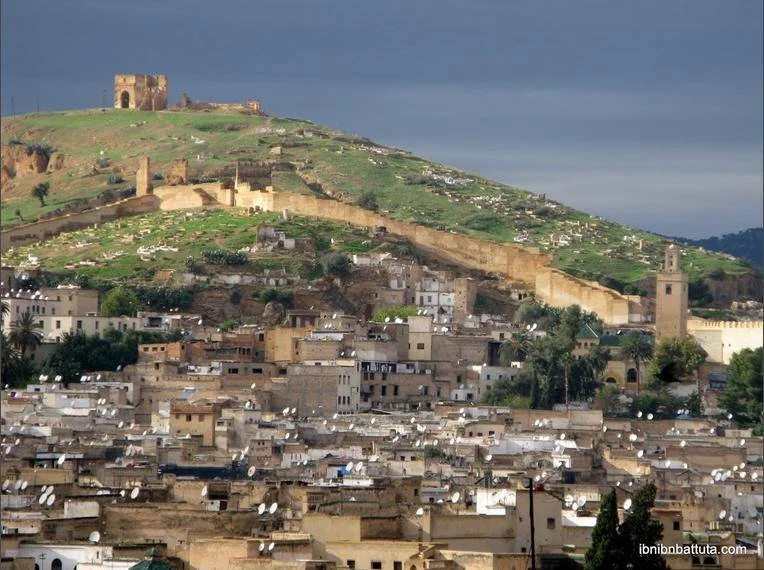
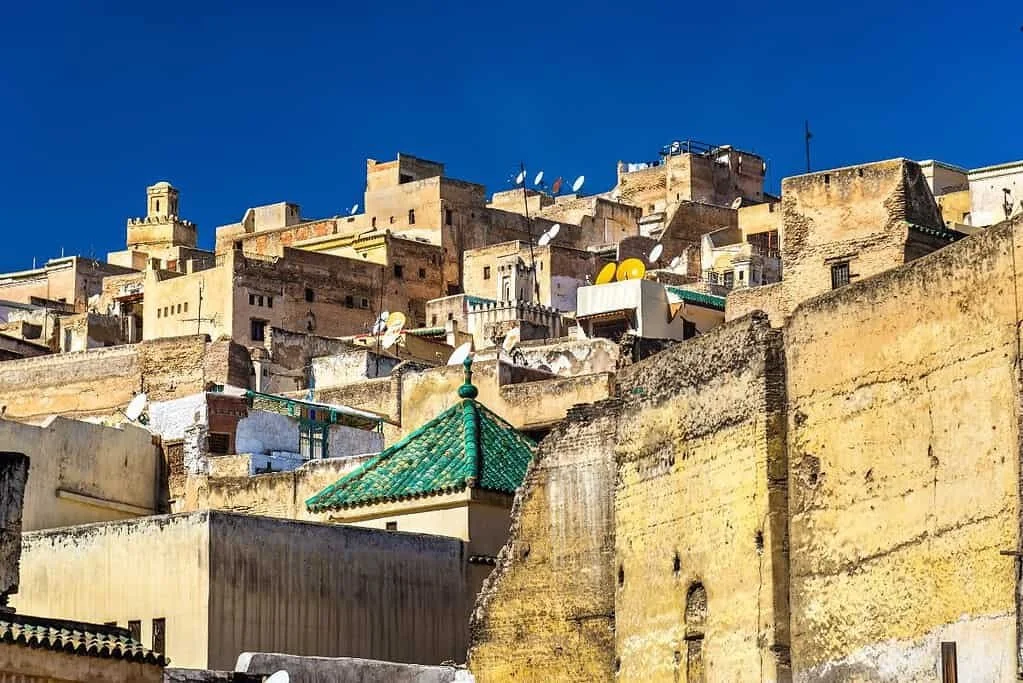
At that moment, overwhelmed, about to cry out so that the people would see — she transformed. And al-Barnāwī stood before him: "I did this to test you, because I know how much sharīfs tend toward women. And I found you as I hoped — praise be to God."
What this passage does, analytically, is extraordinary. It maps the entire social and commercial geography of Fez through a single chase — from a residential quarter through the commercial streets to the craft districts to the sacred precinct to the mosque itself. Each market represents a different layer of Fāsī urban civilization: al-Raṣīf is the circulation of goods and people; al-Sharāṭīn is manual craft; al-Shammāʿīn is illumination and wax and the industries of ceremony; al-Ṣaffārīn is the highest craft, copper beaten into geometric precision; al-Qarawiyyīn is scholarship and sanctity. Al-Dabbāgh ran through the entire city — through every dimension of its civilization — before the test was revealed.
The Shrine of Aḥmad al-Yamanī: Where the Stones Sang
Outside Bāb al-Futūḥ, between the gate and the shrine of Sīdī ʿAlī ibn Ḥirzihim, lay another burial — Sīdī Aḥmad al-Yamanī, the Yemeni-born Qādirī saint who had come to Fez and died there, buried near the muṣallā of Bāb al-Futūḥ beside Sīdī Yūsuf al-Fāsī. His silsila ran through Dafʿ Allāh al-Ghazwānī back to ʿAbd al-Qādir al-Jīlānī. His own teacher, ʿAbd Allāh ibn ʿAbd al-Jalīl al-Barnāwī — a different Barnāwī, an earlier one — had died before al-Yamanī could reach him after a long journey. He arrived and found his shaykh had preceded him to God. He settled in Fez, was hosted by Aḥmad ibn ʿAbd Allāh at al-Makhfiyya in 1090/1679, and died there in 1113/1701 — twelve years before al-Dabbāgh's fatḥ.
The landscape outside Bāb al-Futūḥ was therefore already dense with the dead before al-Dabbāgh's opening descended on it. Sīdī Yaḥyā ibn ʿAllāl on the road. Sīdī Aḥmad al-Yamanī near the muṣallā. The shrine of Ibn Ḥirzihim further on. The gate itself, which would eventually receive al-Jīrūndī and then al-Dabbāgh himself. This was not countryside — it was a sacred landscape that had been accumulating its dead for centuries, each burial adding another layer to the ground through which al-Dabbāgh walked on the morning of his opening.
He was sitting beneath an olive tree near the shrine of al-Yamanī — in the early days of his fatḥ, when the state was still coming and going in waves — when the landscape began to speak. Every stone, small and large. Every tree. Every branch. All of them making tasbīḥ to God in their own languages simultaneously. He nearly fled from what he heard. He steadied himself and listened to a single stone. Multiple voices from one stone. He examined it: it was a composite stone — several stones fused together, each with its own voice, their praise multiplied by their number. One apparent unity concealing a plurality of distinct beings, each engaged in its own glorification.
It happened in the early days of his opening — after the first fatḥ on Thursday the 8th of Rajab 1125, before the greater fatḥ on Sunday the 13th of Dhū al-Ḥijja of the same year. In that interval — between the first opening at the gate and the vision of the Prophet ﷺ — the landscape outside the city was itself in a state of disclosure. The olive trees spoke. The stones spoke. The ground through which he had walked to reach Ibn Ḥirzihim every Thursday night for years revealed what it had always been doing.
What al-Dabbāgh brought to the composite stone was the same precision he brought to everything: not wonder at the miracle but investigation of its cause. One stone, multiple voices — why? He looked. The answer was structural. The stone was not one stone. Its plurality of praise corresponded exactly to its plurality of being. The landscape outside Bāb al-Futūḥ was not performing sanctity for the newly opened saint — it was simply visible to him now as it had always been: a creation in constant glorification, each element according to its nature, the composite stone singing with as many voices as it had components.
Jazāʾ Ibn ʿĀmir: Where the Closest Thing to Love Was Said
The passage begins with a deceptively simple phrase: "We were in the quarter of Ibn ʿĀmir, in the protected city of Fez, may God protect it." The formula of divine protection is not rhetorical. It is a recognition that this city was under a special covenant — protected not by its walls but by its saints and its prophetic genealogy.
Ibn al-Mubārak was walking with al-Dabbāgh in this quarter when the saint said: "Sīdī Manṣūr al-Lahwāj is at the head of the lane — would you like to meet him and know him?" Ibn al-Mubārak said yes — of course, he wanted to meet the quṭb. Al-Dabbāgh's response was among the most intimate things he ever said:
“As for me — even if your father and mother could produce a hundred people identical to you in form, description, knowledge, and everything about your inner and outer being — I would not look at a single one of them. You are my fortune and my portion. They are, to me, like ordinary people.”
The lane of Ibn ʿĀmir was where al-Dabbāgh taught love as an absolute — not as metaphysics but as the specific, irreducible particularity of a relationship between two souls. The quṭb at the head of the lane was not the point. The point was that the saint had already given everything to his disciple, and anything else — including another saint — was beside the matter. The street produced the saying. The saying was only possible because two men were walking together in a specific lane of a specific city, and one of them said something that the other carried for the rest of his life.
The Ṣaqālibiyya: The Rooftop Room Where the Most Intimate Things Were Said
Fāsī domestic architecture is vertical. The house turns inward — around a courtyard, away from the street — and rises. At the top, above the family rooms, above the courtyard that holds the fountain and the daily life of the household, sits the ṣaqālibiyya: the high room, open to the sky, belonging to neither the private interior below nor the public city outside. It is a threshold with walls.
The word carries its own history into the room. Al-Ṣaqāliba — the Slavic captives who moved through Byzantine trade networks into the Islamic world, bought and sold across the Mediterranean, eventually absorbed into Moroccan households as servants given the uppermost chamber. The room was named for those it held. By al-Dabbāgh's time the word had outlasted its origin — the ṣaqālibiyya was now the room for guests, for private gatherings, for conversations that needed elevation and remove. In contemporary Fāsī usage the word has vanished entirely, replaced by "al-Maṣriyya" — the Egyptian room — as if the city needed to forget what it once called that space. But in al-Ibrīz the word appears repeatedly, insistently, as a coordinate.
It is where al-Dabbāgh spent his time with those closest to him. It is where the most interior things were said.
Three passages in al-Ibrīz locate themselves in the ṣaqālibiyya, and each one reveals a different register of what that room held.
In the first, Sīdī ʿAlī ibn ʿAbd Allāh — a disciple from al-Ṣabbāghāt, the dyers' district — came to Fez to die near his shaykh. Al-Dabbāgh nursed him in his own house, his wife and household tending to what the sick man needed. When the end drew near, al-Dabbāgh was downstairs while Sīdī ʿAlī lay in the ṣaqālibiyya above. From the lower room he announced to those present: Sīdī ʿAlī is now seeing the Prophet ﷺ and Abū Bakr. They climbed to the ṣaqālibiyya and found the dying man's tongue already gone — unable to speak — but nodding, opening his mouth in the shape of laughter, his smile continuous until his soul departed. Al-Dabbāgh said afterward: had he sat in al-Ṣabbāghāt for ninety years, he would not have reached the state in which he died. The high room was where the dying man saw what the living saint had already seen. The ṣaqālibiyya became, in that moment, the room where the two registers — the human body failing and the prophetic presence arriving — occupied the same space simultaneously.
In the second, al-ʿArabī al-Zibādī came to the house after the Maghrib prayer and sat at the door in the dark, not knocking, not announcing himself. Al-Dabbāgh was in the ṣaqālibiyya. He descended — his footsteps heard on the stairs — and called out through the darkness: "Is that not you, at the door since an hour ago?" Al-Zibādī had told no one. The darkness had told no one. The room above the city saw what the street below concealed.
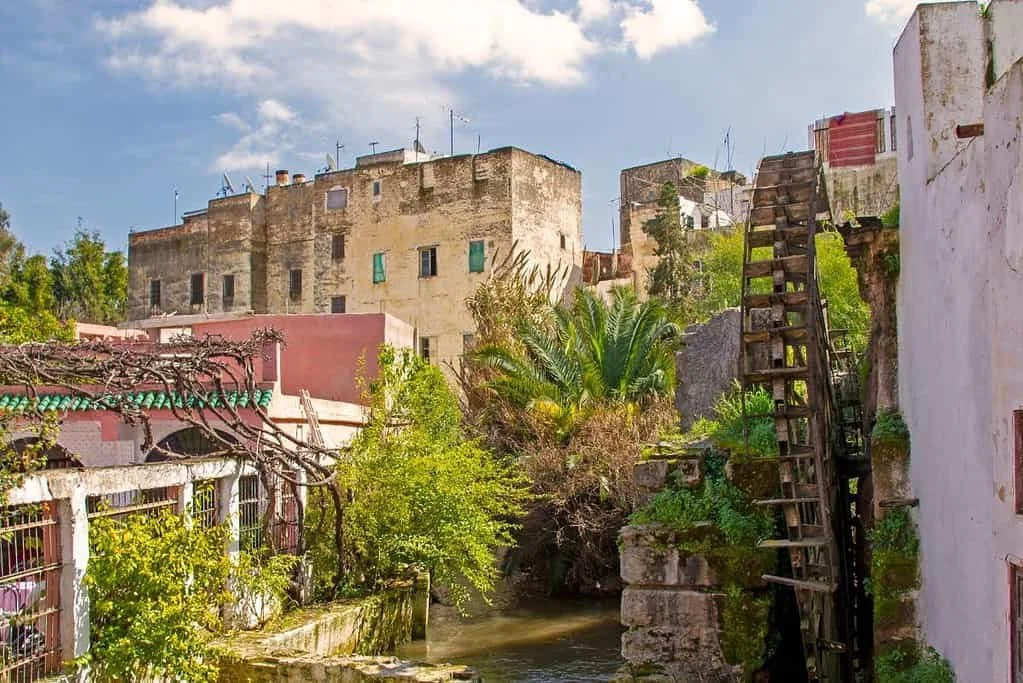
Figure 5. A traditional Fāsī ṣaqālibiyya — the high room at the top of a medina house, open to the sky above the rooftops of Fez al-Bālī. This elevated domestic threshold, neither fully private nor fully public, appears repeatedly in al-Ibrīz as the space where al-Dabbāgh gathered with his closest companions.
In the third, Ibn al-Mubārak was sitting with al-Dabbāgh in the ṣaqālibiyya in conversation when the saint's wife rose weeping in the courtyard below, circling the house in grief — news had reached her of her brother's death while he was traveling. Al-Dabbāgh leaned over from the high room and told her: he has not died. Whoever told you lied. He swore it. She did not stop weeping — the news had struck too deeply — but the word from above proved true. The brother was alive. The ṣaqālibiyya looked down into the domestic grief of the courtyard and corrected it.
What these three passages share is the spatial logic of the room itself: elevation that is not distance. Al-Dabbāgh in the ṣaqālibiyya was above the household — above the dying man, above the dark street, above the grieving wife — but not removed from any of it. The room's position in the architecture of the Fāsī house made visible what was already true of the saint's position in the world: present at every register simultaneously, the cosmic and the domestic occupying the same breath. The grain in the basket. The Prophet ﷺ not absent for the blink of an eye. The roof open to the sky above Ḥūmat al-ʿUyūn, the city spreading below, and in the room between them — the saint, his companions, and whatever needed to be said.
Bāb al-Ḥadīd: The Gate, the Bridge, and the Test
Bāb al-Ḥadīd was a small gate in the eastern wall of Fez al-Qarawiyyīn, opening onto al-Ziyyāt and al-Baṭḥāʾ. It was not a ceremonial gate — not Bāb al-Futūḥ with its sacred charge, not Bāb al-Jīsa opening toward the southern burial grounds. It was a working gate in a working wall, and beside it ran the bridge — Qanṭarat Bāb al-Ḥadīd, also called Qanṭarat Bū ʿAjāra after the neighborhood it served — spanning Wādī al-Jawāhir, the river of jewels that had divided the two banks of Fez since Mawlāy Idrīs II settled both shores in the early third century of Islam. The bridge has since been demolished. But in al-Dabbāgh's time it was still there, still carrying people from one bank to the other above the drop of the river below.
Three sayings of al-Dabbāgh are located at this gate and this bridge. Together they form the most concentrated teaching sequence in al-Ibrīz's Fāsī geography — three different conversations, three different registers, one small gate in an eastern wall.
The first happened near the gate with a man who served al-Dabbāgh with a devotion none of his other companions matched. Al-Dabbāgh turned to him and began a structured interrogation — not of his knowledge but of his loyalty. Would you still love me if my secrets were stripped away? If I became a baker or a rubbish collector? If I returned sinful, transgressing openly, for a year, then another, then another — for twenty years? The man answered yes to each. Ibn al-Mubārak, watching, warned the man: you cannot bear this. How can a blind man endure being tested by one who sees? He begged al-Dabbāgh for pardon on the man's behalf. Al-Dabbāgh said: I will test him. And he did — with something that was for the man's own benefit, something whose purpose the man could not see — and the man broke. His intention toward the shaykh changed.
The gate was witness to the anatomy of spiritual failure. Not dramatic apostasy — simply a man who could not hold love when its object became unrecognizable to him. The Fāsī street was where this was exposed, in front of others, without ceremony. Al-Dabbāgh's comment afterward was surgical: the secret of God can only be borne by one whose clay is sound — whose certainty is firm, whose resolve is unbreakable, whose conviction runs without interruption, who has already performed the funeral prayer over everyone except his shaykh.
The second saying came at the same gate, on a different day. Al-Dabbāgh turned to Ibn al-Mubārak and spoke in a single continuous chain:
“No one should aspire to knowledge of God while he does not know the Prophet ﷺ. No one should aspire to knowledge of the Prophet ﷺ while he does not know his shaykh. No one should aspire to knowledge of his shaykh while he has not performed the funeral prayer over people — until they exit his sight entirely, and he no longer cares about them in any of his words, actions, and affairs. When people exit his sight, mercy comes to him from where he does not expect.”
The statement is a ladder descending from God to the Prophet ﷺ to the shaykh to the disciple's own interior condition — and the bottom rung is a gate through which almost no one passes: genuine indifference to the gaze of others. Not performance of indifference. Not spiritual arrogance. The funeral prayer — the act of releasing a soul into God's custody — performed over the entire world of human opinion. Al-Dabbāgh said this standing at a small gate in a city wall, in a street where people passed, where being seen was unavoidable. The location was the teaching's context: here, in this street, among these people, perform the prayer over all of them.
The third conversation happened on the bridge itself — walking across Qanṭarat Bāb al-Ḥadīd above Wādī al-Jawāhir. Al-Dabbāgh asked Ibn al-Mubārak: what is the purpose of this bridge? Ibn al-Mubārak answered: to cross the gulf below — to carry a person from where he stands to where he intends to go. Al-Dabbāgh said: and if that purpose were removed from it, the bridge would be pure harm to people. Ibn al-Mubārak agreed. Al-Dabbāgh said:
“So it is with the prophets, the messengers, the angels, and all of God’s righteous servants. Their purpose is to guide toward God and to gather toward Him. If that purpose were removed from them, they would be as the bridge described.”
Fez was built on bridges. Wādī al-Jawāhir divided its two original settlements — al-ʿĀliyya and al-ʿAndalus — and the bridges spanning it were among the city's oldest infrastructure, some dating to Mawlāy Idrīs II himself. The bridge at Bāb al-Ḥadīd carried people daily between the two banks. Al-Dabbāgh, crossing it, made it a cosmological argument: the entire chain of prophetic transmission — from the first prophet to the last, from the angels to the saints — exists solely as a bridge. Its sole function is conveyance. Not the bridge itself but what the bridge enables. A prophet who does not guide toward God, a saint who does not gather toward God, is not a lesser bridge — he is a gulf.
The three conversations at Bāb al-Ḥadīd map three concentric circles of the same teaching. The first: the disciple who cannot hold love when he cannot see its purpose — the man who breaks at the gate. The second: the condition for receiving mercy — the funeral prayer over the world's opinion, performed in the middle of the world's street. The third: the metaphysics of transmission itself — every saint, every prophet, every angel as infrastructure, as a span thrown across the gulf between the human and the divine. A small gate. A demolished bridge over an old river. Three of the deepest things al-Ibrīz records.
Jāmiʿ al-Andalus: What the Prophet ﷺ Said From His Grave
Al-Dabbāgh heard this from a reliable source — a man who saw the Prophet ﷺ in waking vision and could smell the fragrance of Medina from Fez.
The man had been one night in Jāmiʿ al-Andalus with one of the saints — the great mosque on the eastern bank of Wādī al-Jawāhir, built by the Idrīsid imam Yaḥyā ibn Muḥammad ibn Idrīs in 245/859, the second mosque of Fez after al-Qarawiyyīn, the anchor of Fez al-Andalus as al-Qarawiyyīn was the anchor of Fez al-Qarawiyyīn. After the prayer, as they came out of the mosque, a man approached the saint, kissed his hand, and said: I love you for God's sake.
The saint looked at him with an expression of disapproval and said: Do you not know that God knows the secret and what is more hidden — meaning: was it not enough for you that God knows and will reward you well?
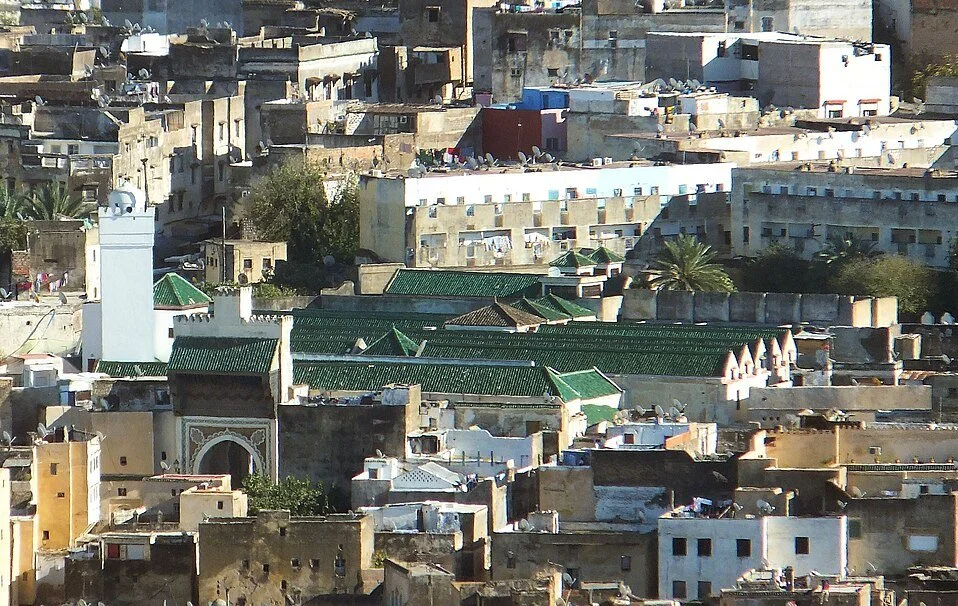
Figure 6. Jāmiʿ al-Andalus, Fez al-Bālī, seen from the hills above the eastern bank of Wādī al-Jawāhir. The mosque's distinctive green-tiled roofline and white minaret rise above the dense medina fabric of Fez al-Andalus. Built in 245/859 by the Idrīsid imam Yaḥyā ibn Muḥammad ibn Idrīs — on the eastern bank settled by Andalusian refugees displaced from al-Andalus — it is the second great mosque of Fez after al-Qarawiyyīn, anchoring the eastern settlement as al-Qarawiyyīn anchors the western.
The man who had declared his love was left weeping at the mosque door as the saint walked away. Al-Dabbāgh's source stepped forward and told him: you have claimed a great thing — the shaykh will test you. Be a man, or it will be separation between you and him.
The test came through a fig tree. The saint had a garden bordering this man's property, and a fig tree stood at the boundary. Every year the man had been taking the figs — and the saint had known, and said nothing, absorbing it with patience and good neighborliness. When the man declared his love, the saint dropped the burden of tolerance and said plainly: the tree is mine, you have no claim to it. The man denied it. They argued. And the narrator heard the man — the same man who had kissed the saint's hand and declared his love for God's sake — cursing the saint in the street.
The declared love lasted until the figs became a dispute. The mosque had been its stage.
But the passage does not end there. The same man — the one who saw the Prophet ﷺ in waking vision, who could smell Medina from Fez — told what had happened to him at the grave of the Prophet ﷺ during the ḥajj. He stood at the noble grave and said: O Messenger of God, I never thought I would reach your city and then return to Fez.
A voice came from the direction of the grave:
“If I am stored in this grave, then whoever comes should stay here. But if I am with my community wherever they are — then return to your lands.”
He returned to Fez.
Al-Qarawiyyīn: The Mosque That Produced His Chain and His Critics
Al-Qarawiyyīn stands at the geographic heart of Fez — not at its edge like Bāb al-Futūḥ, not outside its walls like the shrine of Ibn Ḥirzihim, not on its bridges or in its rooftop rooms. It is the city's center of gravity, the point around which everything else is organized. The lanes of al-Ṣaffārīn and al-Shammāʿīn and al-Sharāṭīn that al-Dabbāgh ran through during al-Barnāwī's test all orbit it. Simāṭ al-ʿUdūl, where al-Jīrūndī met him the morning after the fatḥ, runs along its upper edge. The house near the siqāya beside the washermen is a few steps from its eastern facade. Al-Dabbāgh's entire Fāsī geography revolves around a mosque he never appears inside.
His father Masʿūd ibn Aḥmad al-Dabbāgh was a faqīh — embedded in the scholarly establishment that revolved around al-Qarawiyyīn, appointed administrator of the endowments of the Ḥirzihimī shrine by Mawlāy al-Rashīd, eventually buried there beside the sultan who had honored him. Al-Dabbāgh was born into the world of the mosque and grew up in its shadow. He then turned completely away from it — not in rebellion but in search of something the mosque's apparatus could not give him. Ibn al-Mubārak records this with precision: al-Dabbāgh was illiterate, had turned away from formal learning to the utmost degree, and this was precisely what astonished those who heard his knowledge. The mosque's world produced his biography and then found itself unable to contain him.
The fuqahāʾ of al-Qarawiyyīn criticized him. Ibn al-Mubārak does not name them or detail the criticism, but the fact is present in the introduction — the astonishment of those who heard al-Dabbāgh's words was inseparable from the fact that the scholarly establishment had dismissed him. The mosque that Ibn al-Mubārak's own generation filled with some of the greatest Mālikī jurists Morocco had produced — al-Bardalla, al-Misnāwī, Ibn Zikrī, the younger Mayyāra — was the same institution whose representatives found the illiterate weaver of Ḥūmat al-ʿUyūn unworthy of serious attention.
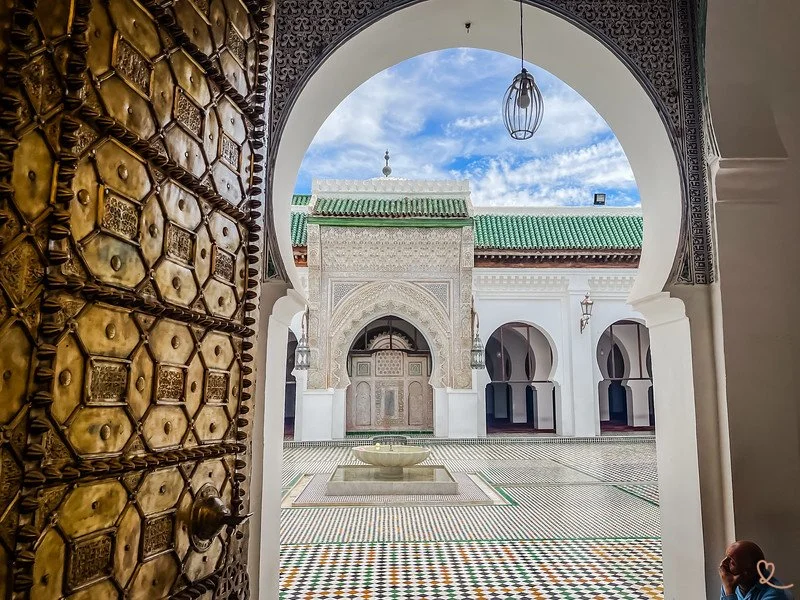
Figure 9. The central courtyard of Jāmiʿ al-Qarawiyyīn, Fez, seen through one of its great brass-clad doors. The ablution fountain at the courtyard's center, the elaborately carved stucco facade, and the green-tiled roof of the prayer hall beyond frame the sacred interior that stands at the geographic heart of al-Ibrīz without ever being its scene.
And yet. When Ibn al-Mubārak transmitted al-Dabbāgh's words privately to those same scholars — describing what he had heard from the saint — they said without exception: “this, by God, is the complete saint and the arrived knower.” The mosque's greatest minds, in private, recognized what their institution's public culture could not accommodate. Mayyāra — Muḥammad ibn Muḥammad Mayyāra, author of the definitive commentary on Mukhtaṣar Khalīl, one of the towering figures of Mālikī jurisprudence in his generation — gave al-Dabbāgh four mawzūnāt. He reached into his pocket, pulled out coins that did not satisfy him, returned them, and gave what was good. Al-Dabbāgh, without being told, described the exact sequence to Ibn al-Mubārak — and when Ibn al-Mubārak reported it to Mayyāra, the jurist confirmed it word for word. The same kashf that had mapped the streets of Fez and the mountains of the Rif between Jabal al-ʿĀlam and and Taza read the pocket of al-Qarawiyyīn's greatest living jurist.
But the deepest connection between al-Dabbāgh and al-Qarawiyyīn runs through a chain he inherited rather than a presence he maintained. Al-ʿArabī al-Fīshtālī — the saint whose trust al-Dabbāgh wore from childhood, whose entire store of secrets he absorbed after the fatḥ through the mediation of Sīdī ʿUmar al-Hawwārī — had himself been formed in al-Qarawiyyīn. It was there that he encountered Mubārak ibn ʿAlī: a man who served the shaṭāṭīb, a craftsman of modest station, not a scholar. Al-Fīshtālī looked at him and recognized something. He asked: how does the sirr come to those who possess it? Mubārak ibn ʿAlī said: sneeze. Al-Fīshtālī said: I feel no sneeze coming. Mubārak said: and neither do I feel how to teach you that. Al-Fīshtālī attached himself to him and held that attachment until he received what he received.
The exchange happened in al-Qarawiyyīn — in the same mosque where al-Fīshtālī later sat with Ibn al-Mubārak's teacher Aḥmad ibn ʿAbd Allāh and turned yellow-faced after reading a verse of Ibn al-Fāriḍ's Tāʾiyya, convinced he had judged himself an apostate for an involuntary passing desire. It was the same mosque where he walked out between prayers not for any need but to retrace the steps of a worshipper coming to pray — because the steps he had already taken had been for the sake of sitting with his companion, not for the mosque's own reward. Al-Qarawiyyīn for al-Fīshtālī was a space of extreme spiritual precision — every step accounted for, every intention examined, the verse of Ibn al-Fāriḍ capable of inducing a spiritual crisis that required another man's word to resolve.
Al-Dabbāgh inherited all of this. After the fatḥ he saw it directly — confirmed that he had absorbed the entirety of al-Fīshtālī's secrets, and more than al-Fīshtālī's secrets, through a chain that had passed from al-Fīshtālī through Sīdī ʿUmar to him. The mosque had been the site where that chain was forged. Al-Dabbāgh never sat in it to teach, never walked its courtyard with Ibn al-Mubārak, never delivered a session there. But the transmission that made him had passed through its interior — between a faqīh who looked at a craftsman and saw a saint, and committed himself until he received what could not be taught on demand.
Al-Qarawiyyīn trained the scholars who dismissed al-Dabbāgh and the scholars who, in private, confirmed him as the complete saint. It was the site where his spiritual grandfather had been formed and where the chain that would produce him had been initiated. The mosque stood at the center of Fez as al-Dabbāgh stood at its margin — and the margin, as al-Ibrīz insists from its first page to its last, was where the real thing was.
The Kasawāt and the City: What the Streets Could Not Contain
There is one passage in al-Ibrīz that brings all of this geography to its philosophical limit. Al-Dabbāgh was entering with Ibn al-Mubārak through Bāb al-Futūḥ — the same gate, the same threshold — when he turned and said: “Upon me in this hour are three garments. If you took one of them and placed it upon the city of Fez, everything in it — its walls and buildings and houses and all their inhabitants — would dissolve into pure nothingness.”
The saint who had been formed by Fez — who had walked its streets, sat in its rooftop room, heard its stones sing, been tested in its markets, been opened at its gate — was now carrying within himself something that, if fully expressed, would dissolve the city that had made him. This is not contradiction. It is the deepest truth of what Fez had produced: a civilization so refined, a baraka so concentrated across nine centuries of Idrīsid founding and Marinid scholarship and ʿAlawī consolidation, that when it finally crystallized in one human being, the result exceeded everything the civilization could contain.
The streets of al-Ibrīz named themselves because al-Dabbāgh moved through them and found them legible. The city was his text. And what he read in it — at al-Raṣīf and al-Ṣaffārīn and the bench beside the fountain and the rooftop room above the neighborhood of springs — was the same thing he read in the seven earths and the seven heavens when the opening descended at the gate: that divine care is locally accessible, personally specific, mediated through actual places. The saint does not transcend geography. He inhabits it so completely that the geography begins to speak.
Conclusion: The Dome at the Gate
Al-Dabbāgh died on a winter morning in Dhū al-Qaʿda 1132/December 1720 at the age of thirty-six. His disciple Ibn Ḥanīnī washed and buried him just outside Bāb al-Futūḥ — the gate where everything had begun. The disciples built a dome over the grave in the first year. Muḥammad al-Tāzī celebrated it in verse:
“Is it lightning from the western clouds? Or the full moon dispersing darkness? Or the radiant sun rising toward the Day of Resurrection? No — it is the lofty dome that has appeared, eclipsing even the greatest stars.”
Three centuries later the dome is still there. The streets he walked are still there — al-Raṣīf and al-Ṣaffārīn and the lane of Ibn ʿĀmir and the threshold of al-Qarawiyyīn where al-Barnāwī revealed himself under the great chandelier. The city has changed and has not changed. The stones outside the gate still have voices, for those with ears purified enough to hear them.
Al-Ibrīz is a book about divine knowledge and the structure of sainthood and the nature of the Prophet's ﷺ light. It is also a map of Fez. The two things are the same thing. The city made the saint. The saint read the city back to us. And in the reading, both the city and the saint became inexhaustible.