
The Saint Who Stubbed the Intellect: How Al-Ibrīz Turned Mystical Vision into a Polemical Weapon
There is a question that never quite disappeared from Islamic intellectual history, no matter how many times it was formally resolved: how do we know what we know about God?
The Muʿtazila answered with reason. The great rationalist theologians of the 3rd/9th and 4th/10th centuries argued that the human intellect (ʿaql) was not merely a tool for understanding revelation — it was a faculty capable of arriving at certain theological truths independently. God's justice, His oneness, the moral status of human acts: these, they argued, could in principle be demonstrated without recourse to scripture alone. Reason was not the servant of naql (transmitted authority); it was its partner, and in some domains its judge.
The Ahl al-Ḥadīth tradition — the traditionalists who formed the spine of what would later crystallize as Atharī Sunnism — rejected this claim with equal force. The intellect, they insisted, was a limited instrument operating within a domain it had not created and could not fully comprehend. Transmitted reports from the Prophet ﷺ and his Companions were the primary axis of religious knowledge. To place reason above them, or even beside them as an independent authority, was to invert the proper order of things and open the door to innovation, deviation, and ultimately disbelief.
Between these two positions, the Ashʿarites — the dominant school of Sunnī kalām — attempted a synthesis. They accepted rational theology as a necessary discipline for defending the faith against its critics, while insisting that reason could not operate autonomously of revelation. Al-Ashʿarī himself had famously abandoned the Muʿtazila, yet retained their tools. The result was a theological tradition perpetually negotiating its own legitimacy: using ʿaql to defend naql, and hoping no one pressed too hard on the tension.
Into this centuries-long contest, Sufism introduced a third epistemological claimant: kashf, the direct mystical unveiling of spiritual realities. The great Sufi theorists — from al-Ḥakīm al-Tirmidhī (d. ca. 318/930) through Ibn ʿArabī (d. 638/1240) — argued that the highest form of religious knowledge was neither deductive nor transmitted but experiential: a direct opening (fatḥ) granted by God to the purified heart. Where the mutakallim argued from premises and the muḥaddith cited chains of transmission, the walī simply saw. His knowledge was immediate, unmediated, and in principle beyond refutation, since its source was not a human faculty subject to error but divine disclosure itself.
This claim was, from the perspective of both rationalists and traditionalists, simultaneously attractive and dangerous. Attractive, because it offered a form of certainty that neither ʿaql nor naql alone could provide. Dangerous, because it was — almost by definition — impossible to verify from outside. A saint who claims to see directly cannot be cross-examined. His kashf is self-authorizing or it is nothing.
The history of Islamic thought is in large part the history of different intellectual traditions trying to manage this danger: to contain the epistemological power of kashf without losing its spiritual energy, to integrate it into existing structures of authority without allowing it to dissolve them. Al-Ghazālī's great project was perhaps the most ambitious attempt at this integration. His Iḥyāʾ ʿUlūm al-Dīn argued that Sufi inner experience was not a competitor to law and theology but their necessary completion — the third element of what DAR.SIRR has called the Niẓāmī Triplex, in which fiqh, kalām, and taṣawwuf form a single, mutually reinforcing system.
But there was another possibility — one less often examined. What if kashf were not merely integrated into orthodoxy but actively weaponized in its service? What if the saint's direct vision, rather than transcending doctrinal disputes, were deployed to resolve them — decisively, irrefutably, and in favor of a very specific theological position?
This is precisely what happens in Al-Ibrīz min Kalām Sayyidinā ʿAbd al-ʿAzīz al-Dabbāgh, the account of the 12th/18th-century Moroccan saint ʿAbd al-ʿAzīz al-Dabbāgh (d. 1132/1719–20), compiled by his disciple Aḥmad ibn al-Mubārak al-Lamaṭī (d. 1155/1743). To read Al-Ibrīz carefully — attending not only to what it claims but to the sequence, structure, and targets of its claims — is to watch a theologian of considerable sophistication use an illiterate saint's luminous experience to defeat enemies that conventional scholarship had failed to dislodge. The weapon is kashf. The targets are the Muʿtazila, the Ismāʿīlī Shīʿa, the Sufi philosophers, and — with more subtlety — the Ashʿarites themselves. And the strategy is one of the most elegant in Moroccan intellectual history.
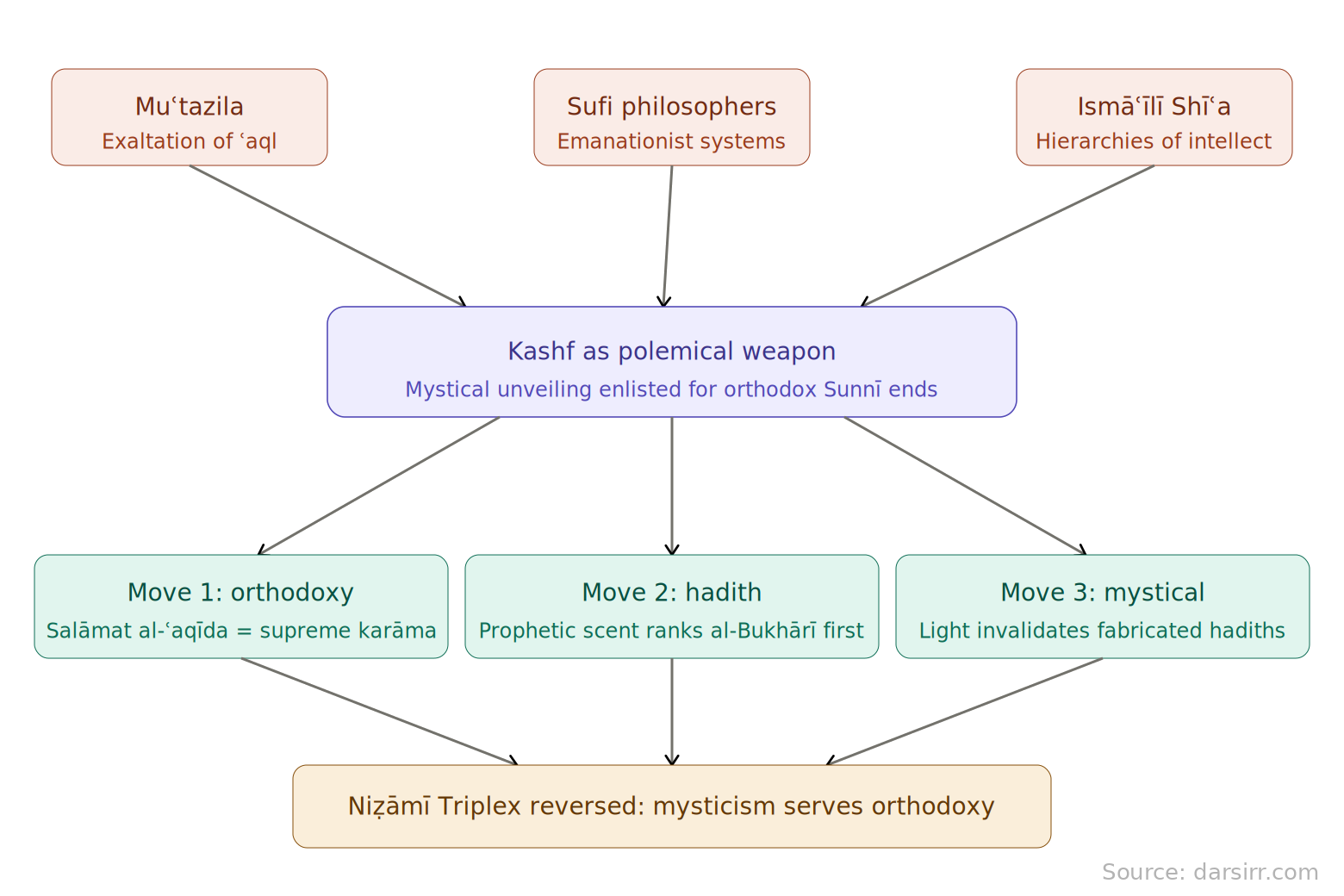
Diagram showing how Al-Ibrīz deploys kashf as a polemical weapon against the Muʿtazila, Sufi philosophers, and Ismāʿīlī Shīʿa through three successive moves — orthodoxy, hadith, and mystical invalidation — reversing the Niẓāmī Triplex so that mysticism serves rather than transcends Sunnī orthodoxy.
1. Orthodoxy as the Supreme Miracle
From the very first pages of his narrative on Dabbāgh's karāmāt, Ibn al-Mubārak establishes a theological proposition so foundational that it functions less as an argument than as an axiom: the greatest miracle a saint can possess is not the capacity to walk on water, heal the sick, or perceive hidden realities across distances. It is salāmat al-ʿaqīda wa-l-istiqāma — the soundness of Sunnī creed and the stability of correct belief.
The statement is startling precisely because of what it displaces. The karāma literature — the genre of hagiographical accounts recording the wonders performed by Sufi saints — had always justified its subjects primarily through exceptional deeds: levitation, teleportation, knowledge of unseen matters, miraculous healings. These phenomena were the evidence of sainthood, its external verification for an audience that could not access the saint's inner states directly. To declare that none of this constitutes the greatest miracle, and to replace it with doctrinal rectitude, is to perform an act of genre transformation at the very threshold of the text.
But Ibn al-Mubārak is not merely being pious. He is building an architecture. By establishing correct Sunnī creed as the supreme karāma, he simultaneously achieves two things that would be impossible to accomplish through direct argument alone.
First, he universalizes baraka. If the highest form of supernatural endowment is the holding of sound Sunnī belief, then every member of Ahl al-Sunnah wa-l-Jamāʿah participates, however modestly, in the same light that illumines the saint. Karāma ceases to be the exclusive property of exceptional individuals and becomes communal inheritance — the wonder of the madhhab before the wonder of the master. The community is canonized before its representative saint. This move binds the reader to al-Dabbāgh not through awe at his exceptional gifts but through recognition of a shared spiritual endowment: what he has in fullness, the orthodox believer has in principle.
Second, and more consequentially, he converts doctrinal error into metaphysical deprivation. If genuine fatḥ — genuine spiritual opening — belongs only to those within the creed of Ahl al-Sunnah, then those outside it are not merely theologically mistaken. They are cut off from the very faculty through which the highest religious knowledge is accessible. The Muʿtazilī theologian, however brilliant his arguments, operates in a domain from which the light has been withdrawn. The Ismāʿīlī Shīʿī, however elaborate his cosmological system, constructs his hierarchies in spiritual darkness. The Sufi philosopher who has absorbed emanationist metaphysics has not achieved a higher synthesis — he has simply confused the counterfeit for the genuine article.
“When God brought us together, I asked him about his creed concerning divine unity (tawḥīd). He proceeded to recite to me the creed of Ahl al-Sunnah wa-l-Jamāʿah in full, leaving nothing out. He said to me on one occasion: ‘No servant receives spiritual opening (fatḥ) except when he holds the creed of Ahl al-Sunnah wa-l-Jamāʿah. God has no walī upon a creed other than theirs. And if someone held a different creed before receiving the fatḥ, it becomes obligatory upon him after the fatḥ to repent and return to the creed of Ahl al-Sunnah.’ ... I never ceased to hear him — may God be pleased with him — praising Ahl al-Sunnah, extolling them greatly, saying: “I love them with a profound love,” and beseeching God Most High to take his life upon their creed.”
This pre-emptive delegitimization is more powerful than refutation because it operates at the level of epistemological access rather than argumentative content. Ibn al-Mubārak does not need to engage the Muʿtazilī on the question of divine attributes, or the Ismāʿīlī on the doctrine of the Imāmate, or the Sufi philosopher on the grades of the Intellect. He simply announces that the light through which such questions are truly resolved is available only inside the creed he is defending. Anyone who has left that creed — or never entered it — is structurally incapable of the highest form of knowing. Kashf is not a universal mystical phenomenon; it is a Sunnī monopoly.
The move then intensifies through the concept of tafwīḍ — the practice of consigning the meaning of ambiguous divine attributes to God without interpretation, affirming the text as transmitted without asking how or why. By privileging tafwīḍ over taʾwīl (rational-allegorical interpretation), Ibn al-Mubārak aligns al-Dabbāgh with the methodology of the earliest Muslim generations (salaf) and implicitly against the two major traditions that favored interpretation: the Muʿtazila, whose taʾwīl was driven by rational theology, and the Ashʿarites, whose taʾwīl was more cautious but still operative. By presenting tafwīḍ as the metaphysical framework through which genuine fatḥ manifests, he makes the methodology of the Ahl al-Ḥadīth not merely one valid approach among others but the precondition of authentic mystical experience.
The Ashʿarite implication deserves emphasis, because it is easy to miss. Al-Dabbāgh's own silsila ran through figures who were institutionally Ashʿarite — as was the overwhelming majority of Moroccan scholarly culture in his era. Ibn al-Mubārak himself was trained in Ashʿarite kalām. Yet by positioning tafwīḍ at the apex of the epistemological hierarchy, Al-Ibrīz quietly places Ashʿarite interpretive theology on a lower rung than the direct, unmediated submission of the salaf. The text never says this explicitly. It does not need to. The architectural logic of the opening declaration — orthodoxy is the supreme miracle, and orthodoxy here means tafwīḍ — does the work without requiring a single polemical sentence directed at the Ashʿarite tradition by name.
What we witness in these opening pages is not a saint being introduced. It is a community being constituted — and a set of rivals being positioned, with great care, outside the circle of light, before the first karāma has even been described.
2. The Hierarchy of Prophetic Scent
Having established the epistemological framework, Ibn al-Mubārak moves to its first concrete illustration — and produces what is, on the surface, one of the most charming details in the entire text. Al-Dabbāgh, we are told, could smell the fragrance of the Prophet Muḥammad ﷺ whenever prophetic traditions were recited in his presence. The scent of the Prophet ﷺ permeated the transmission of his words, so that hearing a ḥadīth was, for al-Dabbāgh, simultaneously an olfactory encounter with its source.
This is not, in itself, exceptional within the genre. Sufi hagiography has a long tradition of sensory karāmāt — saints who perceive spiritual realities through smell, taste, or sound in ways unavailable to ordinary perception. The phenomenon fits naturally within the logic of kashf as a form of experiential knowing that bypasses ordinary sensory and cognitive constraints.
What is exceptional — and what has not received the analytical attention it deserves — is the discrimination that accompanies it. Ibn al-Mubārak records that al-Dabbāgh noticed a consistent variation in the intensity of the prophetic fragrance depending on the source of the tradition being recited. Hadiths from Ṣaḥīḥ al-Bukhārī produced the strongest, most vivid scent. Hadiths from Ṣaḥīḥ Muslim produced a scent that was perceptible but distinctly less intense. Traditions from other collections registered still more faintly, in proportion — it is implied — to their degree of authenticity and proximity to the Prophet's actual words.
This single detail performs an extraordinary amount of theological work.
At the level of hadith scholarship, the relative ranking of al-Bukhārī and Muslim had been debated for centuries. The scholarly consensus, broadly speaking, held that al-Bukhārī's collection was the most rigorously authenticated compilation of prophetic traditions ever assembled — a view not universally shared, and contested on various methodological grounds by scholars who argued that Muslim's organizational principles were in certain respects superior, or that individual hadiths in al-Bukhārī were not beyond criticism. This was, in other words, a live scholarly question, with a mainstream position and a minority tradition of qualified dissent.
Ibn al-Mubārak resolves it through kashf. By reporting that al-Dabbāgh's nose confirmed, through direct prophetic proximity, what the majority of scholars had argued through chain-of-transmission analysis, he places the canonical Sunnī hadith hierarchy beyond the reach of further methodological challenge. The ranking is no longer the conclusion of a scholarly argument — it is a datum of mystical experience. To contest it now requires not a more rigorous isnād analysis but a counter-claim to spiritual perception of equivalent authority. The debate has been moved from a domain where it can continue to one where it effectively cannot.
“Among the most wondrous and remarkable aspects of his character — may God be pleased with him — was that when I engaged with him on this subject, he could distinguish a hadith transmitted by al-Bukhārī but not found in Muslim, from one transmitted by Muslim but not found in al-Bukhārī. When my experience of him had grown long, and his knowledge of hadith from non-hadith had become established in my mind beyond doubt, I asked him about the means by which he knew this. He said on one occasion: ‘The speech of the Prophet ﷺ does not remain hidden.’ I asked him again on another occasion. He said: ‘When a person speaks in winter, vapor (fawwār) issues from his mouth. When he speaks in summer, no vapor issues. Likewise, whoever speaks the words of the Prophet ﷺ — light (nūr) issues forth with his speech. And whoever speaks words other than his — the words issue forth without light.’ I asked him yet again on another occasion. He said: ‘When a lamp is fed, its light grows strong. When it is left unfed, it remains as it was. Such is the state of those who know (al-ʿārifūn): when they hear his speech ﷺ, their lights intensify and their knowledge deepens. When they hear the speech of another, they remain as they were.’ ”
The deeper target, however, is not the minority of hadith scholars who preferred Muslim over al-Bukhārī. It is the entire range of intellectual traditions — Muʿtazilī, Shīʿī, and certain Sufi philosophical currents — that had constructed their theological systems on the basis of selective, partial, or alternative engagement with the prophetic corpus. For the Ismāʿīlī tradition in particular, the relative authority of different textual sources was not merely a scholarly question but a constitutive one: the Imāmate's claim to esoteric knowledge rested precisely on the argument that the exoteric transmission of hadith, no matter how meticulously authenticated, could not exhaust the full depth of prophetic meaning. The Imam's inner knowledge was, by definition, something the ḥadīth scholars' methods could not reach.
By presenting al-Dabbāgh's experience as confirming and deepening the muḥaddithūn's conclusions — rather than transcending or superseding them — Ibn al-Mubārak performs a crucial inversion of this logic. Mystical experience, in Al-Ibrīz, does not reveal what the hadith corpus conceals. It confirms, at a higher register of intensity, what the hadith corpus already contains. The saint's nose does not go beyond al-Bukhārī; it vindicates him. Kashf and naql point in the same direction. The Ismāʿīlī claim that esoteric knowledge supersedes transmitted authority is, in this framework, not merely wrong — it is spiritually illiterate, a confusion of the counterfeit esoteric for the genuine one.
There is a further dimension worth noting. The vehicle for this confirmation is an illiterate saint. Al-Dabbāgh had not read al-Bukhārī. He had not studied the methodological debates about its relative merits. He arrived at his assessment not through the academic path that would ordinarily produce such a judgment — years of study, mastery of the sciences of hadith criticism, familiarity with the relevant scholarly literature — but through direct sensory experience of the Prophet's proximity. This is not incidental to the argument; it is its rhetorical spine. The very absence of a scholarly pathway makes the conclusion more, not less, authoritative. Al-Dabbāgh's ranking is immune to the charge of scholarly bias, methodological error, or institutional loyalty. He smelled it.
The sophistication of this move becomes fully visible when we consider its implications for the three rivals Ibn al-Mubārak has in view. For the Muʿtazila, it answers their elevation of ʿaql by producing a form of knowledge that is more immediate than reason and more certain in its conclusions. For the Ismāʿīlī Shīʿa, it answers their claim to esoteric superiority by demonstrating that genuine kashf vindicates Sunnī transmitted authority rather than transcending it. And for the Sufi philosophers shaped by emanationist systems — who had often been willing to relativize the hadith corpus in favor of cosmological speculation — it reinstates the prophetic text as the ultimate axis of spiritual experience, the source from which all genuine fragrance flows.
3. When Light Kills a Hadith
If the olfactory miracle establishes a hierarchy among authentic traditions, the most polemically charged moment in Al-Ibrīz's early chapters concerns a tradition that is not authentic at all — or rather, one whose authenticity al-Dabbāgh exposes as spurious through the same faculty of luminous perception.
The hadith in question is among the most philosophically resonant in the entire Islamic textual tradition: "Awwal mā khalaqa Allāhu al-ʿaql" — "The first thing God created was the Intellect." The tradition circulated widely, and its appeal was understandable. It provided Qurʾānic and prophetic grounding — or seemed to — for the elevation of reason as a cosmological principle, not merely a human cognitive faculty. For the Muʿtazila, it suggested divine endorsement of the rational faculties they had made the cornerstone of their theology. For the Sufi philosophers working within Neoplatonic frameworks — figures like Ibn ʿArabī and his commentators — it mapped naturally onto the emanationist chain of being, in which the primordial Intellect (al-ʿaql al-awwal) was the first emanation from the One and the source of all subsequent cosmic intelligences. And for the Ismāʿīlī Shīʿa, whose entire theological system was built around a hierarchy of spiritual intellects mediated through the Imāmate, it was close to foundational: the Imam's authority derived precisely from his unique participation in this primordial Intellect, making his esoteric knowledge a form of cosmic rationality rather than merely personal illumination.
“I asked our Shaykh — may God be pleased with him — about the hadith: ‘When God created the Intellect, He said to it: Come forward. And it came forward. Then He said to it: Step back. And it stepped back. Then He said: By My might and My majesty, I have created no creation more beloved to Me than you. Through you I take, and through you I give.’ He said — may God be pleased with him: ‘The Prophet ﷺ did not say this.’ — And Aḥmad ibn Ḥanbal said likewise. Ibn al-Jawzī included it in al-Mawḍūʿāt. Ibn Taymiyya explicitly declared it a lie. Al-Zarkashī stated that it is fabricated by consensus. And al-Ḥāfiẓ al-Suyūṭī likewise included it.”
The hadith's inauthenticity had been argued before. Ibn Taymiyya (d. 728/1328) had condemned it on philological and chain-of-transmission grounds, identifying it as a fabrication without a sound isnād traceable to the Prophet ﷺ. This was a scholarly argument of considerable force, coming from one of the most rigorous hadith critics of the medieval period. But it was still, in the end, an argument — one that could be countered, qualified, or dismissed by those who had methodological objections to Ibn Taymiyya's approach or who preferred the tradition's widespread circulation as evidence of its acceptance.
Al-Dabbāgh condemns the hadith through kashf. The mechanism Ibn al-Mubārak describes is direct and unambiguous: when this tradition is recited, the luminous perception that normally accompanies prophetic words is absent. The scent does not arrive. The light does not appear. Where authentic hadiths carry, for al-Dabbāgh, the unmistakable signature of their source — the sensory presence of the Prophet ﷺ himself — this tradition carries nothing. It is spiritually inert, a forgery recognizable not by the absence of an authenticating isnād but by the absence of prophetic light.
This is the moment at which Ibn al-Mubārak's strategy reaches its full expression, and it is worth pausing on its implications carefully.
What has been accomplished here is not simply the rejection of one hadith, however strategically important that hadith may be. What has been accomplished is the establishment of a new epistemological court of final appeal — one that operates entirely outside the methodological frameworks available to those who wish to contest its verdicts. The Muʿtazilī cannot argue against al-Dabbāgh's perception, because he does not share it and cannot, by the text's own logic, acquire it without first abandoning the creed that made his rationalism possible. The Ismāʿīlī cannot produce a counter-kashf of equivalent authority, because his esoteric tradition has already been positioned as a spiritual counterfeit. Even the Ashʿarite mutakallim, who might in principle acknowledge kashf as a legitimate form of knowing, finds himself without grounds to challenge a verdict that is simply reported as experienced rather than argued.
The epistemological inversion is now complete. Reason (ʿaql), which the Muʿtazila had elevated as the judge of transmitted tradition, has been judged — and found deficient — by a faculty that transcends it. Kashf does not merely supplement rational inquiry; in Al-Ibrīz's architecture, it supersedes it on the very questions where rational inquiry had been most confident of its authority. The saint does not argue against the primacy of the Intellect. He simply does not smell it in the hadith that claimed to establish it. The Intellect, the great rival of transmitted faith, is stubbed out — not by a better argument but by the absence of a fragrance.
The target here is as much cosmological as it is textual. The ḥadīth "Awwal mā khalaqa Allāhu al-ʿaql" was not merely a disputed tradition; it was the scriptural linchpin of an entire alternative epistemological world — one in which reason, cosmic intellect, and esoteric knowledge formed a continuous hierarchy that competed directly with the Sunnī axis of Prophet, Companions, transmitted text, and orthodox community. By dismissing it as spiritually empty through the mouth of an illiterate saint, Ibn al-Mubārak does not merely win a hadith argument. He announces that the entire cosmological architecture built upon it is a construction without a foundation — impressive from the outside, hollow at the center.
This is, in the end, what it means to stub the intellect: not to defeat it on its own terms, which would require engaging it seriously as an intellectual equal, but to produce an authority so immediate, so personal, and so structurally immune to contestation that the intellect's claims become, in the most precise sense, beside the point.
4. The Reversal of the Niẓāmī Triplex and the Politics of Light
Placed in its intellectual context, the strategy of Al-Ibrīz becomes legible as a deliberate inversion of the most influential framework for integrating Sufism into Sunnī orthodoxy that Islamic civilization had produced.
Al-Ghazālī's Iḥyāʾ ʿUlūm al-Dīn had argued that religious truth reaches its fullness only when three domains operate in concert: fiqh regulating outward conduct, kalām securing doctrinal foundations, and taṣawwuf perfecting the inner life. In this formulation — the Niẓāmī Triplex as DAR.SIRR has termed it — mysticism occupies the apex of a pyramid whose base is legal and theological. The Sufi saint does not replace the jurist and the theologian; he completes them. His inner vision corrects the rigidities of law and the abstractions of theology, humanizing them and filling them with experiential content. Mysticism, in this framework, is the highest form of Sunnī religious life precisely because it does not contradict the lower forms but fulfills them.
Ibn al-Mubārak reproduces this triplex in Al-Ibrīz — but reverses its internal logic entirely. His sequence is not law-theology-mysticism (ascending toward experiential completion), but orthodoxy-transmitted hadith-mystical confirmation (a circle that validates itself at every level). The first move is legal-theological: establishing salāmat al-ʿaqīda as the supreme karāma, making sound Sunnī creed the precondition of all genuine spiritual experience. The second move is hadith-theological: binding prophetic fragrance specifically to al-Bukhārī, locating the pinnacle of mystical intensity within the most authoritative text of the transmitted tradition. The third move is mystical-polemical: deploying kashf to invalidate the hadith that underwrote the epistemological claims of rationalism, esotericism, and Shīʿī cosmology simultaneously.
In al-Ghazālī, mysticism corrects and completes theology. In Al-Ibrīz, mysticism serves theology — not by subordinating itself to it, but by providing an experiential ground that makes doctrinal claims irrefutable. The saint is not above the orthodoxy he inhabits; he is its most perfect expression and its most powerful defender.
The political stakes of this reversal, in 12th/18th-century Morocco, were considerable. The Sa'adian and early 'Alawī periods had seen the consolidation of sharīfian political authority alongside — and sometimes in tension with — the zawāyā networks that had become, in many regions, parallel structures of legitimacy and governance. The question of how spiritual authority related to political and scholarly authority was not abstract; it was live, contested, and consequential. A text that positioned the saint as the ultimate epistemological arbiter — capable of resolving by direct perception what scholars argued about for centuries — contributed to a very specific reordering of the authority landscape.
“He said to me on one occasion — may God be pleased with him — gesturing toward the kashf and direct vision that God had opened upon him: ‘We have believed only in what we have seen. Can anyone truly believe in what he does not see? For the whispering of doubt (waswās) is cut off only by direct vision (ruʾya).’”
Al-Ibrīz is, in this light, not merely a biographical account of a saint's illuminations. It is an instrument of community formation, a text that draws the boundaries of legitimate Sunnī Sufism, excludes its rivals from the circle of genuine kashf, and anchors the resulting hierarchy in experiences that are — by the text's own logic — beyond debate. The saint sees what the scholar can only argue and what the rationalist cannot reach at all. In the epistemological order that Ibn al-Mubārak constructs, light is not merely a metaphor for divine proximity. It is authority itself — concentrated, authenticated, and made available, through the text, to every reader who shares the creed from which it flows.
The intellect, in the end, is not refuted. It is simply left in the dark.
